



You are capable. You are experienced. You have built a strong team.
Yet somehow, your days still feel packed with work that never seems to end.
You start the week with good intentions, but by Friday, you are buried in emails, follow-ups, scheduling issues, and small decisions that somehow all land on your desk.
You are working hard, but not always on the work that actually moves the business forward.
This is a common experience for smart leaders. And it is not because you are bad at delegation.
The real issue is something most leaders never name. It is delegation debt.
Delegation debt is the accumulation of tasks and responsibilities that should have been offloaded long ago, but never were. Each task feels small on its own. Together, they create a constant drag on your time, focus, and energy.
Over time, this debt compounds and leaves you feeling overworked even as your team grows.
Most advice about delegation focuses on benefits. Delegate more. Trust your team. Let go.
That advice sounds good, but it misses the real problem.
Delegation fails not because leaders do not believe in it, but because the way work is structured makes delegation feel heavy, risky, and time-consuming.
In this article, you’ll learn what delegation debt really is, why even strong leaders delay delegation, and how holding onto low-value tasks quietly hurts the business.
More importantly, you will see how managed virtual assistant support works as a structural fix.
What “Delegation Debt” Really Means
Delegation debt is not about laziness or poor leadership. It is about work that quietly stays on your plate long after it should have been passed on.
In technical terms, delegation debt is the accumulation of responsibilities that no longer require your direct involvement but still depend on you.
It often starts with reasonable choices. You handle something yourself because it is quicker. You fix a small issue rather than explain it. You stay involved just in case. None of these choices feels wrong in the moment.
The problem is not the individual decision. The problem is repetition.
Like financial debt, delegation debt compounds. Each task you keep reduces the time and energy you have to properly delegate the next one.
Eventually, your workload becomes heavier not because the business is more complex, but because too much depends on you.
Why Delegation Debt Is Hard to See
Delegation debt builds slowly. There is no single moment when it appears.
You adapt to the workload. You normalize the pressure. You tell yourself this is just what leadership looks like.
Success makes it even harder to notice. The business keeps moving. Problems get solved. From the outside, things look fine.
Inside, you feel stretched, distracted, and constantly interrupted. But because the system still works, the cost stays hidden.
Until it does not.
Why Leaders Delay Delegation (Even When They Know Better)
Most leaders understand the value of delegation in theory.
The problem is not awareness.
The problem is everything that makes delegation feel harder than doing the work.
These delays are not about ego or control. They are often practical, emotional, and structural.

The “It’s Faster If I Do It” Trap
You are not wrong when you think it is faster to do something yourself.
In the short term, it usually is.
Explaining a task, answering questions, and reviewing the result takes time. When deadlines are tight, doing it yourself feels efficient.
The hidden cost is repetition. Every time you choose speed over delegation, you train the system to depend on you. The next time the task appears, it lands back on your desk. Over weeks and months, this pattern becomes a major time drain.
Short term efficiency creates long term overload.
High Standards and Control
Many leaders hold onto tasks because they care deeply about quality.
You know what good looks like. You know the consequences of mistakes.
Letting go can feel risky.
This is especially true for work tied to brand, clients, or sensitive operations. You tell yourself you will delegate once things are more stable.
The problem is that stability often never comes. Growth adds complexity. Complexity increases pressure. The window to delegate keeps moving.
Without systems to support quality, control feels safer than delegation.
Cognitive Load and Decision Fatigue
Delegation itself takes mental energy.
You have to decide what to delegate, to whom, and how much context to provide.
When you are already overloaded, delegation feels like another task on an already full list. So you postpone it. You tell yourself you will revisit it later.
Later rarely arrives.
This is how delegation debt grows quietly. Not through big decisions, but through postponed ones.
The Myth of the “Right Time” to Delegate
Many leaders wait for the perfect moment. After this launch.
After this hire. After things slow down.
In reality, growth creates more work, not less. The longer you wait, the more debt you accumulate.
The right time to delegate is usually earlier than feels comfortable. Waiting for calm is what keeps leaders stuck in overload.
The Hidden Business Costs of Holding Onto Low-Value Tasks
Holding onto low-value tasks does not just affect your calendar.
It affects the entire business in ways that are easy to miss and hard to reverse.
These costs rarely show up on a report, but they shape how the business grows and how sustainable your leadership becomes.
Leadership Time Drain
Every hour you spend on low-value tasks is an hour not spent on high-impact work.
That includes strategy, relationship building, hiring, partnerships, and long-term planning. These are the activities that move the business forward, but they require uninterrupted thinking time.
When your day is fragmented by small tasks, your leadership capacity shrinks. You may be busy all day and still feel like nothing important moved.
Over time, this creates a gap between where the business could be and where it actually is.
Executive Overwhelm
Low-value tasks are mentally expensive.
They create constant context switching. You move from email to scheduling to quick fixes to approvals. Each switch pulls attention and energy.
This is why executive overwhelm often feels emotional as much as practical. You are not just tired. You are mentally scattered.
Even when the workload is manageable on paper, the cognitive load feels heavy.
That weight comes from carrying too many small responsibilities at once.
Organizational Bottlenecks
When you hold onto operational tasks, you become the bottleneck.
Decisions wait for you. Work slows when you are unavailable. Team members hesitate because they are used to you being the final stop.
This is not because the team is incapable. It is because the system teaches them to depend on you.
As the business grows, this bottleneck becomes more visible.
Growth slows not because of a lack of demand, but because too much flows through one person.
Opportunity Cost
The biggest cost of delegation debt is what never happens.
You delay initiatives. You pass on opportunities. You stay reactive instead of proactive.
This cost is invisible, but it is often larger than any operational inefficiency. Businesses do not stall because leaders are not working hard enough. They stall because leaders are working on the wrong things.
Delegation debt quietly taxes every part of the organization.
Tasks That Create the Most Delegation Debt
Not all tasks create delegation debt at the same rate.
Some work is strategic and should stay with you. Other work looks harmless but quietly eats up your time every single week.
The most dangerous tasks are not the big ones.
They are the small, recurring tasks that feel too minor to delegate but never go away.

Recurring Operational Tasks
These tasks show up daily and demand constant attention.
Email management is one of the biggest contributors. Sorting messages, replying to routine questions, and following up on threads can consume hours without creating real progress.
Scheduling and calendar coordination is another major source of delegation debt. Booking meetings, rescheduling calls, and managing availability feels simple, but it fragments your day and pulls you out of focused work.
Follow ups and reminders also add up quickly. Checking whether something was done, nudging people, and keeping track of loose ends creates mental clutter that stays with you even when you are not actively working on it.
These tasks are repetitive, predictable, and process driven.
That makes them ideal for delegation, yet they are often the last to be offloaded.
Administrative and Coordination Work
Administrative work is often underestimated because it does not feel complex.
Preparing documents, updating records, organizing files, and maintaining systems all take time. Individually, each task seems manageable. Collectively, they become a steady drain on your energy.
Coordination work is especially costly. Passing information between people, aligning schedules, and making sure everyone has what they need turns you into a human router. The business keeps moving, but only because you are constantly in the middle.
This type of work rarely requires your judgment. It requires consistency and follow through.
Process Heavy, Low Judgment Tasks
Some tasks require effort but very little decision making.
Research, list building, data cleanup, and reporting fall into this category. They require attention and time, but not leadership level thinking.
Leaders often keep these tasks because they want to ensure accuracy or relevance. The result is hours spent verifying details instead of setting direction.
These tasks create delegation debt because they feel important while offering little leverage.
Why Delegation Often Fails in Practice
Most leaders do try to delegate.
The frustration comes when delegation does not stick.
Tasks come back. Quality slips. Oversight increases.
Eventually, you pull the work back just to keep things moving.
Delegation fails not because leaders lack intent, but because the system around delegation is weak.
Delegation Without Systems
Delegating a task without a system is like handing off a responsibility with no instructions on how it should live without you.
There is no clear process. No documented steps. No shared expectations. The task depends on memory and goodwill.
When something goes wrong, it comes back to you. You fix it quickly and move on. The system never improves, and the dependency stays in place.
Without systems, delegation becomes fragile. It only works when everything goes perfectly.
One-Off Delegation Attempts
Many leaders delegate only when pressure is high.
You are overloaded, so you hand off a task quickly. There is little context, no training, and no follow up plan. When the result is not what you expected, it confirms your fear that delegation does not work.
The issue is not the person. It is the timing and approach.
Delegation done in emergencies creates poor outcomes. Those outcomes discourage future delegation, which increases delegation debt even further.
The Supervision Trap
Delegation often turns leaders into full-time supervisors.
You delegate a task, but you still check progress constantly. You answer every question. You review every detail. The work leaves your hands, but the responsibility never leaves your mind.
This makes delegation feel like more work than doing it yourself.
Over time, leaders stop delegating not because they want control, but because the overhead feels too high. Without clear ownership and boundaries, delegation increases cognitive load instead of reducing it.
This is why many leaders say delegation does not save time. In their experience, it never truly removed the work.
How Managed Virtual Assistant Support Eliminates Delegation Friction
Delegation becomes difficult when it relies on constant effort from you.
When every handoff requires explanation, follow up, and correction, the cost feels higher than the benefit. This is where managed virtual assistant support changes the equation.
Instead of treating delegation as an ongoing task, it turns it into infrastructure.
Delegation as Infrastructure, Not Effort
Most delegation fails because it is informal. You pass work to someone and hope it sticks.
When it does not, the work flows back to you.
Managed virtual assistant support is different. It is designed to handle recurring execution without depending on your memory or availability. Tasks are documented, workflows are defined, and expectations are clear from the start.
This removes the constant setup work that makes delegation feel exhausting.
Remove Setup and Oversight Burden
One of the biggest reasons leaders avoid delegation is the training and oversight required.
You have to explain how things work, answer questions, and correct mistakes.
With managed VA support, that burden is reduced. VAs are trained to handle common operational tasks, follow documented processes, and work within clear guidelines. You are not starting from zero every time.
This allows you to delegate with confidence instead of constant supervision.
Consistency Over Heroics
Delegation debt grows when tasks are repeatedly delegated and pulled back. Each cycle reinforces dependence on you.
Managed VA support focuses on consistency. Once a task is delegated, it stays delegated. The system does not rely on one person stepping up or remembering how something was done last time.
Consistency removes friction. Over time, this is what actually frees your time and attention.
Why VAs Solve Delegation Debt Structurally
Virtual assistants are especially effective for tasks that create the most delegation debt.
These tasks are recurring, process driven, and low judgment.
By removing execution from your plate without removing control, VAs help you reclaim mental space. You still set direction and priorities. You simply stop being the execution layer.
This is why managed VA support works as a structural fix. It does not ask you to try harder at delegation.
It changes how work flows so delegation becomes the default.
Virtual Assistant Support vs Traditional Delegation
Not all delegation works the same way.
Many leaders compare virtual assistant support to delegating tasks to employees and assume the experience will be similar.
In practice, the two approaches solve very different problems.
Understanding this difference helps explain why delegation debt often persists inside growing teams.
Delegating to Employees vs Managed VAs
When you delegate to an employee, you are usually delegating as part of a broader role.
That person has multiple responsibilities, shifting priorities, and their own workload constraints. Delegation often requires ongoing coordination, prioritization, and management.
Managed virtual assistant support is built for execution. The focus is on completing defined tasks consistently and reliably. You are not asking someone to balance competing priorities or figure out what matters most. The work is already scoped.
This reduces the management overhead that makes traditional delegation feel heavy.
Why VAs Are Ideal for Debt-Creating Tasks
The tasks that create the most delegation debt tend to share the same characteristics.
They are repetitive. They follow clear processes. They require attention but not strategic judgment.
Virtual assistants excel at this type of work. Inbox management, scheduling, reporting, research, and coordination tasks can be handled without constant input from you.
By matching the right work to the right support model, you avoid pulling senior people into low leverage execution.
This keeps your internal team focused on higher value responsibilities.
Supporting Internal Teams
Virtual assistant support does not replace your team. It supports them.
When operational work is handled consistently, internal teams spend less time chasing information, coordinating schedules, or waiting on approvals. This reduces friction across the organization.
The result is a cleaner flow of work. Leaders are less overwhelmed. Teams move faster. Delegation sticks because the structure supports it.
Virtual assistant support works best when it removes work that should never have been sitting with leadership in the first place.
Signs It’s Time to Offload Operational Work
Delegation debt rarely announces itself clearly.
It shows up through patterns, frustrations, and stalled momentum. Recognizing these signs early helps you address the problem before it becomes overwhelming.
If several of the following feel familiar, it may be time to offload operational work.
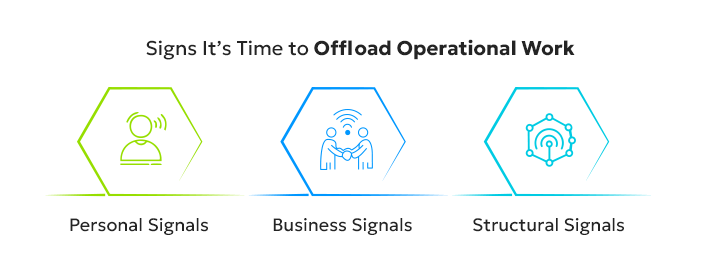
Personal Signals
You feel busy all day but struggle to point to meaningful progress.
Your calendar is full, yet important projects move slowly.
Your focus is constantly interrupted. You jump between emails, messages, and small tasks without long stretches of deep work. Even when you are not working, your mind keeps replaying unfinished items.
You feel guilty stepping away. Time off does not feel restorative because work still depends on you.
Business Signals
Growth feels harder than it should.
Demand exists, but execution lags because too much requires your involvement.
Projects stall while waiting for your input or approval. Progress speeds up when you step in and slows down when you step away.
You notice that many decisions default to you, even when others could handle them with the right support.
Structural Signals
Tasks return to you after being delegated.
You find yourself redoing work, answering the same questions, or stepping back into processes you thought you had handed off.
You are the fallback for small problems. Instead of being escalated only when necessary, everything finds its way to you.
These signals point to a system that depends too heavily on leadership execution. Offloading operational work is not about working less. It is about making the business less dependent on you.
How to Start Paying Down Delegation Debt
Paying down delegation debt does not require a dramatic overhaul.
It starts with small, intentional changes that remove work from your plate permanently instead of temporarily.
The goal is not to delegate more tasks. The goal is to redesign how work flows so it no longer depends on you.
Step 1: Identify Debt-Heavy Tasks
Start by noticing which tasks drain your time without creating leverage.
Look for work that:
- Repeats every week
- Interrupts your focus
- Requires follow up more than judgment
- Would still matter if you were out for a month
These tasks are strong candidates for offloading. You are not looking for everything you do. You are looking for what should not need you anymore.
Step 2: Decide What Should Never Return to You
Some tasks should be delegated permanently.
Decide in advance which work you will no longer take back, even if the first version is imperfect. This boundary is critical. Without it, delegation becomes temporary and debt continues to grow.
Clear ownership matters more than perfect execution. Improvement happens over time, but only if the work stays off your plate.
Step 3: Use VA Support to Lock In Delegation
This is where managed virtual assistant support creates lasting change.
Instead of re explaining tasks repeatedly, you build the process once. The VA follows documented workflows and handles execution consistently. You step out of the execution loop without losing visibility or control.
Over time, this locks in delegation. Tasks stop bouncing back. Your role shifts from doing to directing.
Paying down delegation debt is not about discipline. It is about building systems that protect your time by default.
Conclusion
If you feel overworked despite being capable and disciplined, the issue is likely not effort. It is structure.
Delegation debt builds quietly through reasonable decisions made under pressure. You do something yourself because it is faster. You stay involved because quality matters. Over time, those choices harden into a system where too much depends on you.
The solution is not trying harder to delegate. It is redesigning how work flows so execution no longer requires your constant involvement.
This is where structured support makes a real difference.
Analytix Solutions helps leaders eliminate delegation debt by designing scalable support systems, including managed virtual assistant solutions that remove operational drag without adding management complexity. Our approach focuses on long term efficiency, not short term productivity tricks.
If you feel stuck in execution and want to reclaim time for high impact leadership work, it may be time to address delegation debt at the system level.
Contact Analytix Solutions for a consultation to explore how managed virtual assistant support can help you reduce overwhelm, restore focus, and lead at the level your business requires.
FAQs
1) What is delegation debt in simple terms?
Delegation debt is the buildup of tasks and responsibilities that should no longer require your involvement but still depend on you. It grows slowly and creates ongoing workload pressure without being obvious at first.
2) Is delegation debt a leadership failure?
No. Delegation debt is usually a system issue, not a personal one. Even strong leaders accumulate it when growth outpaces structure and support.
3) Can small teams have delegation debt?
Yes. Small teams are especially prone to delegation debt because leaders often step in to keep things moving. Without support systems, leaders become the default executor for many tasks.
4) Why do smart leaders struggle with delegation?
Smart leaders often value speed, quality, and reliability. In the short term, doing things themselves feels efficient. Over time, that habit creates dependency and overload.
5) How does virtual assistant support reduce executive overwhelm?
Virtual assistant support removes recurring operational work from your plate in a consistent way. Instead of constantly re delegating tasks, you rely on structured execution that does not require ongoing supervision.
6) When should leaders consider managed VA support?
When you spend significant time on repetitive, low judgment tasks and feel busy but not productive, it is usually time to explore VA support. That is often the point where delegation debt is already affecting performance.


.svg)
.svg)