



Hiring a virtual assistant in 2026 is no longer a cost-cutting experiment. It is a strategic staffing decision.
For startups and growing SMBs, the question has shifted from "Can we afford a virtual assistant?" to "Can we afford not to optimize how we structure support?" More specifically, leaders are asking how much does a virtual assistant cost and whether that investment creates measurable leverage.
As operating costs continue to rise, businesses are rethinking traditional hiring models. Global talent access, remote collaboration tools, and AI-assisted workflows have made virtual support more powerful than ever, reshaping expectations around virtual assistant cost structures.
The shift is measurable:
- 65% of SMBs outsource at least one business function
- 40-70% cost savings compared to in-house staffing
- 72% report productivity gains within three months
- $24.65 billion projected global VA market size in 2026
But here is where most businesses go wrong: they focus only on hourly rates. A $6/hour assistant and a $30/hour operations specialist may look comparable on paper. In practice, capability, efficiency, and decision-making depth define true cost.
By the end of this guide, you will have a data-backed understanding of how much does a virtual assistant cost, what the average cost of a virtual assistant looks like in 2026, and how to make the investment work in your favor. How Much Does a Virtual Assistant Cost in 2026
A virtual assistant typically costs between $5 and $75 per hour in 2026, depending on geography, engagement model, and skill depth. That wide range exists because VAs are hired and used in very different ways. The biggest mistake businesses make is reducing virtual assistant pricing to a single number. An hourly rate alone tells you very little. The real cost structure depends on three primary variables.
- Geography
- Engagement model
- Skill depth
And beyond that, there are hidden costs that rarely appear in proposals, but heavily impact ROI. Here’s a detailed break down of it.
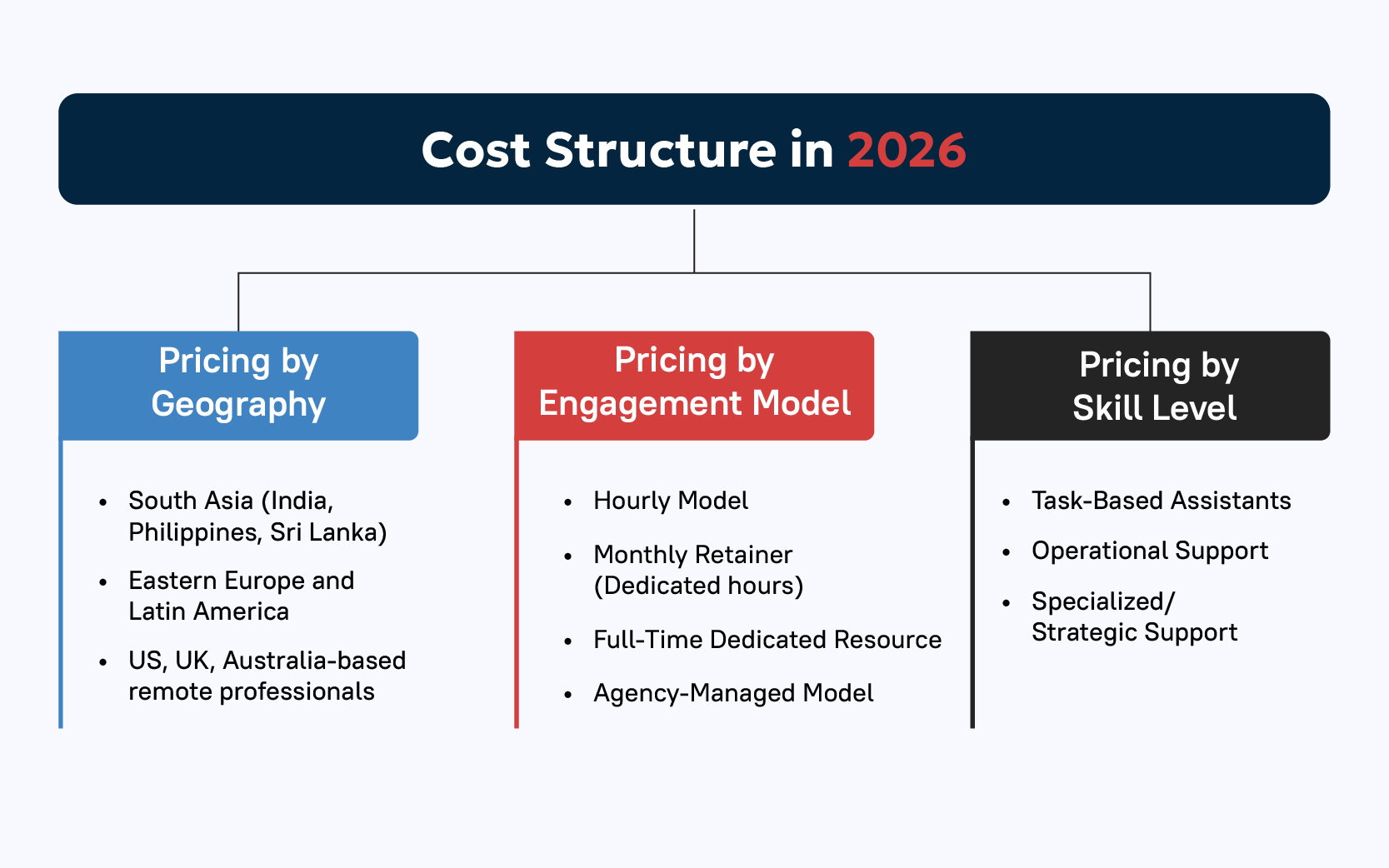
1. Pricing by Geography
Location still influences virtual assistant pricing, but the gap is narrowing for skilled roles.
However, pricing differences are increasingly tied to expertise, not geography alone. A highly trained revenue cycle specialist in India may cost more than a general administrative VA in the U.S. The market in 2026 is skill-driven, not location-driven.
2. Pricing by Engagement Model
How you hire impacts what you pay and how predictable your cost becomes.
In 2026, many growing businesses prefer structured retainers over pure hourly hiring because predictability improves financial planning. This is especially true for businesses that need consistent support across bookkeeping, billing, or customer operations.
3. Pricing by Skill Level
This is where the real difference in cost emerges.
The mistake many companies make is hiring at the lowest tier while expecting mid-level output. In 2026, capability and autonomy are the real pricing drivers, not hourly rates alone.
Why Virtual Assistant Demand Is Accelerating in 2026
The rise of virtual assistants is not happening because businesses want cheaper labor. It is happening because businesses want flexible capability. In 2026, companies are building lean cores and adding specialized support only where needed. That structural change is driving VA demand far more than short-term cost pressures.
1. From Fixed Overhead to a Variable Workforce
Traditional hiring locks businesses into fixed monthly costs, including salary, insurance, compliance, workspace, equipment, onboarding time, and management bandwidth.
Virtual staffing converts much of that into a variable model and gives clarity around virtual assistant cost per hour instead of fixed payroll commitments. Instead of paying for 160 hours because someone is full-time, you now pay for:
- 40 hours of bookkeeping
- 20 hours of admin
- 15 hours of customer support
- 10 hours of CRM management
This approach allows you to align support directly with workload rather than headcount assumptions. In volatile markets, that flexibility becomes a strategic advantage.
2. Access to Specialized Skills Without Full-Time Commitment
In 2026, businesses rarely need general help. They need:
- Someone who understands revenue cycle management
- Someone who can manage HubSpot or Salesforce
- Someone who can reconcile multi-entity accounts
- Someone who understands healthcare billing codes
- Someone who can manage executive calendars across time zones
Hiring these skill sets in-house often means paying senior-level compensation, even if the need is part-time. Virtual models allow you to access experienced operators without committing to full-time, executive-level salaries. For a deeper look at the range of roles available, explore these 17 types of virtual assistants and how each supports different business functions.
This is where leaders begin comparing not just rates but asking how much do virtual assistants cost relative to the value they generate.
3. Remote Infrastructure Is Now Mature
A decade ago, remote staffing created friction: communication gaps, file access limitations, security concerns, and time zone coordination issues.
In 2026, collaboration stacks are standardized. Cloud accounting systems, project management tools, encrypted file sharing, workflow automation, and real-time messaging have removed most operational barriers.
This maturity has shifted virtual assistants from support roles to integrated workflow partners. Companies are no longer asking, "Can remote work?" They are asking, "How do we structure remote capability correctly?"
Hidden Costs That Quietly Erodes Businesses ROI
These hidden costs can add 20–40% to your effective VA spend. Even when companies calculate hourly rates correctly, they often overlook indirect expenses that erode ROI. Here are the most common ones.
1. Onboarding and Training Time
It takes an average of six to nine weeks for a new remote hire to reach full productivity. If leadership spends five to ten hours per week training and reviewing work, that management time has a real cost. Low-cost hiring with high supervision often becomes more expensive than expected.
2. Error and Rework Costs
Mistakes in billing, reporting, or CRM updates do not just create inconvenience. They delay revenue and disrupt workflows. When work requires repeated corrections, productivity drops across teams. Frequent rework can quietly increase operational costs and reduce the efficiency you initially hired for.
3. Turnover and Replacement Risk
High churn among freelancers or poorly structured hires forces businesses to restart onboarding repeatedly. Each replacement means lost continuity, retraining time, and temporary slowdowns in execution. Over time, these disruptions create hidden financial and managerial strain.
4. Security and Compliance Gaps
In regulated industries like healthcare or finance, data exposure risk carries financial consequences. Without proper NDAs, access controls, or secure systems, businesses expose themselves to liability. These factors are rarely included in hourly pricing discussions, but they matter significantly.
These hidden costs clarify something important: virtual assistant pricing alone does not define value. What ultimately matters is measurable return.
The ROI of Hiring a Virtual Assistant in 2026
A well-structured virtual assistant engagement is not an expense line. It is a capacity multiplier. In 2026, ROI is evaluated not just in savings but in operational leverage. Here is where that return becomes visible.
.jpg)
1. Time Reclaimed
When founders or department heads delegate administrative, financial, or coordination tasks, they recover high-value hours each week. Redirecting even eight to ten hours toward strategy, partnerships, or revenue activity can generate significantly greater financial impact than the assistant's monthly cost.
2. Productivity Lift
Dedicated support reduces bottlenecks across workflows. Tasks move faster, follow-ups happen consistently, and reporting becomes structured. Teams operate with less interruption and more clarity, increasing output without increasing headcount. Businesses that structure delegation effectively often see measurable productivity gains within the first quarter.
3. Overhead Reduction
Compared to full-time in-house hiring, virtual assistants eliminate expenses tied to office space, hardware, insurance, and long-term employment liabilities. This leaner cost structure preserves capital while maintaining operational continuity, especially important for growing businesses managing cash flow carefully.
4. Revenue Acceleration
In roles tied to billing, CRM management, lead follow-ups, or collections, improved execution directly impacts revenue timing. Faster invoicing, consistent outreach, and reduced processing delays shorten revenue cycles and improve monthly predictability.
When these four factors combine, ROI becomes clear. That naturally leads to a practical question: "What does this look like in real businesses?"
Real 2026 Business Scenarios With Cost Breakdowns
Example/Scenario 1: SaaS Startup Founder Drowning in Admin
Business type: SaaS startup (five to eight employees)
Challenge: Founder spending 15 hours every week on scheduling, inbox management, and CRM updates.
Solution: Part-time operational VA (60 hours/month)
Rate: $15/hour
Monthly cost: $900
Impact: 15 hours reclaimed weekly, faster lead follow-ups, structured CRM tracking, and reduced email backlog.
Recovered executive bandwidth value: $4,500 (considering founder's time valued at $75/hour)
Net leverage: Significant.
This is where ROI becomes visible beyond salary comparison.
Example/Scenario 2: Healthcare Practice Improving Billing Flow
Business type: Multi-provider healthcare clinic
Challenge: Inconsistent claim follow-ups and rising AR days due to delayed denial management.
Solution: Revenue cycle-focused VA (80 hours/month)
Rate: $22/hour
Monthly cost: $1,760
Impact: Cleaner claim submissions, faster follow-ups with payers, and reduced AR aging.
Cash flow impact: Accelerating even $25,000 in receivables by 15 days improves liquidity and financial predictability.
Net leverage: Strong cash flow stabilization.
This is where ROI becomes visible through revenue timing and operational consistency. For healthcare practices that also need support with medical billing and compliance, partnering with an integrated healthcare solutions provider can further reduce total operational costs by consolidating multiple back-office functions under one team.
Example/Scenario 3: E-Commerce Brand Scaling Customer Support
Business type: Growing DTC e-commerce brand
Challenge: Founder managing customer queries, returns, and order tracking manually.
Solution: Full-time customer support VA (160 hours/month)
Rate: $12/hour
Monthly cost: $1,920
Impact: Faster ticket response times, higher customer satisfaction, and better repeat purchase tracking.
Revenue protection impact: Even a 5% increase in repeat purchases can exceed the assistant's annual cost.
Net leverage: Revenue retention and brand stability.
This is where ROI becomes visible through customer lifetime value, not just cost savings.
Example/Scenario 4: CPA Firm Reducing Administrative Backlog
Business type: Mid-sized CPA firm (three to five CPAs)
Challenge: Partners spending 20+ hours weekly on client communication, document collection, and scheduling during tax season.
Solution: Dedicated operational VA with accounting knowledge (80 hours/month)
Rate: $18/hour
Monthly cost: $1,440
Impact: Structured client intake, organized document workflows, and faster turnaround on financial deliverables.
Recovered billable hours: If each CPA reclaims even five billable hours per week at $150/hour, the firm recovers $3,000+ weekly.
Net leverage: Substantial revenue recovery and reduced partner burnout.
For CPA firms that also need bookkeeping, payroll, or tax preparation support, combining VA services with dedicated accounting outsourcing delivers compounding efficiency gains.
Capturing that return is not automatic, though. It depends on how intentionally you structure the hire from the beginning.
Strategic Tips for SMB Decision-Makers
The difference between a virtual assistant who becomes a growth lever and one who becomes a management burden is rarely about talent alone. It comes down to clarity and decision-making. Here are four strategic principles to apply in 2026.
1. Audit Your Tasks Before You Hire
Before evaluating candidates or comparing rates, conduct an internal task audit.
List your daily, weekly, and monthly responsibilities. Identify what truly requires your expertise and what can be delegated. Calendar coordination, inbox management, CRM updates, reporting compilation, and standard follow-ups are often delegation-ready. If you need inspiration, review this list of 151 tasks you can delegate to a virtual assistant.
This exercise clarifies two things: the exact skill level you need and the number of hours required. Both directly influence cost efficiency and hiring accuracy.
2. Choose the Right Engagement Model
Not every workload requires the same structure.
If your operational needs are consistent each month, a retainer model creates cost predictability and stronger integration. If your work is seasonal or project-based, hourly or milestone pricing may be more appropriate.
The mistake many SMBs make is defaulting to the lowest rate instead of the most suitable structure. In 2026, alignment between workload pattern and engagement model is a primary driver of ROI.
3. Prioritize Security and Compliance
For businesses handling financial data, healthcare information, or customer records, security is not optional.
Ask about password management practices, data access controls, device policies, and familiarity with compliance frameworks such as HIPAA or GDPR. A weak security setup can erase cost savings instantly.
Evaluate risk management alongside hourly rates, not as an afterthought.
4. Document Your SOPs Early
Clear standard operating procedures (SOPs) reduce onboarding time and error rates.
Instead of repeatedly explaining tasks live, create well-maintained documentation or short process walkthrough videos. Defined workflows improve consistency, reduce supervision requirements, and boost productivity.
In 2026, documentation is not administrative overhead. It is operational infrastructure.
When you apply these principles intentionally, hiring shifts from reactive outsourcing to structured capability building. Let’s move into a structured 20-point checklist for hiring a virtual assistant the right way.
The 20-Point Checklist for Hiring a Virtual Assistant
Virtual Assistant Investment in 2026: Build for Growth, Not Just Cost Savings
Sustainable growth in 2026 is not about adding more hours. It is about building the right support structure. Virtual assistants are no longer optional support roles, they have become strategic capacity partners for businesses that want to scale without operational strain.
When you understand the virtual assistant cost structure, account for hidden risks, and focus on measurable return on investment, virtual hiring becomes a smart growth decision rather than a cost-driven choice.
If you are evaluating how a virtual assistant fits into your operations, the next step is identifying operational bottlenecks and defining the outcomes that matter most. Schedule a free consultation with Analytix Solutions to structure support that aligns with your priorities, whether you need a standalone virtual assistant or an integrated back-office partner for finance, operations, and technology.
Frequently Asked Questions
1. How much does a virtual assistant cost per month in 2026?
Monthly costs vary depending on the engagement model and skill level. A part-time task-based VA may cost between $400 and $1,200 per month, while a full-time operational or specialized VA typically ranges from $1,600 to $4,500 per month. Agency-managed models with supervision and quality assurance tend to run 15-40% higher than direct hire rates.
2. Is it cheaper to hire a virtual assistant or a full-time employee?
In most cases, hiring a virtual assistant is significantly more cost-effective. A full-time in-house administrative employee in the U.S. costs between $35,000 and $55,000 annually when you factor in salary, benefits, office space, equipment, and payroll taxes. A virtual assistant performing comparable work typically costs 40-70% less because you eliminate overhead expenses and pay only for productive hours.
3. What is the difference between a freelance VA and an agency-managed VA?
A freelance VA is an independent contractor you manage directly. You handle onboarding, quality control, and replacement if the relationship does not work out. An agency-managed VA comes through a service provider that handles recruitment, training, supervision, and backup coverage. Agencies charge a premium (typically 15-40% more) but reduce your management burden and provide built-in continuity.
4. Can a virtual assistant handle specialized tasks like bookkeeping or medical billing?
Yes. In 2026, many virtual assistants specialize in areas like bookkeeping, financial reporting, revenue cycle management, CRM administration, and healthcare billing. Specialized VAs typically cost $18-$60+ per hour depending on the complexity and compliance requirements of the work. For businesses that need multiple specialized functions, working with an integrated provider like Analytix Solutions can streamline operations under one team.
5. How do I calculate the ROI of hiring a virtual assistant?
Start by calculating the hourly value of the time you or your team currently spend on delegatable tasks. Multiply that by the number of hours a VA would free up each month. Then subtract the VA's monthly cost. For example, if your time is worth $75/hour and a VA frees up 40 hours monthly at a cost of $900, the recovered value is $3,000 against a $900 investment—a strong return even before accounting for improved speed and accuracy.


.svg)
.svg)