
BG Circle V1 - Expert X Webflow Template

Managed Data Processing Services for Research, Cleansing & Reporting

Reliable data, without the recurring cleanup falling back on your team. Analytix Solutions runs the collection, extraction, cleansing, validation, research, enrichment and reporting work that operations and revenue teams depend on every week. A dedicated Coordinator runs each workflow against field rules your team approves, with a delivery manager checking the output before it reaches a live system.

Same Records, One Owner

The records do not change. Who owns them does.

Your data now

With a managed workflow

You are told the output is 99% accurate

You hold it against rules your team signed

Odd records get a quiet judgment call

They stop in a queue with a named owner

The cleanup decays and gets funded again

A cadence holds the standard between cycles

Nobody can trace a record to its source

Every researched record carries its source

20+

Years supporting growing businesses in the US

1,000+

Professionals across Analytix Solutions teams

40+

Less time on a client's recurring weekly data workflow

3

Roles behind every data workflow you delegate

6

Kinds of recurring data work covered

4-5

Years that long-standing support clients have stayed

What It Covers

The Recurring Data Work a Managed Team Takes Off Your Desk

Managed data processing services cover the recurring work behind the records a business runs on: data collection and extraction, document processing, cleansing and validation, enrichment, web research, list building, CRM maintenance, and the preparation of recurring reports. Managed means each one runs as a documented workflow, with a dedicated Coordinator doing the work, a delivery manager checking the output, and a trained backup covering absence.

‍

What separates a managed data processing company from the rest of the category is not the processing. Every provider will return you a file. Far fewer will tell you what was checked, what failed, and what happened to the records that did not fit, because delivering a batch and owning a dataset are two different commitments. A batch arrives once and you audit it yourself. A workflow has one named owner, written field rules, a validation source, cover when somebody is away, and a measure that shows whether it is holding. Analytix Solutions hands over workflows rather than batches, and applies that same standard across its wider back-office support services.

Fit Check Is This Right for You?

A quick gut check before you scope anything.
A strong fit if you
Own the CRM, the reporting, or the operations data and still fix it yourself
Run a team of 10 to 200 people with no dedicated data operations hire
Have data work that repeats weekly, monthly, or per campaign
Paid for a cleanup already and watched the duplicates return
Pull from several sources, each in its own format
Want one named owner for the standard, not a rotating pool
Less of a fit if you
Need a database, warehouse, or pipeline designed and built
Need modeling, forecasting, or data science
Cannot say which sources the team may use
Are comparing providers on a rate per record alone
The Problem
What Happens When Nobody Owns the Data Between Cleanups
Most data problems do not start as problems. The records are clean the week the project closes. Then new ones arrive, three people enter them three different ways, and by the next quarter the same cleanup is back on the budget. The vendor was not the issue, and neither was the tool. Nobody owned the data once the project ended, and these six signs usually show first.
Your Last Cleanup Already Decayed
The file was clean in March. By September the duplicates are back, because nothing maintained the standard in between.
Two Reports Give Two Different Answers
The numbers come from the same system, so the argument is about the records, not the report.
Every Campaign Starts With a Repair Job
Before anyone can send, somebody spends a week fixing the list.
The Backlog Grows Faster Than the Team’s Capacity
Volume rose, capacity did not, and the queue quietly became permanent.
One Person Knows the Rules
How a field should be formatted lives in one head, so the standard changes whenever that person is away.
Nobody Can Trace a Record Back to Its Source
A contact sits in the database. Which source it came from, and under what permission, is anybody’s guess.
None of that means the team did the work badly. It means the work was funded as a project when it needed an
owner and a cadence.
The Managed Layer

Every Data Workflow Carries a Coordinator, a Manager and a Backup

Hand a dataset to one contractor and the standard leaves with them. Analytix Solutions runs every engagement through a managed team, so the work keeps moving and the output gets checked before it reaches a live system.

Role 01
Your Coordinator

Dedicated to your account and the same person every cycle, never a rotating pool. Runs the workflow on cadence, holds the field rules, works the exception queue and answers your questions directly. Coordinators are Analytix Solutions employees, so no part of your data moves to a third party.

Role 02
Delivery Manager

Samples every batch against the acceptance criteria in your rules sheet rather than spot-checking on instinct, and watches how long items sit in the exception queue. Reviews recurring exception patterns, because a rule that keeps failing is usually the wrong rule. You raise concerns here, never with the Coordinator.

Role 03
Trained Backup

Named and trained on your account before cover is ever needed, working from the same rules sheet, approved source list and documented workflow. A covered cycle produces the same output as any other. Continuity becomes something you can verify rather than something you are promised.

Build, Buy or Manage

Data Entry vs. Project Data Processing vs. Managed Data Operations

Buyers researching data processing outsourcing usually weigh three routes, and providers use the labels interchangeably. Here is what actually separates them.

What matters

What you buy
Where the rules live
How quality is defined
Records that do not fit
After delivery
Who manages it daily
Continuity
Provenance for research
Data security
Cost model

A freelance assistant

Keystrokes at a rate
In your brief, per batch
An advertised percentage
Usually a judgment call
Nothing
You do
Whoever is available
Rarely recorded
Varies widely
Per record

An in-house hire

A defined batch, delivered once
In the statement of work
An advertised percentage
Usually a judgment call
Nothing
You do
The project team disbands
Rarely recorded
Varies widely
Per project

Analytix Solutions

A recurring workflow with a named owner
In a rules sheet you approve and can change
Field rules, reference source, sampling method, acceptance criteria
An exception queue with an owner and an age measure
Scheduled maintenance holds the standard
A delivery manager above the Coordinator
A trained backup on the same documented workflow
A source register on every delivered record
ISO 27001:2022 and SOC 2 controls
Scoped to the workflow, cadence and complexity

A data entry vendor earns its place while the input stays uniform. A project vendor is right for a genuine one-time backlog. Managed data operations covers the case most growing companies actually have: data that keeps arriving, more than one person writing to it, and a cleanup that has already decayed once.
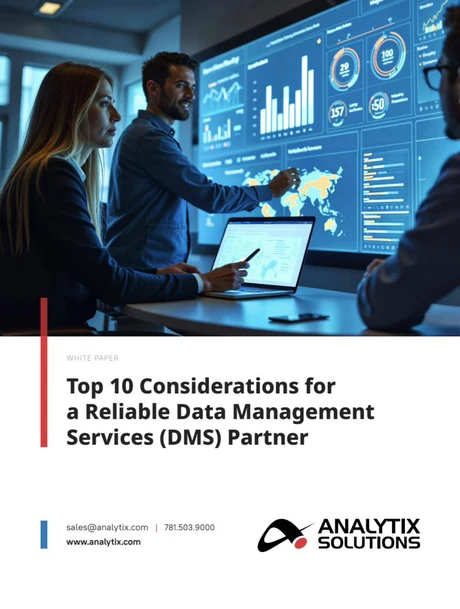
Building a shortlist? Start with the questions that matter
The evaluation guide covers core service scope, security and privacy compliance, scalability, automation, quality assurance, turnaround, account management, and what a long-term partnership should look like.

Virtual Assistant Services

By submitting this form, you confirm that you have read & agreed to Analytix's Privacy Policy & Terms of use.
Thank you! Your submission has been received!
Oops! Something went wrong while submitting the form.
Human + AI

AI Runs the Repeatable Steps. People Own the Judgment.

Every provider in this category claims to be AI-enabled. Far fewer will show you where the technology stops. These are the four answers recorded in the rules sheet you approve, before any automated step touches your data.

Pick a question

Will AI touch our records?›
Who checks the output?›
What is off limits?›
Can we disable an automated step?›

Technology-led, human-accountable. AI speeds the repeatable steps, a named person verifies the output, and Analytix Solutions stays accountable for whatever reaches a live system.

01 / 04Scope
Question 01

Only the records inside the workflow you approved

Automation runs on datasets that already sit inside an agreed workflow, and never beyond that workflow. Your systems are not indexed, mined, or used to train any model. Which sources and data classes fall in scope is written into the rules sheet before any access opens.

Scope, agreed before access opens
In scopeDatasets in the agreed workflowApproved sources
Out of scopeUnrelated systemsRestricted data classesModel training
AutomatedExtraction from documents with a known layout
HumanReading anything ambiguous, illegible or unusual
Your callWhich sources and data classes are in scope at all

Access is granted by your administrators at the permission level they choose.

Every data engagement runs through the same four stages. Nobody hands over a production database on day one, and the first two stages finish before you commit to anything.

01

Discover

A working session on one recurring dataset: where the records come from, how much arrives and how often, which fields carry weight, where the process breaks today, and what a good output actually looks like. Nothing is committed before the shape of the work is clear on both sides.

You getA prioritized workflow inventory and a baseline you can measure against.
02

Document

Field rules, validation sources, the match and merge rule, sampling method, acceptance criteria, exception routing and reporting cadence get written down and approved. Your administrators grant the exact access needed, at the permission level they choose.

You getAn approved workflow playbook, a clear owner map, and controlled access.
03

Deliver

A controlled sample batch runs first so you can review the output, the exception list and the batch summary while changes are still cheap. The workflow then moves to its agreed cadence, with the Coordinator executing and a delivery manager owning quality, capacity and escalation.

You getWork completed, status visible, and exceptions surfaced rather than absorbed.
04

Improve

Exception patterns, cycle time and capacity get reviewed together, because a rule that keeps producing exceptions is usually the wrong rule. Safe automation gets identified here rather than assumed at the start, and the next workflow moves only once this one runs a full cycle inside the agreed measures.

You getMonthly insights, improvement actions, and capacity that compounds.
Why Analytix Solutions

6 Reasons Growing Companies Choose Managed Data Processing

Every data processing company promises accurate records. What managed support adds is the structure behind the work, and these six decide whether the dataset still holds up in month six.

A Managed Team, Not 1 Processor

Your data does not sit with one person. A delivery manager owns quality and samples the output, and a trained backup covers absence from the same documented process. Most data processing companies stop at the delivery and leave the checking to you.

Quality Defined Per Field, Not Per Percentage

Accuracy gets written into a rules sheet your team approves: required fields, the reference each one is checked against, the sampling method, and what a batch must clear before release. You can audit that document. Nobody can audit a percentage.

Every Researched Record Carries Its Source

Research and enrichment run only against sources your team approved in writing, and each delivered record carries a source register entry showing where it came from and when. Provenance is a legal question later, so it gets recorded now.

Maintenance, Not Just Cleanup

A cleanup that decays is a cleanup you pay for twice. Recurring engagements run the same rules on an agreed cadence, so the standard holds between projects instead of drifting until the next budget request.

You See What Stopped, Not Just What Shipped

Most data vendors report how many records they processed, and volume is the one number that says nothing about quality. Every batch summary from Analytix Solutions reports what passed, what failed validation, why it failed, and how long each exception has waited. A monthly scorecard then tracks duplicate rate, completeness and exception rate against the baseline taken in week one.

A Whole Back Office Behind the Data Team

When the work outgrows records, the same engagement reaches further. Coordination and follow-through, bookkeeping support, technology and automation all sit inside Analytix Solutions rather than with a second vendor.

Long-running engagements say more than a promise does. These are clients who handed recurring work across and kept widening the scope.

“

Left Field Investors

Chad Ackerman, Chief Operating Officer

Our experience with Analytix has been a solid partnership. The Analytix team have gotten involved to understand our business and the tasks that we have asked them to manage for us. Communications have been easy and thorough throughout our relationship with them. They connect with us on a daily basis to touch base and make sure things are progressing. The work provided by Analytix has been reliable with a high degree of accuracy. The team has been very open to feedback to better understand our needs to provide the best possible product the can for us. We continue to look for more areas to get them involved with our business.

“

Trepp, LLC

Dan Gottlieb, Chief Operating Officer

We used Analytix Solutions' data processing services to manage some of the volumes of data we input each month. We have been pleased with their services. The Analytix team is very good with project management, meeting deadlines, and submitting timely deliverables.

“

USA 500 Clubs LLC

Joe Chatham, Managing Partner and Founder

I am writing to let you know how happy we are with Krish's work and attitude. Krish is not only a quick study, but he also has a wonderful work attitude. He is asked to do something, and he does it with a smile. If Krish does not understand the task, he asks focused questions, records the session, and rarely comes back for more clarification. He does it right.

Case Study

A Weekly Data Task, Rebuilt Around a Repeatable Method

Data work is easier to judge on one specific workflow than on a percentage. This is one recurring task Analytix Solutions took over, and what changed for the team that used to carry the load.

Reporting and data processing

A 5-Hour Weekly Task, Rebuilt Into a 3-Step Method

Context

A recurring client reporting workflow for a vegetation management services provider, running every week against a shared Smartsheet register.

Challenge

Formatting a raw client file, checking Smartsheet for active records, manually filtering columns for each record, and updating results back into Smartsheet. The work took 5 to 6 hours every week, and the manual filtering step carried the highest risk of inconsistency.

Solution

Analytix Solutions rebuilt the process around a purpose-built Excel template using formulas, data validation, and dynamic filtering. Selecting a record from a dropdown triggers the calculation and displays the filtered data, and values copy cleanly between the template and Smartsheet.


case-1
Outcome
  • ✓A dozen manual steps reduced to three
  • ✓Error risk down, with validation built into the template
  • ✓A method that runs the same way every week
An operations lead reviewing a weekly reporting board
40%Less time every week
3-4 hrsDown from 5 to 6 hours
ThreeSteps, down from a dozen
OneDocumented method, repeatable
Inbox and coordination

15,000 Emails, One Owner, and a Queue That Clears Every Morning

Industry

Hospitality and hotel groups, running a shared operations inbox across properties.

Challenge

Daily email volume had outgrown what the internal team could keep organized. Important messages sat buried, follow-ups happened inconsistently, and the backlog grew every week rather than clearing.

Solution

Analytix Solutions took ownership of inbox organization as a recurring daily workflow, applying agreed rules for sorting, cleaning, and surfacing what needed attention, so the team opened each day against a clear queue rather than a backlog.

case-1
Outcome
  • ✓A clear queue at the start of every working day
  • ✓Follow-ups handled on a schedule rather than on memory
  • ✓Cover that holds when the regular owner is away
A client handover meeting in an office
15,000+Emails organized
200+Cleaned every day
100Hours of manual work returned
1Daily workflow, owned end to end
A Conversation With an Expert

Talk it through with someone who runs this work.

Bring one recurring item and see exactly where an assistant would take over.
Book a Workflow Review
Business Support Services
Analytix Solutions
A Conversation With an Expert

Walk through one dataset with someone who runs this work.

Bring the process that keeps breaking and see exactly which rules a Coordinator would apply.
Before You Start

Straight Answers to the 5 Questions That Stall a Decision

These come up in almost every first conversation about data work. Pick one to see the answer.

Will this decay again in a year?

Probably, if you buy another cleanup. A backlog pass fixes the records that exist today and nothing about the ones arriving tomorrow. What stops the loop is a rules sheet that outlives the project and a maintenance cadence that runs against those rules. The workflow review tells you which of the two your situation needs, and a genuine one-time backlog gets scoped as a project without the recurring cost attached.

Quality Standard
Accuracy You Can Check, Not a Number You Have to Trust
Every provider on your shortlist will show you a percentage. Almost none of them will tell you which fields it covers, what it was measured against, how the sample was drawn, or what happened to the records that failed.
That gap matters on the day a report looks wrong. You call the vendor, you ask which records are affected, and the percentage cannot answer the question. Nobody can audit a number, which is why a number is the easiest thing in this category to publish.
Analytix Solutions defines quality one workflow at a time instead, in a short document your team approves before the first record moves. It names the fields, the reference each one is checked against, how the batch is sampled, and what has to clear before anything reaches you. You can hold any delivery against it, and you can change it as the work changes.
What You Approve
The Data Rules Sheet, approved before any record moves
Quality Standard
Which fields are required, what format each one takes, and what makes a record complete.
Validation source
The specific reference each field gets checked against, named rather than implied.
Check method
Full check or sample, and if a sample, how large it is and how it is drawn.
Acceptance criteria
What a batch has to clear before it is released to you.
Exception ownership
Who reviews the records that fail, and how long one may sit before it escalates.
Change log
Every change to a rule, who asked for it, and the date it took effect.

Your trained backup reads this sheet before covering a cycle. That is what makes continuity something you can verify rather than something you are promised.

Process Controls

How 1 Record Moves From Approved Source to Approved Output

The section above shows what a live engagement looks like. This one shows the control chain running underneath all of them, and every record follows it whether the batch holds 50 rows or 50,000.

01

Approved source

Only sources your team named in writing.

02

Intake rules

What to take, what to ignore, what format.

03

Extraction

Collected, extracted or entered to the rules.

04

Validation

Checked against the named reference.

05

Exception queue

Anything that fails stops here, with an owner.

06

Approved output

Passing records move, with a batch summary.

07

Maintenance

The same rules run on the agreed cadence.

The rule that holds it together. No record leaves the workflow on a guess. It either matches the rules or it goes to the queue, which is the whole reason an exception queue exists.
Exceptions and Control

The Line Between What Runs to the Rules and What Comes Back to You

Outsourced data work rarely fails through carelessness. It fails because somebody did not want to stop the batch, made a reasonable-looking assumption, and kept going. Nobody ever notices. An exception queue removes the incentive to guess.


Handled inside the agreed rules
  • Records that match the field rules and pass validation
  • Duplicates resolved under the match rule you approved
  • Formatting, standardization and classification
  • Enrichment from sources already on the approved list
  • Recurring maintenance passes on the agreed cadence
  • Routine reporting inputs prepared to your template
Stops and comes back to you
  • Any record that fails validation against the named reference
  • Two sources that contradict each other
  • A close match that is tempting, yet not safe to merge
  • A field the rules miss, or a record of unknown origin
  • Anything resembling sensitive data outside the agreed scope
  • Any change to a field rule, a source, or the merge logic
Every rule your data runs on stays yours to set, and checking each batch stops being your problem.
The Onboarding Week
The Groundwork That Makes a Cleanup Stick
Most data engagements fail in week one, not week twenty. Somebody explains the rules verbally, the work starts, and three months later nobody can explain why a field was formatted that way. Writing the rules down once, before any record moves, is what prevents the drift. These nine items make up the rules sheet, and the discovery session exists to get them out of your team's heads and onto a document you own.
The Source List
Which systems, files, portals and sites the work may draw from, and which it may not.
Field Rules
Required fields, the format each one takes, and what makes a record complete.
The Match and Merge Rule
How a duplicate is identified, and which record wins when two describe the same thing.
The Validation Reference
The named source each field gets checked against, rather than a general instruction to verify.
Volume and Cadence
How much arrives, how often, and the date the output is actually needed.
The Output Format
The template, the destination system, and the file convention your team already uses.
Exception Routing
Who reviews a failed record, how long it may wait, and what triggers escalation.
The Escalation Contact
Who to reach when a source is missing and a reporting deadline is at risk.
Reporting Cadence
The batch summary you will actually read, and the day of the week it arrives.
You review the sheet, you correct it, and it changes as your data does. Your trained backup reads that same sheet, so
the week somebody covers, nothing about your output changes.
The Ongoing Rhythm

How a Week, a Month and a Quarter Run

Data support goes wrong when nobody agrees what ongoing actually means. This is the rhythm most recurring engagements settle into by the second month.

Every week

New records processed against the agreed intake rules. Validation sampled to the method in your rules sheet. The exception queue worked through and anything needing your decision grouped into one message. A batch summary showing what passed, what stopped, and why. Anything that threatens a reporting deadline flagged the same day.

Every month

A workflow review with the delivery manager. Exception patterns examined, because a rule that keeps producing exceptions is usually the wrong rule. Field rules and approved sources updated where the business has moved. A short list of what could sensibly move next, and what should stay in house.

Every quarter

A health check across every dataset under management, measured against the baseline taken at the start. Duplicate rate, completeness and exception rate compared against the first cycle, so drift is visible early. Cadence and capacity reset for the quarter ahead.

Who It Is For

Data Support Built Around Where Your Records Break

The first dataset to move looks different for every buyer. These are the eight teams that use data processing services from Analytix Solutions most often.

Operations Leaders

Backlogs, inconsistent handoffs, and processing that slows down every time volume rises past what the team can absorb.

‍

Hands over first
  • Email management
  • Document extraction
  • Backlog clearance

RevOps and Sales Operations

The database drifted, the duplicates came back, and sellers have started keeping their own version of the truth in a spreadsheet.

Hands over first
  • Meeting preparation
  • Action item tracking
  • Research and briefings

Marketing Operations

Every campaign starts with a week of list repair, and segmentation only works on the fields somebody remembered to complete.
‍

Hands over first
  • List building
  • Data enrichment
  • Segmentation fields

Data and Reporting Owners

The reporting cycle begins with a repair job, because the inputs arrive in documents and portals nobody has time to process.
‍

Hands over first
  • Recurring extraction
  • Validation
  • Reporting inputs

Finance and Billing Teams

Invoices, statements and vendor records arrive in a dozen formats, and somebody senior ends up retyping them before the month closes.

Hands over first
  • Invoice data extraction
  • Vendor record upkeep
  • Statement processing

Teams Growing Faster Than Headcoun

The records moved across and nothing was reconciled afterward, so the new system inherited every problem the old one had.

Hands over first
  • Post-migration cleanup
  • Field mapping checks
  • Duplicate resolution

Firms Using a Freelance Assistant

The person is capable and the arrangement is fragile. One holiday or one better offer and the process leaves with them.
‍

Hands over first
  • Process documentation
  • Oversight and sampling
  • Backup cover

Teams Whose Cleanup Already Decayed

You have funded this once and the duplicates are back, which usually means the problem was never a project in the first place.

Hands over first
  • Backlog pass
  • Field rules
  • Scheduled maintenance
Owned Workflows

What Workflow Ownership Looks Like in Practice

Three recurring data workflows. CRM maintenance, research and validation, and recurring extraction each run to a documented process, with AI assisting the repeatable steps and your Coordinator taking every decision.

01
CRM data maintenance

CRM cleanup to recurring maintenance

Backlog pass, then weekly or monthly
02
Research and enrichment

Account research to a validated list

Per project, plus any refresh you set
03
Extraction and reporting

Recurring extraction to a reporting file

Weekly, monthly, or per reporting cycle
CRM data maintenance

CRM cleanup to recurring maintenance

Deduplication, field rules, and the cadence that stops the drift.

Starts when

A migration or reporting dispute exposes the drift

Cadence

One backlog pass, then weekly or monthly upkeep

Measured by

Duplicate rate, completeness and exception rate

How Analytix Solutions Runs This Workflow

Finding the duplicates
AI assistsGroups records that look like the same company or contact, and scores how close each match is.
Your Coordinator ownsDecides which matches are safe under the merge rule you approved, and which are only tempting.
Fixing the fields
AI assistsStandardizes formats, casing and country codes to the template, and flags values outside expected ranges.
Your Coordinator ownsFills the gaps from approved sources only, and leaves anything unverifiable empty rather than guessed.
Checking against the reference
AI assistsCompares each required field against the reference source named in your rules sheet.
Your Coordinator ownsReads every failure, decides whether the record or the rule is wrong, and records which.
Writing back
No AINo automated write. Nothing reaches the live database from an automated step.
Your Coordinator ownsLoads corrected records after your sign-off, and reports what changed in a batch summary.

How You Benefit

✓A database that holds between cycles
✓Duplicates resolved to a rule you set
✓A written record of every change

The standing rule. Nothing in this workflow writes to your live database without your sign-off.

Research and enrichment

Account research to a validated list

Approved sources, recorded provenance, and nothing taken on trust.

Starts when

A campaign or new territory needs records you lack

Cadence

Per project, plus an agreed refresh cycle

Measured by

Validation pass rate and records rejected

How Analytix Solutions Runs This Workflow

Working the brief
AI assistsTurns the ideal-customer brief into search criteria and drafts a candidate set from approved sources.
Your Coordinator ownsJudges whether a candidate genuinely fits the brief, and drops the ones that only look right.
Recording where it came from
AI assistsLogs the source and the collection date against every record as it is captured.
Your Coordinator owns Confirms the source sits on your approved list, and excludes anything that does not.
Verifying the fields
AI assistsChecks formats, flags likely errors, and matches new records against your existing database.
Your Coordinator ownsVerifies the fields that matter against a second source and decides what cannot be confirmed.
Handing it over
No AINo automated enrichment from unapproved sources, and no pre-built purchased lists.
Your Coordinator ownsDelivers in your format with a source register attached and a written note on every exclusion.

How You Benefit

✓Every record traceable to a source
✓ Exclusions reported, not hidden
✓ A list your team can defend later

The standing rule. A record that cannot be verified is excluded and reported, never quietly left in the list.

Extraction and reporting

Recurring extraction to a reporting file

Documents and portals turned into inputs that arrive prepared.

Starts when

A report relies on documents nobody has time to process

Cadence

Weekly, monthly, or aligned to each cycle

Measured by

On-time delivery, field accuracy and cycle time

How Analytix Solutions Runs This Workflow

Pulling the sources
AI assistsCollects from the agreed sources on schedule and extracts fields from layouts it already knows.
Your Coordinator ownsReads anything ambiguous, illegible or newly formatted, and decides how it should be treated.
Reconciling the differences
AI assistsNormalizes formats across sources and flags totals that do not agree between them.
Your Coordinator ownsDecides which source wins when two disagree, and records the reason in the batch summary.
Building the file
AI assistsConsolidates into your template and produces a first pass at the summary figures.
Your Coordinator ownsChecks the fields you marked critical and holds the file if any of them fail.
Flagging the risk
No AINo automated release. A batch is never delivered on an automated pass alone.
Your Coordinator ownsReports a missing or contradictory source before the deadline, with an impact note attached.

How You Benefit

✓ Inputs ready before the cycle opens
✓Late sources flagged early
✓ A summary of anything unresolved

The standing rule. A reporting owner hears about a problem before the deadline, never after it.

Analytix Solutions is format agnostic. Wherever your administrators allow it, the work happens inside your existing systems, so your data stays where it already sits.


Spreadsheets, files and documents
CRM and client records
Tracking, projects and delivery
Fit is confirmed during the workflow review. If a format or system is unfamiliar, we say so before the engagement starts, never once it is running.
Trust and Security

Your Business Data, Protected at Every Step

Data work carries two risks that coordination work does not. The volume is large and the records are often personal, and a record with an unknown origin becomes a problem later in a place nobody is watching. Certifications answer the first. Documented practice answers the second.
ISO 27001:2022 Certified
SOC 2 Compliant
Encrypted File Sharing
Role-Based Access Control
01
Access is granted by your team, and revoked by your team

Your administrators decide who sees what, and nothing outside that scope is touched.

  • Permission level set by your administrators
  • Access reviewed whenever the workflow changes
  • Revoked the moment an engagement ends
  • Work runs inside your systems, not on copies
02
Records are handled under documented procedure

Every account runs to written procedure, never to one person’s habits.

  • Monitored activity, with backups and restore
  • Privileged access management and password policy
  • Background checks and account-specific confidentiality training
  • A signed non-disclosure agreement, under your terms if you prefer
03
Every researched record carries its origin

Research and enrichment run only against sources your team approves in writing.

  • Source and collection date logged per record
  • No unrestricted web scraping
  • No pre-built purchased lists
  • Anything unverifiable is excluded and reported
Where the boundary sits. Analytix Solutions prepares data and records provenance. Decisions about lawful basis, consent, retention periods and outbound communication stay with your team and your counsel. The service supports those decisions and does not make them.
Industries Served

Where Recurring Data Work Looks Different

Anyone can process records. The difference is whether the rules hold up against your sources, your systems, and the decisions your data has to support. These are the settings where recurring data work behaves differently enough to need its own rules.

Accounting Firms

Client document collection and extraction, engagement record upkeep, research for advisory work, and the recurring reporting inputs behind every partner review.

Real Estate

Listing and property data processing, document extraction, portal record maintenance, lead record hygiene, and past-client database upkeep.

Restaurants and Hospitality

Guest and vendor record upkeep, invoice and delivery document extraction, menu and pricing data standardization, and multi-location reporting inputs.

Technology and Communications Providers

High-volume record intake from multiple vendors, inconsistent source formats, validation before transfer into internal systems, and vendor-specific processing rules.

Distributors and Product Businesses

Product and catalog record upkeep, specification and pricing standardization, supplier file processing, and cross-reference maintenance across systems.

Field Services and Operations Teams

Recurring job and schedule file processing, tracking system reconciliation, and the weekly reporting inputs behind every operations review.

Common questions

Data Processing Services FAQs

1.

What is the difference between data processing and data management services?

Data processing describes the operational work: collecting, extracting, cleansing, validating, enriching, and preparing records so a team can use them. Data management is used across the market to describe a much broader territory, including enterprise master data platforms, integration architecture, and governance consulting. Analytix Solutions provides the operational work and prepares data for the systems your engineering team owns. It does not design or build those systems under this service.

2.

How is data processing different from data entry?

Data entry is one step inside data processing. Entry moves information into a system. Processing decides what should enter, checks it against a reference, standardizes it, resolves what does not fit, and maintains it after delivery. Buying entry when the problem is processing is the most common reason a cleanup decays.

3.

What is included in your data management services?

Five groups of work: collection and extraction, cleansing and validation, processing and maintenance, research and enrichment, and reporting preparation. That covers web research, document processing and conversion, data extraction, deduplication and standardization, validation against an agreed source, CRM data maintenance, business-to-business list building, and recurring reporting inputs.

4.

How do you measure accuracy?

By workflow, never as a single published percentage. Before work starts, a rules sheet records which fields are required, what format each takes, which reference source each field is validated against, whether the workflow uses a full check or a sample, and what a batch must clear before release. You can audit that document. Nobody can audit a percentage.

5.

What happens to records that do not match the rules?

They go to an exception queue instead of being resolved on assumption. The Coordinator records what failed and adds a recommendation. The delivery manager reviews the queue and its age on an agreed cadence. Items needing your decision come to you grouped, and every batch summary reports the exception count.

6.

Can you clean and then maintain our CRM data on a recurring basis?

Yes, and that is the most common engagement shape. A controlled backlog pass runs first against agreed match, merge, and field rules. Scheduled maintenance then runs weekly or monthly using the same rules, which is what keeps the database from drifting.

7.

Which formats and systems do you support?

Analytix Solutions is format agnostic and works with spreadsheets, delimited files, documents, scanned records, portal exports, and direct system access wherever your administrators grant permission. Wherever possible the work happens inside your existing systems, so your data stays where it already lives. Share a sample during the workflow review and the team will confirm before anything is agreed.

8.

Where do research records come from, and how are permissions handled?

Only from sources your team approves in writing. Each delivered record carries a source register entry showing its origin and collection date. Analytix Solutions does not perform unrestricted web scraping and does not supply pre-built purchased lists. Decisions about lawful basis, consent, retention, and outbound communication remain with your team and your counsel.

9.

Is my data, and my customers' data, secure?

Engagements run under ISO 27001:2022 and SOC 2 controls, with encrypted file transfer, role-based access, and documented procedures. Access is granted by your administrators at the permission level they choose and can be revoked at any time. Teams working on your data receive security and confidentiality training. Every engagement operates under a signed non-disclosure agreement, and Analytix Solutions will work under yours instead.

10.

Where is AI used in the work?

On repeatable, unambiguous steps: extraction from known document layouts, classification against defined categories, format standardization, and flagging likely duplicates or out-of-range values. A person reads anything ambiguous, decides which source wins when two disagree, resolves every exception, and reviews the batch against acceptance criteria before release. You approve which tools may be used and which data classes may be processed.

11.

What happens when the person handling our data is unavailable?

A trained backup covers, working from the same rules sheet and the same documented workflow. Because the standard lives in a document rather than in one person's memory, a cycle does not slip when somebody is away.

12.

How is pricing determined, and how do we start?

Pricing follows the work type, the volume, the cadence, the complexity of the rules, and the sensitivity of the data, so it gets set once the workflow review is done, not ahead of time. The first step is reviewing one recurring dataset or process. That review tells you what would be owned, what stays with your team, which rules would apply, and whether the work is a fit.

Next Step

Review the Data Work That Keeps Repeating

Bring the dataset or process that gets repaired every cycle. Analytix Solutions reviews how it runs today, where it breaks, and what a managed version would look like. No long proposal, and no commitment to get started.
You bring
One recurring dataset or process, its sources, and roughly how much and how often.
We review
Sources, rules, validation method, exception handling, cadence, and the measures that would prove it works.
You receive
A written outline of scope, the rules that would apply, what stays with your team, and a straight answer on fit.
Review a Data Workflow