Outsourced Accounting Services for CPA Firms: The Complete Buyer's Guide



For growing CPA firms, outsourcing often starts with recurring bookkeeping, reconciliations, month-end close, or cleanup work that is absorbing internal capacity.
Once the delivery model is established, the relationship can expand into tax preparation support, controller-level reporting, and advisory preparation based on the firm's needs. Somewhere on your partnership meeting agenda sits the question: should the firm outsource at all, and is it even ready?
This guide is for Managing Partners and Owner-CPAs at growing US full-service CPA and accounting firms with approximately 5-50 employees and $1M-$20M in revenue, delivering a combination of tax, bookkeeping/accounting, and advisory services. It is not a vendor pitch, and it is not a comparison of the specific providers on your shortlist. That comes later.
The guide covers the six-layer scope of outsourced accounting services. It walks through how to evaluate providers for CPA firm work, the three engagement models, the first 90 days, and your buying committee questions.
What Outsourced Accounting Services Actually Cover: 6 Service Layers
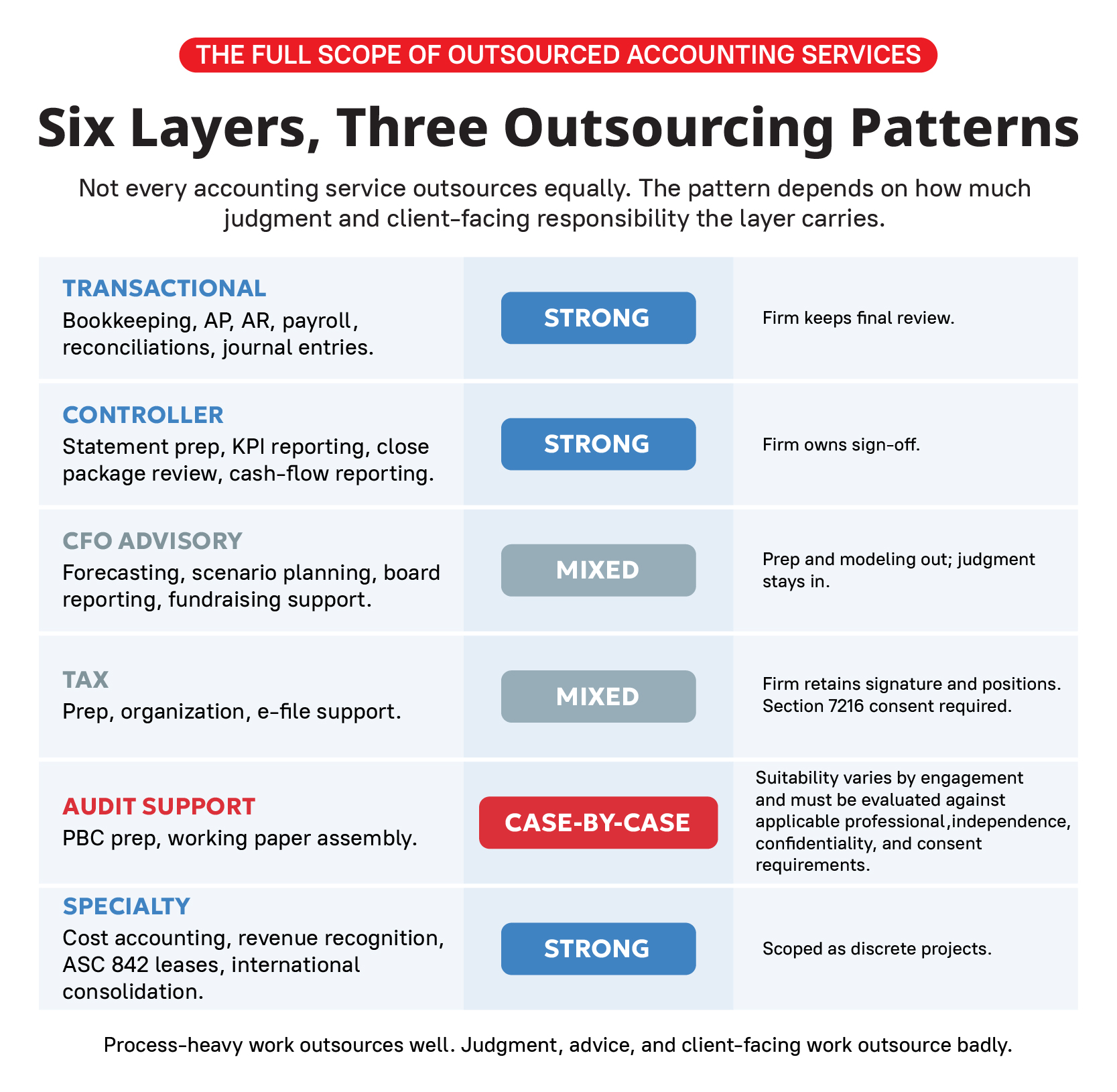
The most common outsourcing opportunities for CPA firms begin with transactional accounting and bookkeeping, followed by tax preparation support and controller/advisory preparation. Specialized accounting or audit-support activities may also be considered depending on the engagement, professional requirements, and provider capability. Each of the six layers below carries a different outsourcing fit based on how much judgment and client-facing responsibility it involves.
The honest strategic answer for most growing firms is to start with the recurring layers first, then expand into higher-judgment layers as the delivery model proves out.
- Layer 1: Transactional and production work. Bookkeeping, accounts payable, accounts receivable, payroll, bank and credit card reconciliations, and journal entries. Rules-based, repeatable, and the strongest outsourcing fit. The accounting and bookkeeping practice at Analytix Solutions operates primarily at this layer.
- Layer 2: Controller-level work. Financial statement preparation, KPI reporting, budget-versus-actual analysis, cash-flow reporting, and month-end close review. Requires accounting judgment but not client-facing responsibility. The controller-level services practice covers this layer when the firm keeps sign-off authority.
- Layer 3: CFO and advisory work. Forecasting, scenario planning, board reporting preparation, and fundraising support. Outsourcing fit here is mixed. Preparation and modeling outsource well; judgment, client-facing advice, and strategic recommendations stay with the firm. The CFO advisory services practice illustrates the split.
- Layer 4: Tax preparation and organization. Return preparation, workpaper organization, and e-file support. Highly regulated. IRC section 7216 requires specific client consent before a firm discloses tax return information to a third party. The tax preparation and compliance practice operates under this constraint.
- Layer 5: Audit support. Prepared-by-client document assembly and working paper preparation. The suitability of outsourced support in this layer varies by engagement and must be evaluated against applicable professional, independence, confidentiality, tax-information, and client-consent requirements under the AICPA Code of Professional Conduct.
- Layer 6: Specialty engagements. Cost accounting, revenue recognition (ASC 606), lease accounting (ASC 842), and international consolidation. Outsourcing fit is strong when scoped as discrete projects rather than ongoing recurring work.
Engagement Models Explained: 3 Ways to Structure the Arrangement
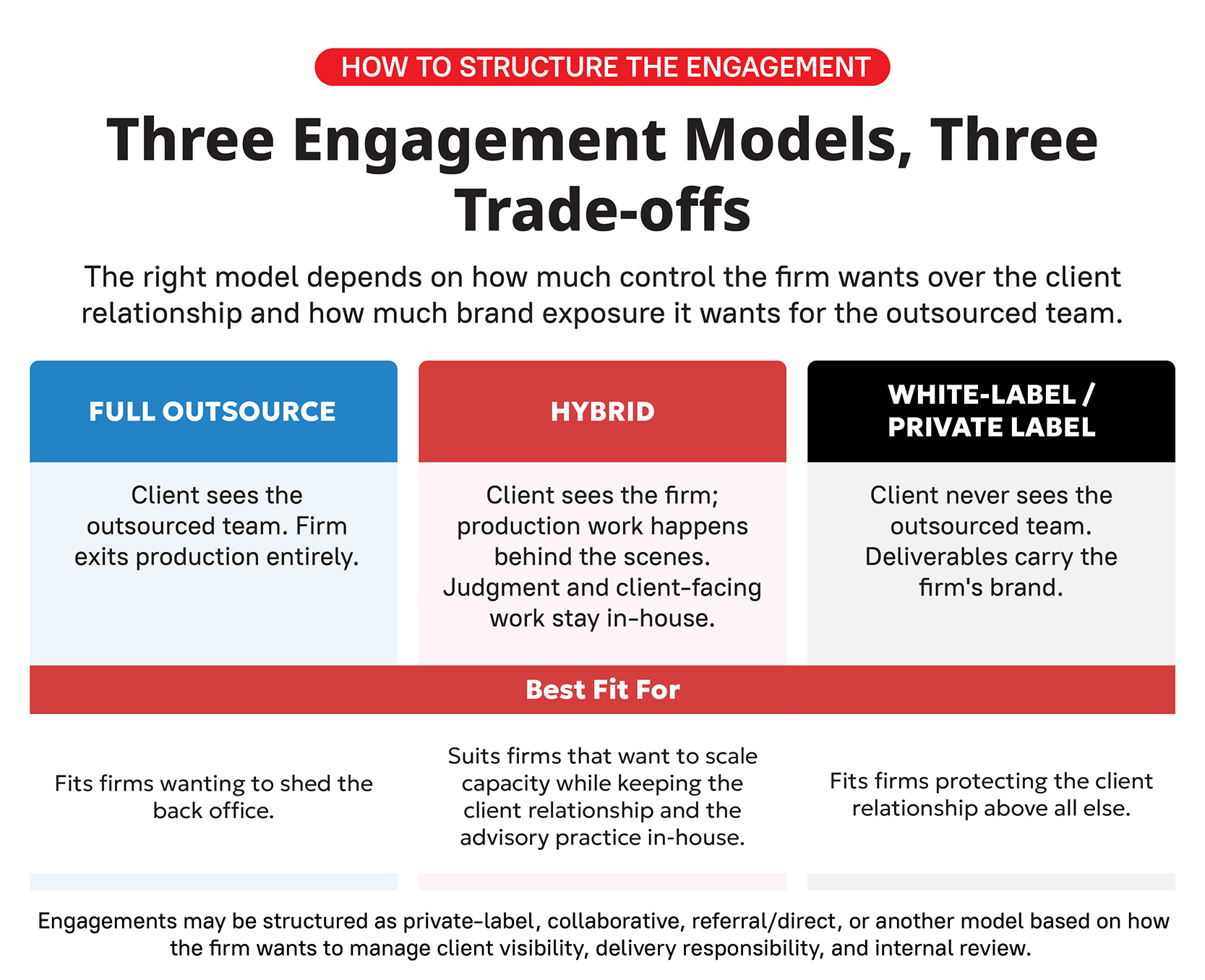
Three engagement models dominate the outsourced accounting services market for CPA firms. Each carries a distinct trade-off between client visibility, firm control, and scaling pace.
- Model 1: Full outsource. The external team runs the entire back-office function. The firm exits production work entirely and focuses on advisory, relationship, and strategic layers. Fits firms wanting to shed the operational load completely. The failure mode is losing the internal review layer. Full outsource typically pairs with a dedicated firm-side reviewer who signs off on deliverables.
- Model 2: Hybrid. Some functions outsource, others stay in-house. The typical split sends transactional and controller-level work outside while keeping CFO advisory, tax judgment, and client-facing work internal. Suits firms that want to scale capacity without giving up the client relationship or the advisory practice. Lets the firm scale capacity without giving up the client relationship or the advisory practice. The failure mode is scope creep as the boundary drifts over time.
- Model 3: White-label or private-label. The outsourced team operates as an extension of the firm and is invisible to the end client. Deliverables, reports, portals, and communications carry the firm's brand. Fits firms wanting capacity without any change to the client experience. Analytix Solutions runs its private-label model as the most common engagement type for CPA firm clients on its accounting firms industry page.
Two adjacent models are worth naming. Staff augmentation assigns specific named individuals on a flat monthly rate. Seasonal overflow covers capacity spikes during tax season or year-end close without committing to ongoing scope.
How to Evaluate a Provider's Qualifications for CPA Firm Work: 7 Criteria
CPA firm work carries evaluation criteria that a small business outsourcing engagement never touches. Seven criteria separate providers built for CPA firm work from providers built for general business accounting.
- Criterion 1: Credentialing of the actual delivery team. Not the sales team. Ask for the credentialing breakdown of the specific staff who will work on the firm's book. The Analytix delivery team includes CPAs, CAs, and Enrolled Agents with US tax-law experience, supported by accounting professionals across multiple service areas.
- Criterion 2: CPA-firm references and proof points. Ask for relevant CPA-firm experience, approved case studies or testimonials, and, where available and permissioned, reference conversations with firms facing similar capacity and delivery challenges.
- Criterion 3: AICPA Code of Professional Conduct considerations. Arrangements involving a third-party service provider are subject to the firm's applicable professional-conduct obligations. These typically include confirming the provider has appropriate qualifications, planning and supervising the work, and addressing client confidentiality through a confidentiality agreement, specific client consent, or both. Firms should validate the specific requirements and documentation with their compliance or legal advisor before signing.
- Criterion 4: Tax-information handling workflow. Any disclosure of client tax-return information to a third party is subject to IRC section 7216 and its implementing regulations, which may require specific written client consent. The provider should have a documented consent and tax-information handling workflow in place. Firms should confirm the specific requirements for their engagements with their tax or legal advisor.
- Criterion 5: Security controls and SOC 2 documentation. Do not accept "SOC 2 compliant" as a checkbox. Ask for the actual report. Ask whether it is Type I (point-in-time) or Type II (over a period). Ask for the auditor name and the most recent report date. Confirm whether the vendor also holds ISO 27001 certification and how it supports due-diligence requests, confidentiality practices, and documented security procedures.
- Criterion 6: Professional liability and cyber insurance coverage. As part of vendor due diligence, firms should review the provider's applicable professional liability and cyber insurance coverage, security controls, confidentiality practices, and contractual responsibilities. The firm carries its own PL policy. The vendor should carry its own too.
- Criterion 7: Technology stack fit. The provider should work fluently in the platforms the firm uses. QuickBooks, Xero, Sage Intacct, and NetSuite for the general ledger. CCH Axcess, Thomson Reuters CS, Lacerte, and ProConnect for tax. SmartVault, ShareFile, and Karbon for workflow. Fluency means production experience, not training slides.
Implementation Timeline: The First 90 Days in Context
Implementation of an outsourced accounting engagement typically progresses through a set of phases rather than a fixed calendar. Timing depends on scope, client volume, process documentation, system access, and the firm's internal review capacity.
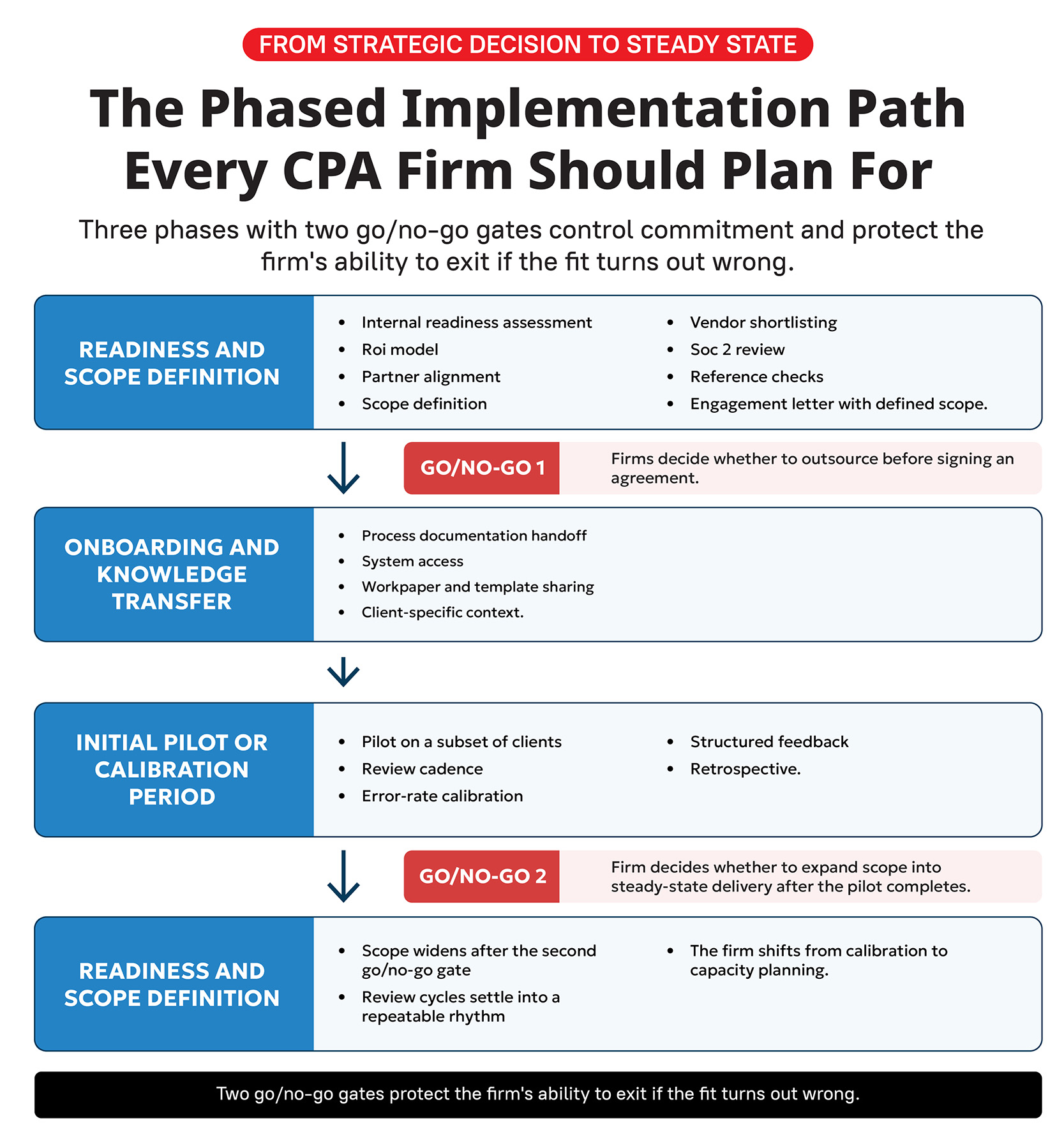
Four stages structure the implementation path, with two go/no-go decision gates protecting the firm's ability to exit if the fit turns out wrong. Implementation progresses through readiness and scope definition, onboarding and knowledge transfer, an initial pilot or calibration period, and then expansion into steady-state delivery.
Phase 1: Readiness and scope definition.
Before signing anything, the firm conducts an internal readiness assessment and defines the scope of work to be outsourced. Which work is consuming staff time without requiring judgment? What is the opportunity cost of partner time spent on production work? What is the ROI model at expected scope? Who signs off on the strategic decision, and what does partner alignment look like? The firm also assembles its vendor shortlist, reviews SOC 2 reports and other security documentation, checks references, and executes an engagement letter with clearly defined scope. Blurry scope is the single most common source of disputes in outsourcing arrangements. The engagement letter should specify what is included, what is excluded, how out-of-scope work is authorized and billed, and what the exit terms look like. The output is a go or no-go decision at the end of this phase. If the readiness assessment surfaces internal blockers, the honest answer is to fix those first.
Phase 2: Onboarding and knowledge transfer.
Once the engagement letter is signed, onboarding and knowledge transfer begin. The firm shares process documentation, system access, workpapers, templates, and client-specific context with the delivery team. The scope of onboarding depends on the complexity of the firm's workflows and the readiness of its documentation. This phase sets the foundation for the pilot and the review cadence that follow.
Phase 3: Initial pilot or calibration period.
The delivery team runs an initial pilot or calibration period on a subset of clients. Review cadence, error-rate calibration, and structured feedback build throughout this phase. The firm-side reviewer and the delivery lead meet on a regular cadence to resolve questions, align on standards, and surface issues early. A retrospective at the end of the pilot becomes the second go/no-go gate before expansion into steady-state scope.
Phase 4: Expansion into steady-state delivery.
After the pilot proves out and the second go/no-go gate is cleared, the engagement expands into steady-state delivery. Scope widens, review cycles settle into a repeatable rhythm, and the firm shifts its attention from calibration to capacity planning. The firm's internal reviewer retains sign-off on deliverables, and the engagement letter continues to govern scope, exclusions, and exit terms.
The AICPA & CIMA outsourcing readiness self-assessment is the profession's formal tool. Three signals separate firms ready now from firms that need a readiness phase first.
- Signal 1: Workflows documented well enough for an outsourced team to absorb. If the firm's month-end close lives inside one senior staffer's head, no outsourced team can absorb it. The test is whether an incoming team member could complete the close from written documentation. If no, the fix is 30 days of documentation before vendor selection.
- Signal 2: Internal reviewer capacity to hold the review layer during the onboarding and pilot period. Outsourcing does not eliminate review load during that period. It usually increases the load, because the firm-side reviewer is teaching, correcting, and calibrating a new team. If the reviewer is already at 60 hours in busy season, adding calibration load is not realistic.
- Signal 3: Partner-group alignment on the strategic decision. One champion pushing outsourcing against partner skepticism produces a fragile engagement. When the first disruption arrives at day 45, the champion becomes the target. Alignment means every partner has read the ROI model and voted yes.
Questions Every Buying Committee Should Ask Before Signing: 6 Categories
The buying committee at a growing US full-service CPA firm (typically 5-50 employees, $1M-$20M revenue) is typically 4-6 people.
Managing Partner owns decision and budget. Practice Manager runs research and shortlist. Tax Partner covers subject-matter fit. IT or Operations lead covers technology and security. A Client Partner optionally covers relationship risk.
Six question categories should structure diligence. Each maps to a different failure mode.
- Category 1: Firm-readiness questions. Is the firm ready to outsource anything at all? Does it have internal reviewer capacity to onboard a new team in the first 90 days? Are workflows documented well enough for an outsourced team to absorb them? If any answer is no, the readiness phase is the priority, not the vendor selection.
- Category 2: Scope-definition questions. What specifically would the firm outsource to the external team? Which of the six service layers stay in-house and which go outside? Where is the boundary between the outsourced team's work and the firm's review layer? Scope in writing is the single most reliable predictor of engagement success.
- Category 3: Success-metrics questions. How would the firm know the arrangement is working? Leading indicators (turnaround, error rate, client satisfaction)? Lagging indicators (partner time recovered, new-client capacity, revenue per partner)? Metrics get harder to define after the engagement starts.
- Category 4: Risk-tolerance questions. What could go wrong, and can the firm absorb it? What happens if a critical client sees an error trace back to the outsourced team? What is the exit path if the vendor turns out wrong? What is the professional liability exposure? The firm carries the ultimate responsibility regardless.
- Category 5: Partnership-fit questions. Does the vendor's culture and communication style match the firm's? Is a named account manager reachable during business hours? Do the vendor's references sound like firms the committee would want as peers? Culture clash shows in the first 60 days.
- Category 6: Financial questions. What is the ROI model, and what does it assume about scope, transaction volume, and internal review time? What is the break-even point? What is the opportunity cost of partner time managing the vendor? The honest ROI answer is usually smaller than the vendor's pitch suggests, once management overhead is counted.
How Analytix Solutions Supports CPA Firm Outsourcing
Analytix Solutions helps growing CPA firms add scalable delivery capacity behind their existing client relationships. The firm retains ownership of client strategy, professional judgment, and advisory relationships, while Analytix supports the repeatable accounting and production work that can otherwise constrain growth.
The live positioning is explicit. Growing CPA firms partner for recurring bookkeeping, reconciliations, financial reporting, month-end close, controller services, and advisory preparation. The CPA firm remains strategy and relationship owner.
Three Engagement Models Named on the Live Site
Three models on the accounting firms industry page cover the delivery range.
- Private label keeps the outsourced team invisible to the end client, with deliverables operating under your firm's brand.
- Collaborative acknowledges the outsourced team while the firm remains primary relationship owner.
- Referral or direct covers overflow and referral partnerships. You pick the model that fits your client mix rather than accepting a one-size-fits-all arrangement.
Capacity Discovery Through Pilot
The onboarding process runs capacity discovery followed by a pilot project. The pilot structure lets the firm test fit before expanding scope, matching the two-gate go/no-go pattern described earlier. Timing depends on scope, client volume, process documentation, and the firm's internal review capacity.
Security and Professional Standards
The delivery infrastructure operates under SOC 2 attested controls and ISO 27001 certification, with encrypted file sharing, controlled access, confidentiality practices, and documented security procedures. The delivery team includes CPAs, CAs, and Enrolled Agents with US tax-law experience, supported by accounting professionals across multiple service areas. Firms should validate these credentials and controls against a proof-of-concept engagement as part of standard vendor due diligence.
CPA Firm Proof Point
How to Move From Strategic Question to Scoped Decision
You now have the framework: the six-layer scope map, the three engagement models, the seven evaluation criteria, and the phased implementation path with two go/no-go gates.
Plus, the six question categories for your buying committee. The next step is not signing with a vendor. It is running the readiness assessment that becomes the first gate.
A capacity audit is different from a vendor pitch. It walks through the firm's book of business, staffing model, partner time allocation, and client mix. The output identifies where capacity is genuinely constrained and where the fix is process, not outsourcing.
One adjacent guide covers a related next step. The hire-or-outsource framework covers the parallel bookkeeping-layer question.
The assessment process is a diagnostic, not a commitment. You keep the authority, the deliverable and the decision.
Frequently Asked Questions
What Are Outsourced Accounting Services?
Outsourced accounting services are accounting functions delivered by an external provider under contract, rather than internal staff. For CPA firms, outsourced accounting spans six layers. Transactional work like bookkeeping. Controller-level work like statement preparation. CFO advisory preparation. Tax preparation. Audit support. And specialty engagements. The CPA firm keeps client strategy, judgment, and professional responsibility. The outsourced team handles the production layer.
How Much Does It Cost to Outsource Accounting?
Pricing varies based on the engagement model, scope of services, transaction and client volume, complexity, technology environment, and level of review required. Firms should compare total delivery economics rather than hourly or FTE cost alone, factoring in internal review time, management overhead, and the opportunity cost of partner hours spent coordinating the vendor.
What Are the Disadvantages of Outsourced Accounting?
Four disadvantages surface most often. Rework and review burden can eat the savings if vendor quality is inconsistent. Client-trust risk exists if the arrangement is not structured to preserve the relationship. Communication overhead across time zones can slow turnaround. And the firm remains ultimately responsible regardless of who produced the work, per Journal of Accountancy guidance from September 2024. Each disadvantage is manageable with the right vendor selection, scope definition, and review cadence.
What Can a CPA Firm Actually Outsource Without Violating Professional Responsibility?
The suitability of outsourced support varies by engagement and must be evaluated against applicable professional, independence, confidentiality, tax-information, and client-consent requirements. Common patterns show firms retaining professional responsibility, signature authority, final review of tax positions, and client-facing advice, while working with external providers on preparation and production layers across transactional work, controller preparation, CFO advisory preparation, tax preparation, and specialty engagements. Firms should validate the specific scope boundaries and documentation requirements with their compliance or legal advisor.
How Do I Know If My CPA Firm Is Ready to Outsource?
Three readiness signals matter most. First, whether the firm has documented workflows an outsourced team can pick up (or willingness to document them before the engagement begins). Second, whether the firm has internal reviewer capacity to carry the review load during the onboarding and pilot period. Third, whether the partner group aligns on the strategic decision. If any signal is weak, the readiness phase is the priority. The vendor selection can wait.
What Questions Should a Buying Committee Ask Before Signing?
Six question categories should structure the buying committee's diligence. Firm-readiness (is the firm ready to outsource anything?). Scope-definition (which work would the firm outsource?). Success-metrics (how would the firm know it worked?). Risk-tolerance (what could go wrong?). Partnership-fit (does the vendor's culture match?). And financial (what is the ROI model and the opportunity cost?). Each category maps to a different failure mode. The committee should get honest answers to all six before signing.