Common Area Maintenance Charges: A CAM Billing Guide for Property Managers



Common area maintenance (CAM) charges can represent a meaningful portion of a commercial tenant's occupancy cost. For property management teams, that makes CAM billing more than a year-end accounting exercise. It is a monthly control process.
Regency Centers' 2024 annual data reported $345.1 million in tenant recoveries and $986.9 million in base rent. That illustrates how significant recoverable property operating costs can become at scale.
The problem is that a tenant question raised during a year-end true-up may trace back to an ordinary transaction recorded many months earlier: an invoice coded to the wrong account, a lease cap that was never updated, or an expense assigned to the wrong pool.
This guide explains how to manage common area maintenance charges month by month so the year-end CAM reconciliation becomes primarily a confirmation exercise, not a reconstruction project.
What Are Common Area Maintenance Charges?
Common area maintenance charges are shared property operating costs that commercial tenants may pay in addition to base rent. Depending on the lease, those costs can include items such as landscaping, common-area utilities, snow removal, property insurance, real estate taxes, management fees, and routine maintenance.
Each tenant's share is typically determined by the lease. A common method is a pro rata allocation based on the tenant's rentable square footage as a percentage of the applicable rentable area. Only expenses that are recoverable under the lease should enter the tenant's CAM calculation.
During the year, tenants often pay monthly estimates based on a budget. After year-end, the landlord or property manager compares those estimates with actual recoverable expenses and applies the lease terms. The difference is then billed or credited through the CAM true-up.
Why Year-End CAM Problem Usually Starts Months Earlier?
Common area maintenance charges often start going wrong early in the year because the first quarter sets the pattern for everything that follows. Budgets are finalized, monthly estimates are set, coding decisions are made, and lease files are assumed to be current. Once those foundations are in place, they can easily go unchecked until year-end.
Tenants continue paying a fixed monthly estimate with their rent, so the billing can feel settled. But behind the scenes, actual invoices keep flowing into the general ledger throughout the year. A miscoded expense or incorrect entry may not look significant when it is recorded, and it may not show up clearly on a tenant statement right away.
The CAM reconciliation guide breaks down the eight steps involved in the year-end true-up. But even the strongest reconciliation is only as accurate as the numbers feeding into it throughout the year. That is why monthly CAM billing deserves just as much attention.
Put simply, a careful year-end review cannot fully make up for weak monthly inputs. If the numbers going into the process are wrong, the final calculation will reflect those same issues.
How One Early Coding Error Grows Into a Larger CAM Dispute
Picture a retail center with 50,000 leasable square feet. One tenant rents 5,000 square feet, giving it a 10% pro rata share. The annual CAM budget is $360,000, so the tenant's monthly estimate is set at $3,000.
Now imagine that in February, the property team pays a $48,000 parking lot resurfacing invoice. The accounting team codes it as a repair and includes it in the shared expense pool. Under many leases, however, resurfacing may be treated as a capital project and excluded from the recoverable CAM pool.
By year-end, the shared pool totals $448,000 instead of $400,000. The tenant's share rises to $44,800 rather than $40,000. After paying $36,000 in monthly estimates during the year, the tenant receives an $8,800 true-up bill instead of a $4,000 bill.
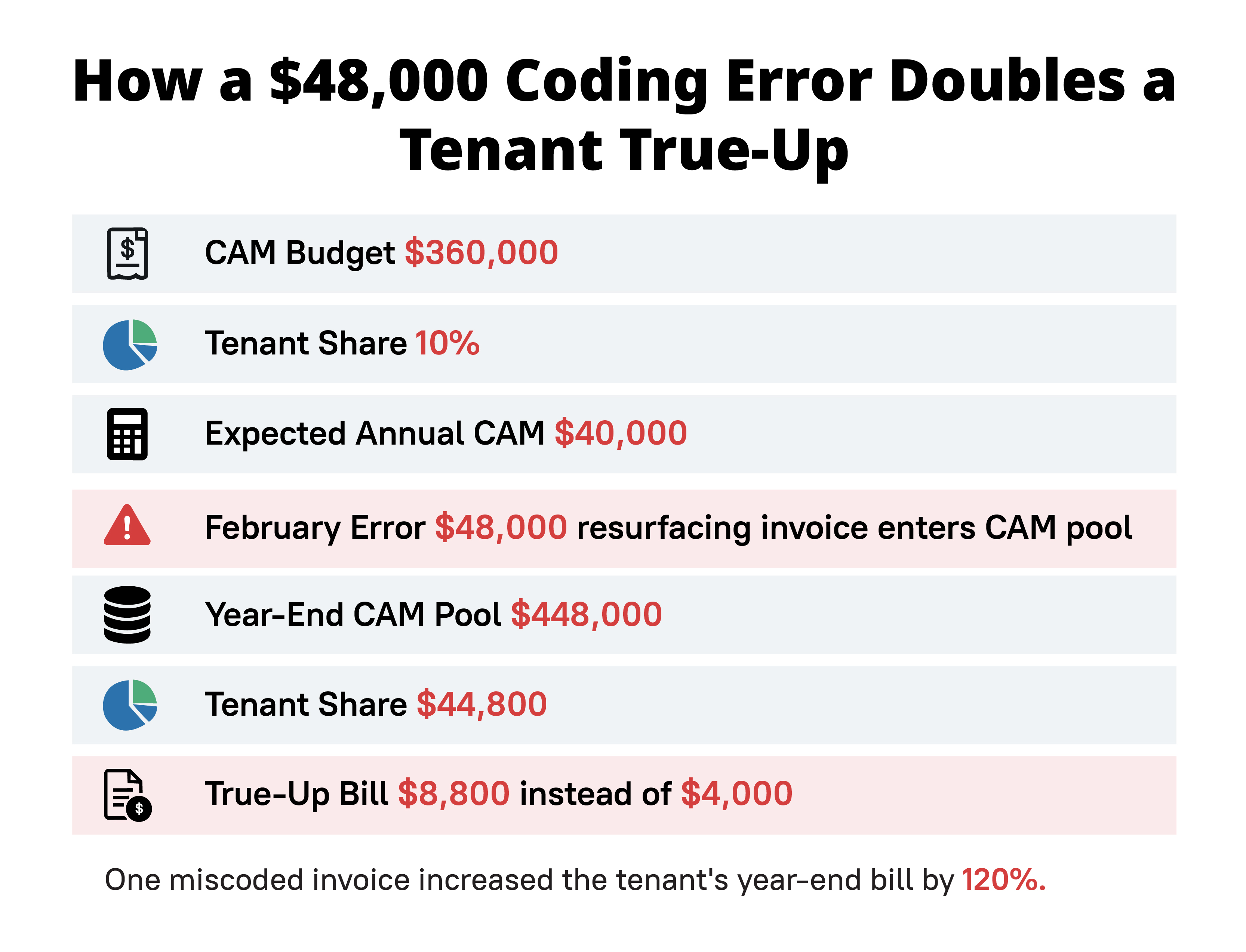
The difference is fairly easy for a tenant accountant to notice. The harder part is tracing it back to one invoice that was recorded months earlier. That is why CAM billing problems often begin in the first quarter, even though they may not become visible until year-end.
The Institute of Real Estate Management (IREM) makes a similar point in its guidance on year-end preparation: strong year-end results are usually built on disciplined processes throughout the year.
Three areas are especially important early in the year:
- Monthly estimates. If the budget starts too high or too low, the difference can build throughout the year and create a larger true-up later.
- Coding rules. These determine which recoverable expenses enter the shared CAM pool and which expenses stay out.
- Lease terms on file. Caps, base years, exclusions, and other lease provisions should match the executed lease documents.
If any one of these is wrong in March, the impact can continue through December. Fixing the issue early may take a short review. Reconstructing the same issue at year-end can take much longer.
What Does a Clean Monthly CAM Billing Checklist Look Like?
A clean monthly CAM billing routine is a short, repeatable review of the general ledger, property management system, lease data, allocation rules, and supporting documents. That discipline becomes particularly important when accounting teams oversee multiple properties and entities under a single portfolio. The purpose is to find discrepancies while the transaction and lease context are still easy to verify.
The formula sets the monthly estimate, but the estimate is only as reliable as the information behind it. The budget can change, expenses can be coded incorrectly, lease terms can be updated, and costs can land in the wrong pool.
That is why a clean monthly CAM checklist should do more than recalculate the estimate. Before the month closes, the team should verify the numbers, lease terms, allocations, and supporting records feeding into it.
Run these seven checks:
- Tie the system to the general ledger: Compare CAM expense totals in the property management platform with the general ledger. Whether the team uses AppFolio, Yardi, MRI Software, Buildium, or another platform, the CAM balances should reconcile before the month closes.
- Tag each expense as recoverable or nonrecoverable: Review the expense against the applicable lease terms before it enters the CAM pool. Capital items, leasing costs, and single-tenant expenses may need to stay outside the shared pool depending on the lease.
- Confirm the correct property and expense pool: If a property uses multiple CAM pools, make sure each invoice is assigned to the right property and the right pool before tenant allocations are calculated.
- Compare actuals with the budget: Look for material differences between actual CAM expenses and the budget supporting the tenant estimates. Set an internal variance threshold that triggers review and documentation. For example, a team may use 10% as a management threshold, but the appropriate level should reflect the property and portfolio.
- Post lease changes promptly: Amendments, renewals, new caps, exclusions, and other relevant lease changes should update the tenant record as soon as the approved documents are available.
- Track caps and base years: Review the running calculations against lease caps, base years, and other applicable limits each month rather than waiting until year-end.
- File the supporting documents: Keep invoices, lease references, approvals, and calculation support in a location another reviewer can find quickly.
A checklist works best when every step has a clear owner. The property accountant may handle the ledger tie-out and expense coding. The property manager may update lease changes because those often come through tenant communication and property activity. The controller may review material variances and approve the reconciliation.
The exact titles can vary from one organization to another. What matters is that responsibility for each step is clear.
Why the Checklist Needs to Run Every Month
The value of the checklist comes from when it is used.
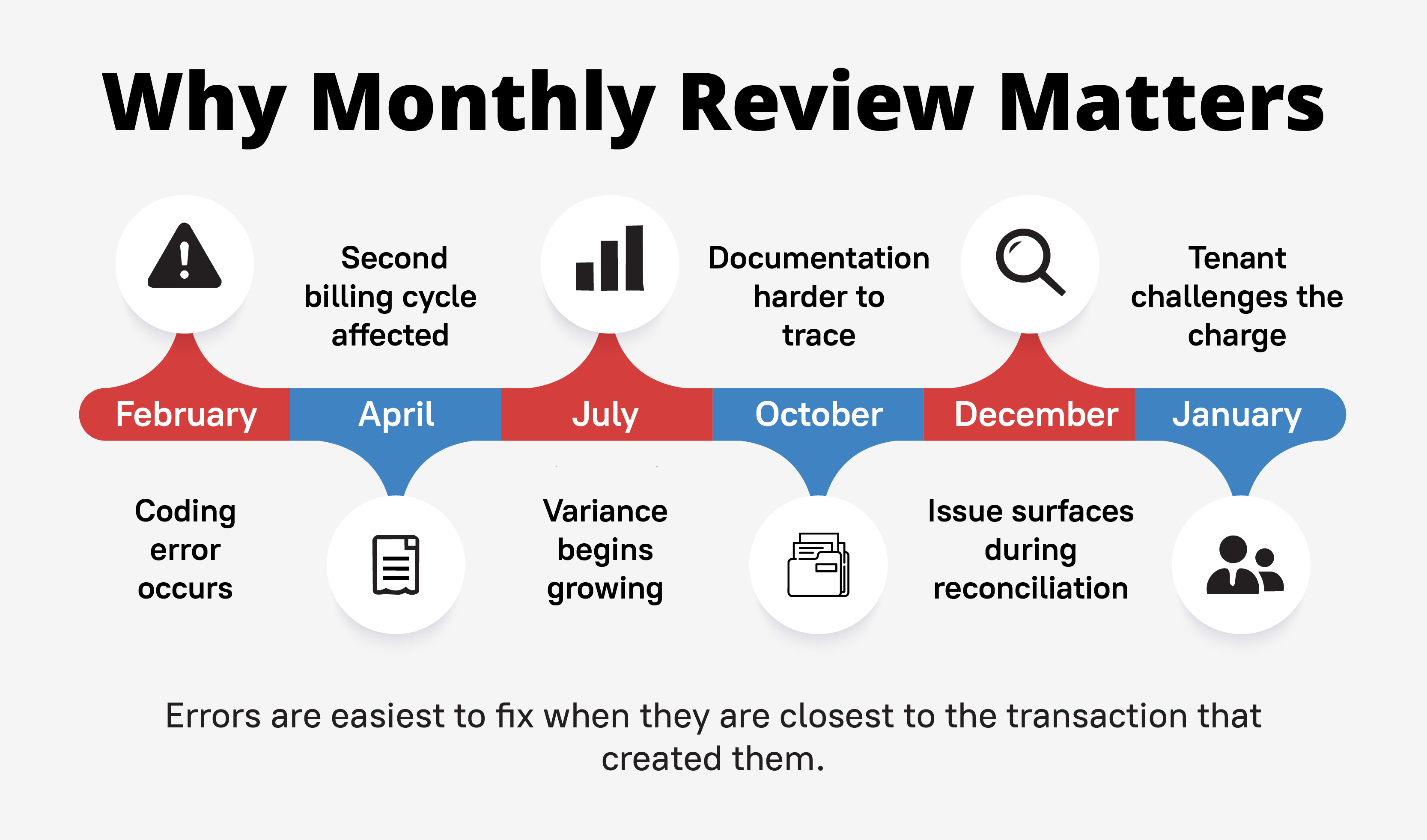
A coding error identified during the same month can usually be traced back to the invoice, lease provision, and person who processed it without much reconstruction. Leave the same issue untouched for several months, and it can begin affecting multiple tenant billings, budget comparisons, cap calculations, and year-end reconciliation schedules.
Monthly review keeps accounting activity aligned with lease requirements. It gives the team a regular opportunity to ask:
- Did anything change in the lease?
- Did actual costs move away from the budget?
- Did an expense enter the wrong pool?
- Are caps or base-year calculations still tracking correctly?
- Is the support available for charges posted this month?
A quarterly review can still identify those problems, but by then the same incorrect input may already have carried through several billing cycles. Monthly review keeps the issue closer to the transaction that created it, which generally makes it easier to investigate and correct.
Keep the Estimate Under Review Too
The checklist should not focus only on coding and lease terms. The estimate itself also needs attention.
A CAM estimate is usually based on a budget created before many of the year's actual costs are known. Even when every invoice is coded correctly, actual operating costs can move away from that original assumption.
That does not mean the estimate should change every time an expense moves. It means material differences should be visible, reviewed, and documented rather than discovered for the first time during the year-end true-up.
Regency Centers, for example, reported an increase in operating and maintenance expenses driven in part by CAM, management fees, and utilities. Individual properties can experience similar cost movements on a smaller scale.
The purpose of the monthly review is therefore not to eliminate every year-end adjustment. It is to make sure the adjustment can be explained by current information rather than by errors that went unnoticed during the year.
How Should Common Area Maintenance Charges Be Documented for Tenant Review?
Document each material CAM charge so another qualified person can understand what was billed, why it is recoverable, how it was allocated, and what support exists.
Good CAM documentation generally has three layers:
- Invoice layer: Vendor invoice, contract or work order when relevant, and evidence supporting the amount charged.
- Lease layer: The lease provision or amendment that supports recovery, including applicable caps, exclusions, base years, or allocation rules.
- Math layer: The expense pool, tenant share, gross-up if applicable, estimates already paid, caps, and remaining balance shown in understandable numbers.
A tenant statement should make the calculation easy to follow. Show the expense category, total recoverable cost, tenant allocation, estimates already paid, applicable caps or adjustments, and the remaining balance.
Tenant CAM statements should be easy to follow. Each statement should show the expense category, the total cost, the tenant's share, the estimates already paid, and the remaining balance. Caps and gross-ups should appear as separate line items rather than being buried in a formula.
Many disputes begin when a tenant cannot see how a charge was calculated. A clear statement reduces confusion, shortens review time, and helps answer questions before they become disputes.
Before issuing statements, perform a quick internal review. Confirm that the expense pool, lease caps, and allocations match the lease terms. Audit rights vary by lease, so review those provisions before responding to tenant requests.
Keep each tenant's CAM statements and supporting records in a single file. When questions arise months later, the information should be easy to retrieve and explain.
If a tenant questions a charge, follow three simple steps:
- Pull the invoice and relevant lease provision within one business day.
- Explain the calculation clearly using straightforward numbers.
- Correct the charge promptly if an error is discovered.
A clear and timely response does more to maintain trust than a lengthy explanation.
Which Monthly Billing Errors Commonly Become Year-End CAM Problems?
Recurring CAM problems usually come from ordinary process gaps rather than complicated accounting. The most common categories are incorrect expense coding, outdated lease terms, estimates that no longer reflect actual costs, incorrect pool assignments, and differences between the property system and the general ledger.
Most of these issues are not difficult to identify when reviewed monthly. They become difficult when the team has to reconstruct the reason, lease treatment, and supporting documentation many months later.
What Does a Specialist CAM Process Track Throughout the Year?
A specialist CAM process does not necessarily mean a separate full-time employee. It means the work has defined ownership, recurring controls, and people who understand how lease terms affect accounting treatment.
The difference is consistency. Lease changes, caps, occupancy, pool assignments, estimate variances, and supporting documents are reviewed as activity occurs rather than reconstructed at year-end.
Here is what a specialist team tracks all year:
- Lease changes: Amendments, renewals, caps, exclusions, and relevant terms are updated promptly.
- Caps and base years: Running calculations are maintained, so limits are not discovered only at year-end.
- Occupancy and gross-up inputs: Relevant occupancy data is maintained when gross-up provisions apply.
- Pool assignments: Invoices are checked against the correct property and expense pool.
- Estimate versus actual: Material variances are reviewed during the year.
- CAM audit file: Supporting records are organized as transactions are processed.

Building this consistency internally can be difficult when accounting teams are already stretched. Robert Half reported in July 2026 that 58% of surveyed U.S. hiring managers said finding qualified talent was harder than a year earlier. That does not automatically mean a firm should outsource CAM work, but it does reinforce the importance of continuity, documentation, and backup coverage.
Whether the work stays in-house or is supported by a specialized accounting team, the objective is the same: keep billing aligned with lease terms as changes occur.
How Do You Decide Between Fixing the Process In-House and Bringing in Support?
The right answer depends on three things: how reliable the current process is, how much capacity the team has, and how complex the portfolio has become.
Start with what is already happening inside the close and reconciliation process. The purpose is not to assume that outsourcing is better or that everything should stay in-house. It is to identify where the process is breaking down and whether the existing team has the time and expertise to fix it.
Signs Your CAM Process May Need Attention
Look for patterns such as:
- Reconciliations require substantial cleanup or manual reconstruction every year.
- Lease changes sit in emails or individual files instead of a controlled workflow.
- CAM review regularly gets pushed outside the normal close process.
- One employee holds most of the lease or allocation knowledge.
- Tenant questions repeatedly require the team to rebuild calculations from prior periods.
- The property system and general ledger frequently differ without a documented explanation.
If several of these issues happen repeatedly, the problem may be larger than a one-time accounting error. It may point to a gap in process ownership, team capacity, or CAM-specific expertise.
When an In-House Fix May Be Enough
An in-house approach can work well when the team has the right knowledge and enough capacity to maintain the process consistently.
If the main issue is that ownership is unclear or the monthly review is not yet standardized, start by strengthening the process internally.
A simple 30-day plan can help:
- Week 1: Name the CAM process owner and add the monthly review steps to the close calendar.
- Week 2: Review leases with caps, base years, exclusions, or special allocation provisions.
- Week 3: Compare year-to-date actual recoverable expenses with the budget supporting tenant estimates.
- Week 4: Define variance-review triggers and standardize where tenant CAM statements and supporting documents are stored.
After that, review whether the process is becoming easier to manage. If CAM review is staying on schedule, documentation is improving, and fewer issues require reconstruction; the internal changes may be enough.
When Additional Support May Make Sense
Outside support becomes more relevant when the process is clear, but the team still lacks the capacity or specialized knowledge to run it consistently.
That may include situations where:
- CAM review continues to fall behind despite a defined process.
- The portfolio has grown more complex.
- Lease structures vary significantly across properties or tenants.
- Key CAM knowledge is concentrated with one person.
- Internal teams spend too much time rebuilding schedules or responding to avoidable tenant questions.
In those cases, the decision is less about replacing the internal team and more about adding capacity, continuity, or specialized support where the current process needs it.
Questions to Ask a Specialized CAM Accounting Provider
If you decide to explore outside support, ask:
- Does the team work inside your existing property management and accounting systems?
- Who reviews the CAM calculations and supporting schedules?
- How is continuity handled when a team member is unavailable?
- How are lease changes communicated, approved, and reflected in billing?
- What documentation is retained for tenant questions and audits?
The right provider should fit into the existing process rather than create a parallel one.
For teams weighing both options, in-house versus outsourced property management accounting offers a practical comparison of the costs, trade-offs, and day-to-day considerations involved.
Where Better CAM Billing Starts
Year-end CAM problems rarely begin at year-end. They usually develop when small issues remain unresolved for several billing cycles.
Accurate CAM billing depends on a few repeatable disciplines: code expenses correctly, keep lease terms current, reconcile systems, review material variances, preserve supporting documents, and assign clear ownership.
The objective is not a perfect December. It is a monthly process that makes December easier to verify.
How Analytix Solutions Can Help
Keeping CAM billing accurate requires coordinated lease administration, expense tracking, tenant billing, documentation, and financial review throughout the year.
Analytix Solutions supports commercial property management firms with real estate accounting professionals experienced in CAM reconciliation, tenant recoveries, property-level accounting, month-end review, and documentation controls.
The objective is not to replace sound internal ownership. It is to give property management teams additional capacity and specialized accounting support where the existing process needs it.
What property management firms can gain:
- More accurate CAM billings
- Fewer avoidable tenant questions and disputes
- Better alignment with lease terms
- Stronger documentation controls
- Cleaner year-end true-ups
- Improved visibility into caps and base years
- Reduced key-person dependency
- Faster issue resolution
- Audit-ready supporting records
- More consistent month-end reviews
If your team is spending too much time rebuilding CAM schedules, chasing lease updates, or resolving avoidable year-end discrepancies, an outside review can help identify where the process is breaking down before you decide whether to change staffing, controls, or delivery support.
Frequently Asked Questions
How often should common area maintenance charges be reviewed?
CAM-related activity should be reviewed as part of the monthly close. Monthly review helps teams identify coding, lease, allocation, and estimate issues before several billing cycles build on the same error.
What expenses should not be included in common area maintenance charges?
The answer depends on the lease. Costs such as capital expenditures, leasing costs, ownership-level expenses, or charges attributable to a single tenant may be excluded, limited, or treated differently. The executed lease and amendments should control the billing treatment.
What usually causes CAM reconciliation disputes?
Common causes include unsupported expenses, incorrect allocations, stale lease terms, missed caps or exclusions, unclear calculations, and differences between the property system and the general ledger.
Should CAM estimates change during the year?
They can, if the lease and billing process allow it and actual costs materially diverge from the budget. Teams should define a review threshold, document the reason for any change, and communicate adjustments clearly.
Who should own the CAM billing process?
Ownership can vary by organization, but the process should clearly assign responsibility for ledger reconciliation, expense coding, lease updates, variance review, calculations, and final approval.
When does specialized CAM accounting support make sense?
Additional support may make sense when internal teams consistently lack capacity, lease knowledge is concentrated with one person, reconciliations require repeated cleanup, or the portfolio has enough complexity that CAM review is regularly deferred.