

Investor Variance Reports: Why They Are Always Late and How a Specialist Team Creates a Reliable Reporting Cadence



It is the 14th of the month. Property books closed on the 8th. Owner statements went out on the 10th. Your CFO asks about the investor variance package on Monday. It is not ready. It is never ready by the 14th.
You have already tried the fixes. A new template last quarter. A tighter approval workflow the prior quarter.
A weekend close attempt in June that burned out your senior accountant. Each fix moved the number a day or two. None of them changed the pattern.
This guide covers why investor variance reports are consistently the last deliverable out the door. It maps what actually breaks along the way. It shows what a properly structured report looks like at 500-2,500 units.
It covers how an embedded outsourced team turns variance reporting into a standing SLA.
Why Investor Variance Reports Are Consistently the Last Deliverable Out the Door
Every other month-end deliverable has a hard external deadline. Owner statements have to go out by a stated date. Bank reconciliations have to clear the trust rule. Rent posting has a daily rhythm.
The wider 10-day month-end close framework sets the cadence every other deliverable respects. Investor variance reports are the one deliverable where the deadline is internal and the pressure comes from a single stakeholder asking one time per quarter.
That is why they slip. Not because the team is careless. Because everything else has an external clock, and the variance package is what fills whatever time is left.
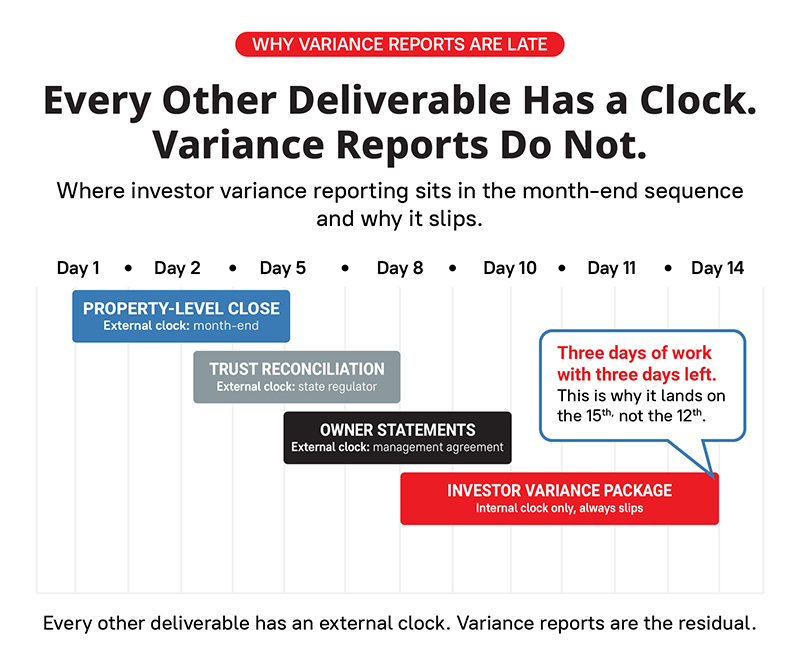
Across mid-size property management firms the structural pattern is consistent. Property-level close finishes on schedule. Owner statements publish on schedule. Then the accounting team turns to the variance package with three days left in a two-week window that was already tight. Data has to be pulled from three systems.
Intercompany balances have to be reconciled. The CFO has to review before it goes to investors. Formatting takes an afternoon. None of that fits in three days at the end of a close cycle already running hot.
More effort is not the fix. Every Controller reading this has already tried more effort. Part of the ceiling comes from the wider shortage of real estate-trained accountants most mid-size firms already know. A different structure works. The variance package gets produced on its own cadence. Someone whose SLA is the variance package specifically owns it. Production runs in parallel with other deliverables, not after them.
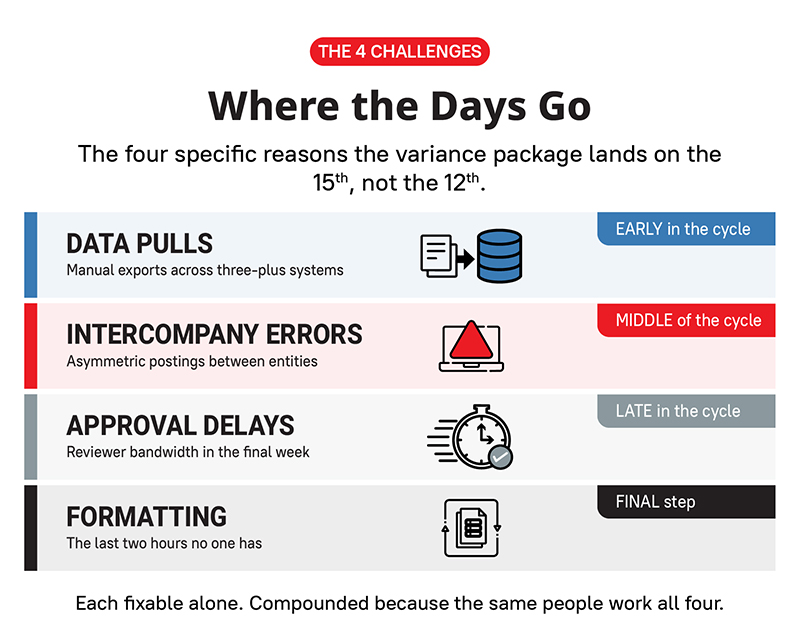
The 4 Challenges: Data Pulls, Intercompany Errors, Approval Delays, Formatting
The specific reasons the variance package runs late are consistent across firms. Four challenges account for nearly every day of delay.
Challenge 1: Data pulls across multiple systems
The property-level actuals live in AppFolio, Yardi, MRI or Buildium. The budget lives in Excel or in a separate FP&A tool. Consolidation happens in another workbook. Every pull is a manual export, a manual paste, a manual reformat. A coding change during the month surfaces as a variance the team has to explain before the package can move forward. What looks like an hour of data work turns into a day of chasing exceptions.
Challenge 2: Intercompany reconciliation errors
Property LLCs, holding companies, management entities and GP vehicles all book transactions that touch each other. Management fees move from property to management company. Reserves move from operating to a separate account. Cost allocations cross entities. Asymmetric postings during the month leave intercompany balances that do not net to zero. The consolidation cannot close until they do. Every unresolved intercompany line becomes a variance the report has to explain.
Challenge 3: Approval delays
The variance package needs the CFO or the Director of Accounting to sign off before it goes to investors. That review is judgment work. It cannot happen at 5:00 PM in fifteen minutes. A package landing on the reviewer's desk on the 13th, with other work already booked into that week, slides by two or three days. This is the single most common source of delay across firms that have already fixed the data and reconciliation challenges.
Challenge 4: Formatting time no one owns
The last two hours of every variance package are formatting. Numbers rounded consistently. Variance thresholds highlighted. Commentary paragraphs written under each material line. Table of contents updated. PDF assembled. The person who does this work is usually the same person who did the data pull and the reconciliation. By the time formatting starts, that person is already past their bandwidth for the week. So the package sits.
Each challenge is fixable on its own. They compound because the same people work every challenge sequentially. The timeline is compressed.
Team capacity has already been consumed by the earlier deliverables.
What a Properly Structured Variance Report Looks Like: 5 Sections for a 500-2,500 Unit Portfolio
A well-built variance report is not longer than a bad one. It is shorter. The discipline is knowing what to cut.
The foundations of real estate accounting that produce the underlying numbers sit outside this section.
Specialist processes like CAM reconciliation run alongside them.
At the 500-2,500 unit range, the variance package usually covers three to eight properties or vehicles rolled to a fund level. A portfolio summary sits on top. An investor should read the summary in under five minutes and know what happened, what to ask about, and what to expect next quarter.
One structure produces that reading experience consistently.
Section 1: Portfolio summary
One page. Actual vs. budget vs. prior year at the portfolio level. Percentage and dollar variances for revenue, operating expenses, NOI, capital expenditures. Only the totals that matter, not the full P&L.
Section 2: Material variances by property or vehicle
Only lines above a defined materiality threshold. For a mid-size portfolio, that threshold is typically $5,000 or 5% of the line item, whichever is greater. Immaterial variances get suppressed. Each material line gets a one-sentence explanation and, where relevant, a forward-looking note about what the next quarter will show.
Section 3: Capital projects status
Any capital work in progress. Budget vs. actual to date and expected completion. Only what the investor needs to know, not the full project ledger.
Section 4: Cash position and distributions
Current operating cash, reserve balances, planned distributions for the next quarter, any distribution timing changes.
Section 5: Forward-looking commentary
Two to four short paragraphs covering the material variances, the operating environment, and any known changes to the next quarter's forecast. Written in language the investor can act on, not accounting language.
The whole package usually runs eight to fifteen pages depending on portfolio complexity. Longer means immaterial detail is being included. Shorter usually means material context is being cut.
How to Build a Variance Reporting Template: 5 Characteristics That Cut Prep Time
A well-designed template can cut variance report prep time by roughly half. It cannot close the delivery gap by itself, but it moves the ceiling.
The template design that produces that gain has five specific characteristics. Firms using AppFolio-specific bookkeeping approaches find these characteristics translate directly to the platform.
- Live data connections rather than pasted values: The template pulls actuals directly from the property management platform via API or scheduled export, and budget values from the FP&A tool or budget workbook. When the source data updates, the template refreshes. Removing the manual paste step removes the reconciliation step that follows every manual paste.
- Built-in materiality filters: The template suppresses variance lines below the defined threshold automatically. The accountant does not decide what is material each month, the template does. This removes an hour of judgment work per package and forces consistency across quarters.
- Standard commentary prompts under each material line: Fill-in fields with a defined question ("what caused this variance?" and "what does the next quarter look like?") rather than open text boxes. Prompts turn the commentary from a writing task into a review task.
- Approval routing built into the template itself: The reviewer gets a notification when the template is complete, reviews inside the same document, and marks approval directly. No separate email, no separate meeting.
- Version control and audit trail: Every field change is logged. When the CFO or an investor asks how a variance was calculated three quarters later, the answer traces back to the specific entries and reviewer.
A template with all five characteristics is a genuinely useful piece of infrastructure. But even the best template still relies on the internal team to run it every month, and that is where the delivery gap survives. The template moves the ceiling. It does not remove the constraint.
How an Embedded Outsourced Team Delivers Variance Reports: 4 SLA Commitments
Once internal template and workflow changes have hit their ceiling, the structural fix is to move production. An embedded outsourced team with a standing SLA takes it. The in-house versus outsourced comparison covers the wider cost and control trade-offs. This section covers what the model looks like specifically for variance reporting.
An embedded team is not the same as a project-based outsourcing engagement. Their people work inside your property management platform on a documented cadence. Your close deadline is their deadline. The variance package gets produced on a fixed calendar every month.
The output is the same. What changes is who owns the workflow. Firms that recognize the signals it is time to hire a real estate accountant often find the embedded model fits better than one internal hire. The questions worth asking before you sign with a provider come next.
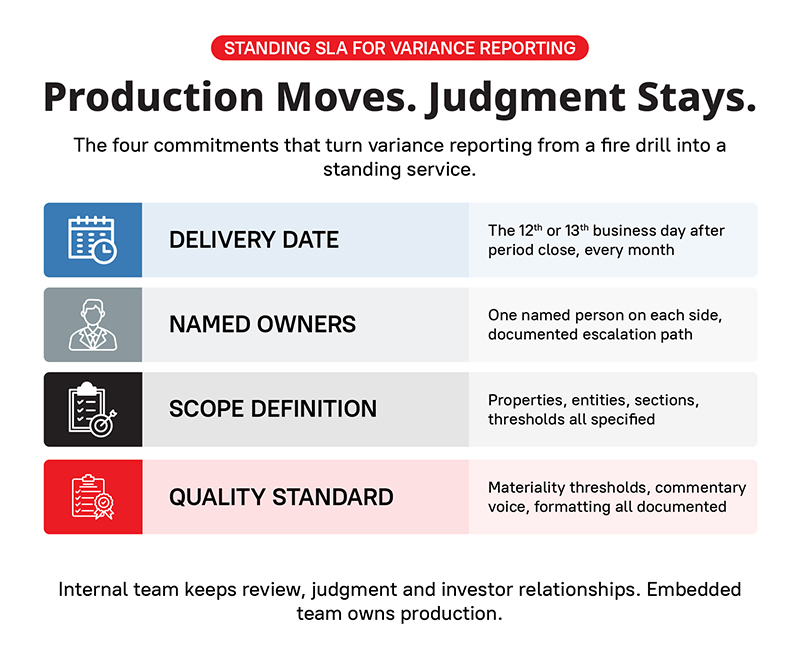
The standing SLA typically covers four commitments.
- Delivery date: The variance package lands on a stated calendar day every month. Not "within the close window." For most 500-2,500 unit portfolios, that date is the 12th or 13th business day after period close. That falls inside the window the CFO needs for their own review.
- Named owner on each side: One named person on the embedded team owns the package. One named person on your team owns the review. Nothing operates on assumption. When either side needs to escalate, the path is documented.
- Scope definition: The SLA specifies what the package covers: which properties, which entities, which sections, which thresholds. Scope changes get handled through a defined process, not through a Slack message in the last week of the month.
- Quality standard: The variance package meets a defined quality bar: materiality thresholds applied consistently, commentary written to a standard length and voice, formatting to a documented template. Quality is not a negotiation each month.
The controller-level review and CFO advisory services that sit above the variance package stay with your team. What moves is production. The judgment and the investor relationship stay with you.
One thing to settle before any external team touches financial data: ask for current security certifications and compliance documentation in writing. A specialist provider produces them without being chased.
How Analytix Solutions Delivers Variance Reporting as a Standing SLA
Analytix Solutions runs real estate accounting for property management firms at the 500-2,500 unit range. The delivery scope for variance reporting sits in three areas. Your internal team keeps authority. The delivery team handles production. Judgment stays with you.
Embedded Team Structure
The engagement runs inside AppFolio, Yardi, MRI, Buildium or whichever platform your team already uses. Communication happens directly with named individuals through your existing channels, not through an account manager. The variance package cadence gets documented at the start of the engagement and drives the calendar every month. Final authority stays with your CFO or Director of Accounting on every package before it publishes to investors.
Technical Depth
The delivery team brings property-management-specific accounting expertise. Multi-entity consolidation, intercompany reconciliation, materiality thresholds, forward-looking commentary and audit-ready formatting. The scope of the wider real estate accounting services practice covers the accounting work under the variance package as well as the package itself.
Reliable Delivery
Delivery teams are pre-trained on AppFolio, Yardi, MRI, Buildium, Xero and QuickBooks before an engagement begins. Most property management clients are fully operational within two to three weeks of the onboarding call.
There is no ramp-up fee and no learning curve charged to you. Month-end close lands within 10 business days of period close, and reconciliation accuracy runs at 99.9% across client portfolios.
How to Bring the Variance Reporting Case to Your Executive Team
You have already tried the template overhauls. You have already tried the tighter workflows. You know what the internal ceiling looks like because you have hit it.
The four challenges show up in some form inside every property management firm producing variance reports at scale. A good template moves the ceiling by roughly half. It does not remove the constraint. The constraint is that the same people are producing every deliverable, sequentially, in a compressed window at the end of the close cycle.
Moving production is the structural fix. Someone whose SLA is the variance package specifically, working on their own cadence in parallel with the other deliverables. Judgment stays with your CFO. Investor relationships stay with your team. What changes is who does the production work and when.
Name the pattern this clearly to your CEO or CFO and the conversation shifts. It stops being a defense of why the package landed on the 15th. It becomes a decision about which structural change to make first, on what timeline, against what measurable outcome.
A free property accounting audit produces the written evidence to bring to that conversation. It is a diagnostic, not a proposal. You keep the authority, the deliverable and the decision on what to do next.
Frequently Asked Questions
Why Are Investor Variance Reports Always Late?
The structural reason is that every other month-end deliverable has an external deadline and the variance package does not. Owner statements have to publish by a stated date, trust reconciliation has to clear a state rule, rent posting has a daily rhythm. The variance package fills whatever time is left, which is almost always less time than the work requires. The four specific challenges are data pulls across systems, intercompany reconciliation errors, approval delays and formatting time no one owns.
What Is an Investor Variance Report?
An investor variance report is a monthly or quarterly document showing actual financial performance against budget and prior period. Reporting runs at the portfolio, vehicle or property level. Material variances get explained. Forward-looking commentary covers what the next period will show. For a mid-size property management firm at 500-2,500 units, the package usually runs eight to fifteen pages. It typically covers three to eight properties or vehicles rolled to a fund level.
What Should an Investor Variance Report Include?
Five sections. A one-page portfolio summary with actual versus budget versus prior year. Material variances by property or vehicle above a defined threshold. Capital projects status. Cash position and planned distributions. Forward-looking commentary. Only material variances get explained. Immaterial lines get suppressed. The investor should be able to read the summary in under five minutes.
How Do You Reduce Variance Report Prep Time?
A well-designed template can cut prep time by roughly half. It needs live data connections, built-in materiality filters, standard commentary prompts, approval routing inside the document and version control. Beyond the template, the structural fix is to move production to a dedicated team. Their SLA is the variance package specifically. They work in parallel with other deliverables rather than after them.
How Does an Embedded Outsourced Accounting Team Work?
An embedded team works inside your property management platform on a documented cadence. Your close deadline is their deadline. The variance package gets produced on a fixed calendar every month. Communication happens directly with named individuals through your existing channels. Final authority stays with your CFO on every package before it publishes to investors. The model differs from project-based outsourcing because production ownership shifts rather than staying inside your team.
What Is a Standing SLA for Investor Reporting?
A standing SLA covers four commitments. A fixed delivery date each month. Named owners on each side with documented escalation paths. Scope definition covering which properties and entities and sections the package includes. A quality standard for materiality thresholds and commentary voice. The SLA turns variance reporting from a monthly negotiation into a documented service with predictable output.


.svg)
.svg)