

How to Choose a Real Estate Accounting Outsourcing Partner: 7 Questions to Ask Before You Sign



Three proposals sit on the desk, each with a glossy deck and a promise of faster books at a lower cost. On paper, every real estate accounting outsourcing firm sounds the same.
Ask one direct question, and the gap shows fast. A specialist answers with specifics: trust account rules, AppFolio workflows, an actual close date. A generalist answers with a pitch instead.
CFOs and CEOs at growing property management firms rarely struggle to find outsourcing options; the market is full of them. What is hard to find is a clear way to separate a real estate accounting outsourcing partner from a bookkeeping shop that added property management to its website last year.
This guide covers seven questions worth asking while the proposals are still on the desk. Each one exposes something a sales deck will not: whether the firm understands this industry or just knows how to sell into it.
Why the Wrong Choice Costs More Than a Bad Month
Switching accounting partners twice in two years is nothing new. The first hire looked capable on paper. Six weeks in, month-end slipped, an owner statement went out with errors, and trust reconciliations needed a full rebuild.
That kind of restart costs real money along with an owner's trust in the numbers.
A generic bookkeeping firm can balance books, while a real estate accounting partner has to do more than that. It needs to understand trust account law, owner reporting standards, and property management software, all at the same time.
The seven questions below are built to expose that gap early, before any contract gets signed.
7 Questions to Ask Any Real Estate Accounting Outsourcing Partner
Each question below has a weak answer and a strong one. The difference tells you more than any reference call.
1) Do They Actually Specialize in Real Estate, or Is Property Management One Vertical Among Many?
Ask any outsourcing firm if they work with real estate clients, and the answer is always "Yes". Ask what share of their total clients are property management firms, and the number often drops fast.
A firm juggling restaurants, medical practices, and property portfolios cannot go deep in any single one of them. Property accounting has its own language: CAM reconciliations, owner draws, security deposit liability, and trust fund segregation. A generalist accountant learns this on the job, using a client's books as the classroom.
- Weak answer: "We can definitely handle real estate; we work with all kinds of businesses."
- Strong answer: "A named percentage of clients in property management, sample owner statements, and a clear description of how CAM billing actually gets handled. "
Real estate accounting outsourcing only works when a firm treats this vertical as a core focus, not a side offer picked up to fill capacity.
2) How Do They Handle Trust Accounting and State-Specific Compliance?
Once you confirm specialization, test compliance next. Trust accounting is where property management accounting parts ways with standard bookkeeping. Every dollar that moves through an owner's account needs a three-way reconciliation, tied to rules that change by state.
The risk here is not theoretical. The California Department of Real Estate (DRE) closed 440 trust account audits in one fiscal year, and property management brokers made up 330 of them. Of those, 124 firms carried shortages totaling just over $9 million, according to DRE audit data.
In fiscal year 2023-24, 57% of DRE audits turned up trust fund recordkeeping violations, as per US Realty Training's research.
A real estate accounting partner should explain how the team runs monthly three-way reconciliations, how owner funds stay segregated, and how the firm tracks state-specific trust rules. A vague answer here is the biggest red flag on this list.
3) Have Their Accountants Actually Worked Inside Yardi, AppFolio, or MRI?
There is a big difference between being familiar with property management software and working in it every day. A CFO can spot that difference within minutes.
As of June 30, 2026, AppFolio reported 9.6 million units under management, up 8% year over year. Add Yardi, MRI, and Buildium, and most growing property management firms run on one of these systems. A partner who has not worked inside that specific platform will spend the first month learning it on the client's dime.
Ask for a walkthrough. A real estate property accountant can describe exactly how a security deposit gets posted in AppFolio, or how Yardi handles a multi-entity consolidation. A generalist will describe accounting software in general terms, then change the subject.
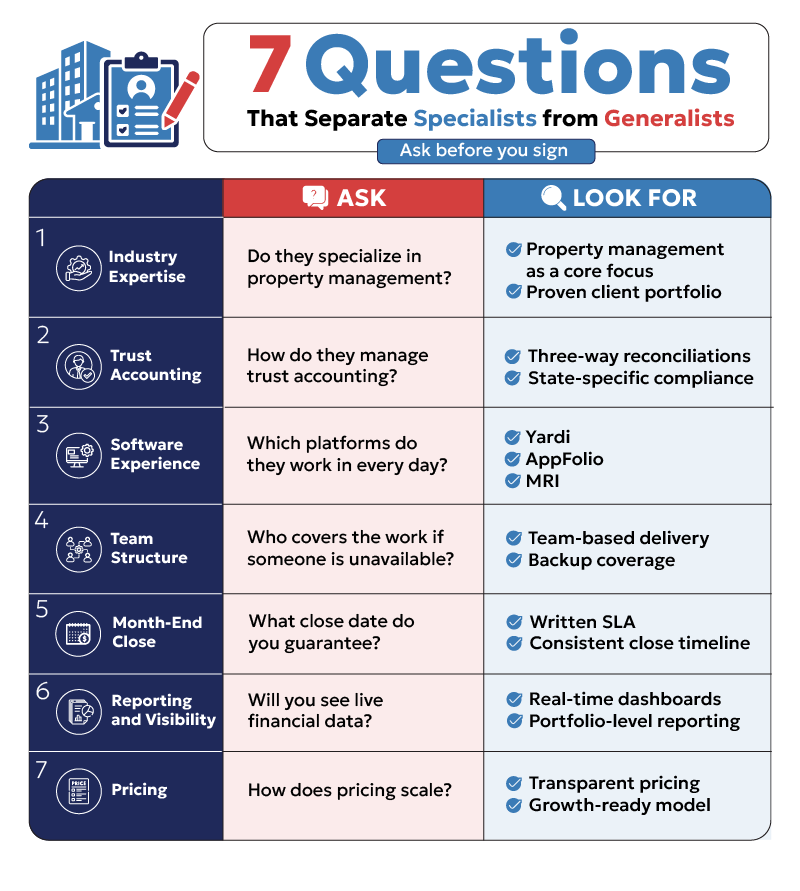
4) Do They Staff Your Account With One Person or a Team?
A single dedicated contact feels reassuring, right up until that person is out during month-end close, or leaves for another job entirely.
This is not hypothetical. A closer look at controller turnover in property management found that replacing a single controller can cost 50% to 200% of their salary.
Outsourcing does not remove this risk on its own. A one-person outsourced account carries the same single point of failure, just with a different name on the invoice. The same pattern shows up in-house, and there are clear signs an accounting function has hit its ceiling.
Ask directly: "What is the backup plan if the dedicated accountant is out for two weeks?" A team-based real estate accounting outsourcing partner has a documented coverage process, while a one-person setup has an apology.
5) What Day Do They Close the Books Each Month, and Is It in Writing?
"Fast close" means nothing without a number attached to it. Ask for the exact business day when the books close, every month, for every property in the portfolio.
A 1,200-unit multifamily portfolio cut its close time from 18 days to 10 business days within 90 days of switching to a specialized, team-based accounting partner. The gain came from a documented process, not from longer hours or a rushed year-end scramble.
A vague promise like "we'll close faster" is not a real commitment. A written service-level agreement names a specific close date and states what happens if the team misses it.
6) Do They Give You Live Numbers, or a Monthly PDF?
A CFO who only sees financials once a month is always deciding on data that is already a few weeks old.
Live dashboards change that math, because the numbers update as the month runs. A commercial property firm managing 45 properties in two states switched from monthly static reports to live Power BI dashboards. The result was nearly 40% more time for strategic work, supported by portfolio-level P&L and built-in variance alerts.
Ask how the reporting really looks day to day. A live dashboard is a different product than a PDF that lands in an inbox once a month, and the difference shows up the first time owner calls with a question.
7) Does Their Pricing Stay Flat as Your Portfolio Grows?
A growing portfolio shows the same pattern every time: unit counts go up, new entities get added, and reporting needs get more complex. Pricing should account for that growth before anyone signs.
Some outsourcing firms price by the hour, with invoices that swing month to month depending on how busy the season gets. Others price by unit count or portfolio complexity, with the scaling built into the agreement from day one.
Ask for a scenario: what does the fee look like at 500 units, and again at 1,000? A partner who can answer both numbers on the spot has priced this before. A partner who needs to "check with the team" has not.
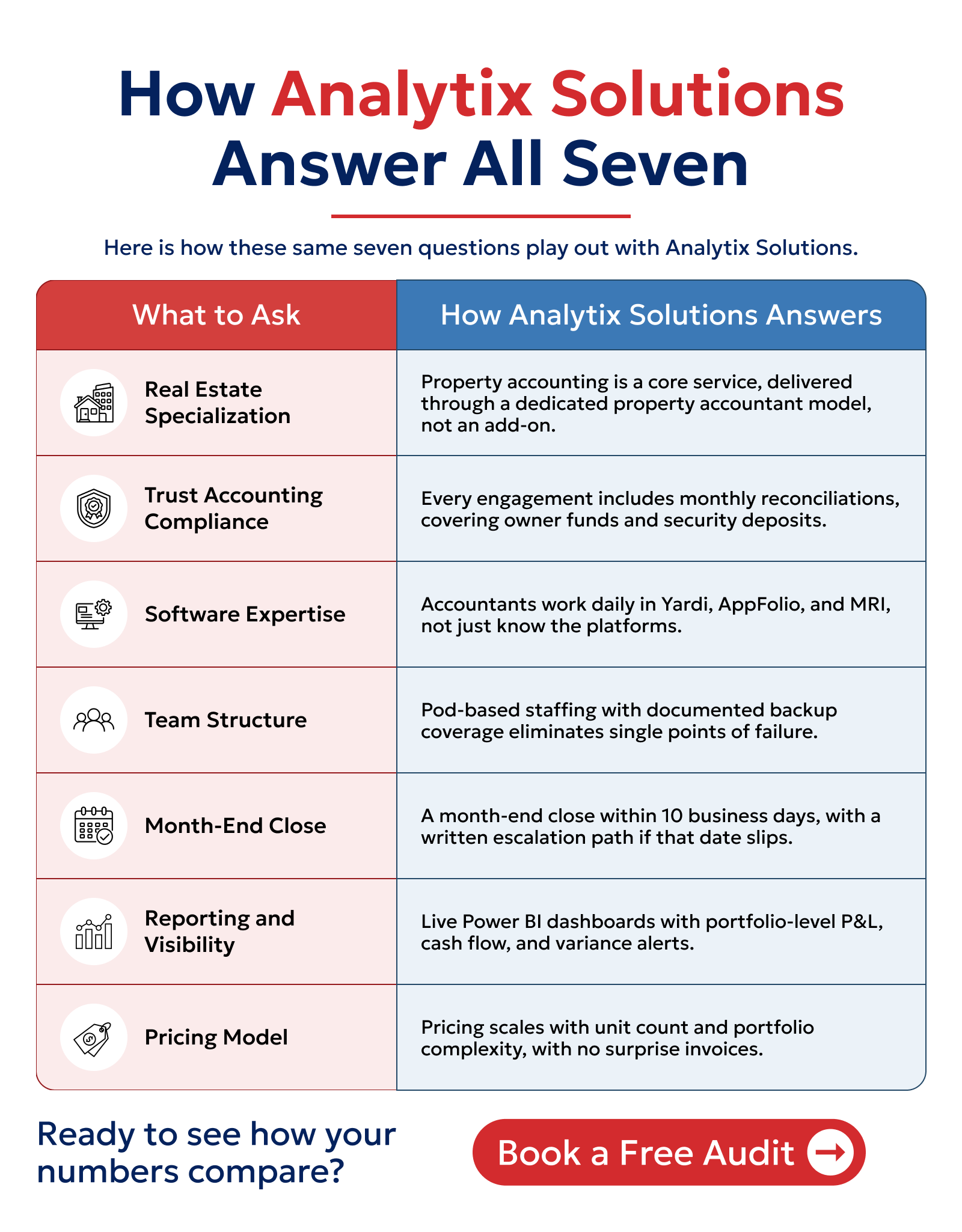
How Analytix Solutions Answer All Seven
Here is how these same seven questions play out with Analytix Solutions.
Before Signing Anything
Seven questions are not much to ask before handing over trust accounts, owner relationships, and month-end close. A firm that welcomes all seven, with specifics instead of talking points, has likely earned the conversation.
A firm that dodges two or three of them has told you something useful.
For a firm managing a growing property portfolio, the choice of accounting partner sets the pace for every owner report, every audit, and every board update that follows. Getting it right the first time costs far less than fixing it the second time.
See Where Your Current Setup Stands
A free property accounting audit checks your current setup against the seven questions above, and returns a written report on what works and what does not.
Book a Free Property Accounting Audit →
Not ready for a call yet? Download the property management accounting capacity checklist to find capacity gaps before they turn into operational problems.
Frequently Asked Questions
1. Que - What am I actually handing over if I sign with a real estate accounting outsourcing partner?
Ans: Real estate accounting outsourcing means handing property-level bookkeeping, trust accounting, and reporting to an outside firm that specializes in property management, rather than a generalist bookkeeper or a new in-house hire.
2. Que - How do I tell a real estate accounting outsourcing partner from a regular bookkeeping firm?
Ans: A specialized partner understands trust accounting law, owner reporting standards, and property management software like Yardi or AppFolio. A generalist bookkeeping firm typically does not carry that depth.
3. Que - How long will my transition to an outsourced accounting partner actually take?
Ans: A typical transition runs 30-60 days, depending on portfolio size and the software already in place.
4. Que - If I outsource my accounting, will I lose visibility into my own numbers?
Ans: The opposite is usually true with the right partner. Real-time dashboards can offer more day-to-day visibility than once-a-month internal report ever did.
5. Que - What should I make sure is written into my service-level agreement with an accounting outsourcing partner?
Ans: A clear close date, a defined next step if that date is missed, a reporting cadence, and a named backup for the dedicated accountant.
6. Que - Will outsourced real estate accounting end up costing me more than my in-house controller?
Ans: A direct salary comparison misses the full picture. Vacancy costs, training time, and turnover risk usually make outsourcing the lower-risk option for a growing portfolio.


.svg)
.svg)