



Around 4 in 10 accounting firms struggle to hire junior-level professionals with more than one year of experience, adding pressure to firms already managing growing client workloads. At the same time, finance and accounting leaders continue to report difficulty filling accounting roles, highlighting how difficult it can be to add qualified capacity through traditional hiring alone.
For CPA firms, the challenge is not simply finding more bookkeeping work. It is finding enough qualified people to perform that work consistently while maintaining the accuracy, turnaround times, and client experience the firm has built its reputation around.
That is where virtual bookkeeping services have become a very practical operating model.
Virtual bookkeeping allows firms to add capacity through a remote team without relying exclusively on local recruiting. But adding people is only part of the equation.
Bookkeeping Growth = Capacity + Quality
Capacity creates room for additional clients and increasing workloads, while quality ensures the work remains accurate, consistent, secure, and delivered on time.
The strongest virtual bookkeeping models address both sides of the equation. They combine experienced professionals with standardized workflows, documented procedures, independent review, secure access controls, clear communication, and visibility into ongoing work.
In this guide, you will learn how virtual bookkeeping services operate, how quality is maintained across growing client portfolios, how virtual and in-house staffing models compare, and what to look for in a provider designed to support long-term growth.
How Virtual Bookkeeping Services Work Day to Day
At a high level, virtual bookkeeping works much like an in-house bookkeeping function.
The difference is not necessarily the work being performed. It is how the firm accesses, manages, reviews, and scales the people performing that work.
Instead of depending entirely on local hiring, a CPA firm can add bookkeeping capacity through a virtual team that works within its existing technology environment and operating procedures.
A mature engagement should feel less like sending work to an outside vendor and more like extending the firm's existing bookkeeping operation.
Virtual bookkeeping teams commonly work within cloud accounting platforms such as QuickBooks Online, Xero, or Sage Intacct. Depending on the engagement, the responsibilities may include:
- Managing bank and credit card feeds
- Coding transactions
- Performing account reconciliations
- Investigating unusual or unclear activity
- Maintaining supporting documentation
- Following client-specific bookkeeping procedures
- Preparing month-end close activities
- Documenting exceptions and open items
- Providing status updates
- Preparing books for review and client delivery
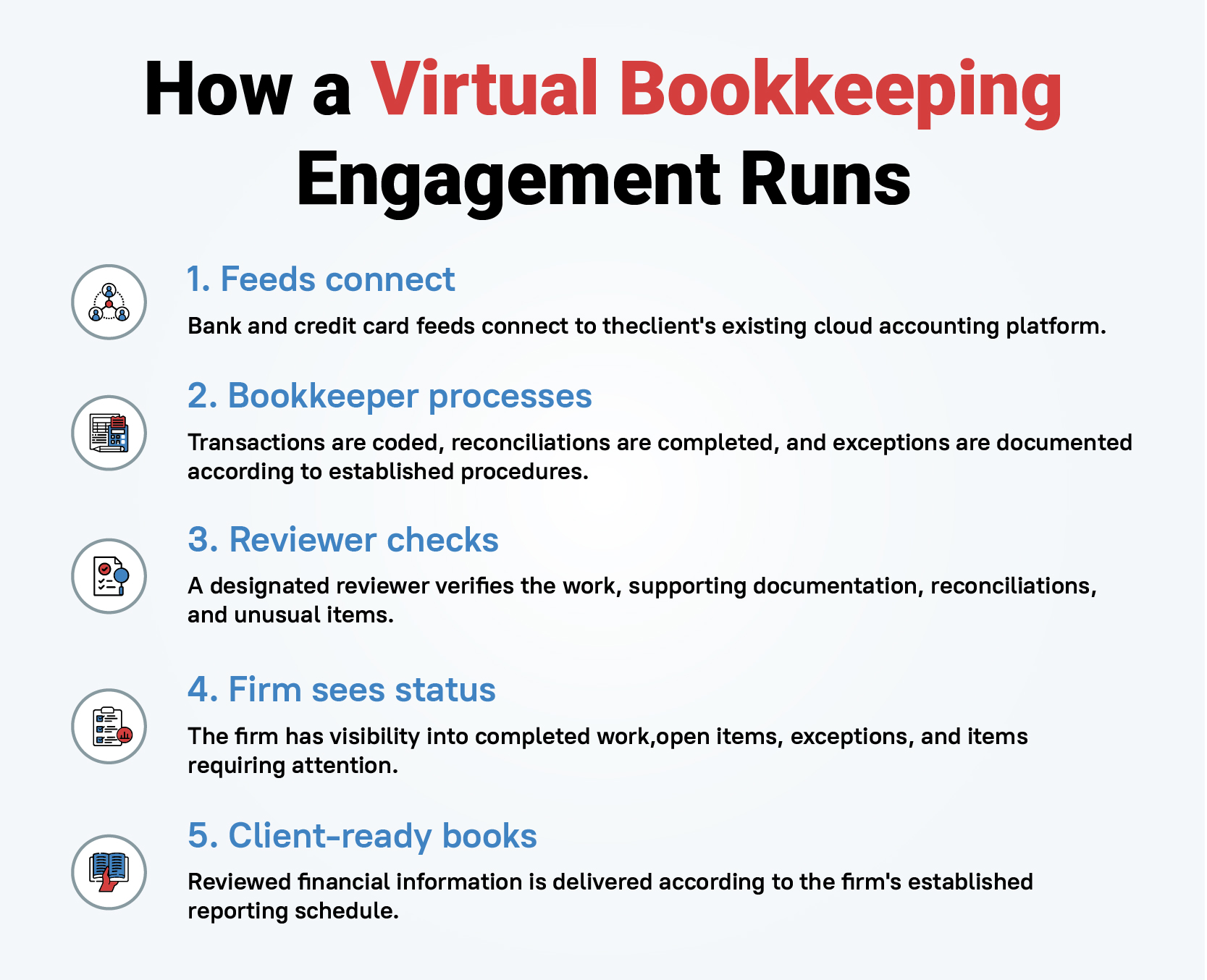
The technology may be familiar. What changes is the firm's ability to access and scale bookkeeping capacity without rebuilding its internal team every time client demand increases.
Why CPA Firms are Turning to Virtual Bookkeeping Services
The business case becomes clearer when viewed against the accounting talent market.
Many firms are not struggling to generate bookkeeping demand. They are struggling to find and retain enough qualified professionals to support that demand.
That challenge is reflected across the profession, with 62% of finance and accounting leaders reporting difficulty filling accountant roles, while the unemployment rate among accountants and auditors stood at just 1.0% in May 2026.
When a firm wins new clients, expands services, or takes on more complex accounts, bookkeeping workload can increase faster than internal staffing capacity.
Traditional hiring can solve that problem, but it is rarely instantaneous. Recruiting, interviewing, onboarding, training, and retaining qualified accounting professionals requires time and management attention. Even after a position is filled, the new employee still needs to learn the firm's systems, workflows, quality expectations, and client preferences.
That creates a capacity gap.
Virtual bookkeeping provides another way to address it.
Rather than treating every increase in workload as a staffing challenge, firms can add virtual bookkeeping support through an established delivery model built for growth.
That distinction matters because the right staffing model should solve more than a short-term backlog. It should help the firm create a repeatable way to absorb growth.
Virtual Bookkeeping vs. In-House Hiring
Virtual bookkeeping does not have to be an either-or decision. A lot of CPA firms use a combination of internal professionals and virtual bookkeeping resources.
The better question is which responsibilities should remain inside the firm, and which can be supported by a remote support team.
The important point is that virtual does not automatically mean better. A poorly managed virtual team can create communication problems, inconsistent work, or knowledge gaps. A well-designed virtual team can provide additional capacity while fitting into the firm's existing processes.
That makes the operating model more important than the physical location of the team.
Two Common Staffing Models for Virtual Bookkeeping Services
Not all virtual bookkeeping providers use the same staffing structure. Two common approaches are shared resources and dedicated teams.
Shared Resource Model
In a shared resource model, bookkeeping professionals support multiple firms or client accounts based on workload, availability, and provider allocation.
The primary advantage is flexibility. Providers can move resources where demand is highest and potentially accommodate short-term fluctuations more efficiently.
The tradeoff can be continuity. If personnel change frequently, firms may experience more handoffs, repeated training, or additional time spent explaining client-specific preferences.
Good fit for firms that:
- Need flexible bookkeeping capacity
- Experience seasonal workload fluctuations
- Have standardized bookkeeping processes
- Need short-term remote support
- Manage relatively straightforward client accounts
- Prefer resource flexibility over continuity
Dedicated Team Model
In a dedicated team model, bookkeeping professionals are aligned with a specific firm or group of client accounts. As the engagement matures, the team becomes familiar with the firm's charts of accounts, reporting requirements, communication preferences, internal review procedures, recurring transactions, industry-specific considerations, and overall expectations.
The primary advantage is continuity. Because the same professionals remain involved over time, firms can benefit from greater familiarity with client needs, fewer knowledge-transfer requirements, and more consistent collaboration.
Good fit for firms that:
- Need consistent, long-term bookkeeping support
- Manage complex client accounts
- Value strong team continuity
- Require client-specific bookkeeping knowledge
- Expect steady portfolio growth
- Prioritize close collaboration and communication
Neither model is universally better.
The right choice depends on the firm's workload, client complexity, growth plans, communication preferences, and need for continuity. But whichever staffing model is used, one principle remains the same: capacity without quality control is not scalable capacity.
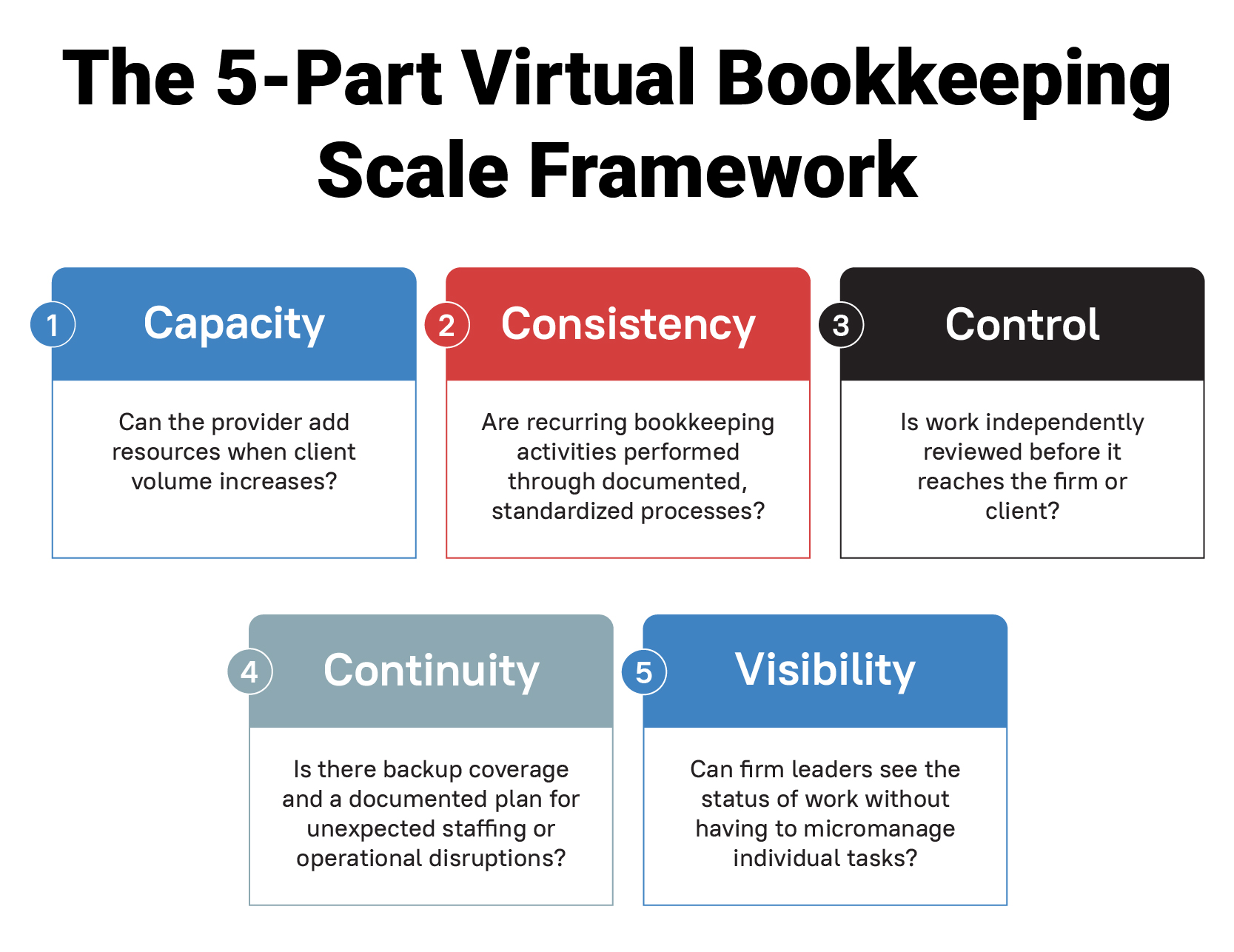
How Virtual Bookkeeping Services Maintain Accuracy at Scale
Supporting multiple clients is not always difficult.
Supporting multiple clients consistently and accurately as volume increases is the real challenge.
As a client portfolio grows, transaction volumes increase, reporting requirements become more varied, and exceptions become harder to manage through informal processes.
The strongest virtual bookkeeping environments do not rely on individual memory or heroic effort. They use systems designed to make quality repeatable.
1. Standardized Workflows Create Consistency
Growth puts pressure on consistency. The more client accounts a team manages, the harder it becomes to rely on individual habits and still produce the same quality of work across every account.
Standardization also makes work easier to transfer.
If a team member is unavailable, another qualified professional can follow the documented process instead of relying on informal knowledge. That creates an important scalability advantage.
2. Independent Review Helps Catch Errors Before Delivery
Even experienced bookkeepers can occasionally miscode a transaction, overlook a reconciling item, or miss an unusual charge.
The objective should not be to pretend errors never happen. The objective is to build a process that identifies and resolves them before they become client-facing problems.
A meaningful review process may examine:
- Account coding
- Reconciliation completion
- Supporting documentation
- Unusual transactions
- Unsupported entries
- Significant balance changes
- Recurring error patterns
- Items requiring clarification
Separating preparation from review creates a second layer of accountability.
3. A Two-Layer Review Creates Accountability
A strong quality-control structure can be represented simply:
Layer 1: Bookkeeper
Processes transactions, performs reconciliations, maintains documentation, and flags unusual activity.
Layer 2: Reviewer
Independently checks the work, verifies supporting information, evaluates flagged items, and confirms that required procedures have been completed.
Result
Clients get reviewed books. This separation of responsibilities matters because the person performing the original work is not the only person responsible for determining whether that work is ready for delivery.
4. Exception Management Prevents Escalation
Not every transaction deserves the same level of attention. A recurring subscription may follow an established pattern, while an unusual vendor payment may require investigation. Mature bookkeeping teams therefore need an exception-management process.
For example:
Normal activity → Process according to standard workflow
Unusual activity → Flag
Question identified → Investigate
Clarification required → Escalate
Resolution documented → Complete
This approach allows teams to apply human attention where it matters most without treating every transaction as an exceptional event. It also creates a documented history of how unusual items were resolved.
5. Visibility Helps Firms Maintain Oversight
Quality control is stronger when firms can see what is happening.
A virtual team does not provide the same physical proximity as an employee sitting down in the hall, so visibility needs to be created intentionally. Shared dashboards, workflow tracking, status reports, open-item lists, documented notes, escalation queues, and completion reporting can all contribute to that visibility.
Firms already using dashboards and reporting built for business analytics tend to extend the same expectation to their virtual bookkeeping engagements.
A good visibility system should make it easy to identify:
- What has been completed
- What is still open
- What is waiting on the firm
- What is waiting on the client
- Which accounts require attention
- Whether deadlines are at risk
6. AI Can Support Bookkeeping Without Replacing Accounting Judgement
AI-assisted bookkeeping tools are increasingly being used to identify anomalies, flag unusual transactions, highlight missing information, and surface reconciliation exceptions. Used correctly, these tools can help teams identify potential issues faster.
But automation should support accounting judgment rather than replace it. A mature process looks more like:
Automation → Exception detection → Human evaluation → Documented decision → Review
The technology helps determine where attention is needed. Qualified professionals remain responsible for evaluating the situation and making the appropriate accounting decision.
7. Communication Procedures Support Accuracy
Communication problems can become accounting problems. An unanswered question about a transaction can delay reconciliation. Missing supporting documentation may delay month-end close activities, while unresolved classification issues can affect reporting accuracy.
A defined communication cadence helps prevent small questions from becoming larger operational problems.
Daily
- Flagged exceptions
- Unusual transactions
- Time-sensitive questions
Weekly
- Open-item status
- Items awaiting firm input
- Scope or volume changes
Monthly
- Close package review
- Reporting walkthrough
- Upcoming priorities
The exact cadence can vary by firm. What matters is that expectations are established before problems arise.
8. Secure Access Controls Protect Client Information
Virtual bookkeeping involves access to sensitive financial information, so security needs to be considered alongside accuracy and capacity.
Firms should understand how a provider manages:
- User access
- Multi-factor authentication
- Role-based permissions
- Least-privilege access
- Data transfer
- Audit logging
- Access removal
- Data retention
- Incident response
- Business continuity
Security requirements will vary by provider and engagement, but firms should not have to guess how client information is protected.
The Operational Impact of Virtual Bookkeeping Services
Firms also need to understand what changes operationally when bookkeeping capacity is added through a virtual team. The objective is not to replace the firm's existing professionals. It is to distribute work more strategically.
Routine transaction processing, reconciliations, recurring bookkeeping activities, and backlog cleanup can be handled by the delivery team, while internal professionals spend more time on work requiring judgment and client interaction.

That shift can change how the firm uses its most valuable internal capacity.
1) Internal Capacity Shifts Toward Higher-Value Work
Bookkeeping can consume significant professional time when internal accountants are responsible for every transaction, reconciliation, cleanup task, and follow-up.
Virtual support can move much of that recurring workload to a dedicated delivery team. Internal professionals can then focus more heavily on:
- Reviewing exceptions
- Client communication
- Advisory services
- Financial analysis
- Tax-related coordination
- Relationship management
- Practice development
- Higher-level financial oversight
This can become particularly valuable during tax season, as competing deadlines often stretch internal capacity. The objective is to use professional capacity where professional judgement creates the greatest value.
2) Ownership and Accountability Stay with the Firm
Adding a virtual team does not transfer the firm's responsibility for client relationships. The firm remains responsible for:
- Client communication
- Reporting expectations
- Service standards
- Professional oversight
- Engagement management
- Final review requirements
The virtual team supports execution. That distinction should be clear from the beginning of the engagement. A strong provider should be able to explain exactly where its responsibilities start and finish, while clearly defining how those responsibilities align with the firm's internal team.
3) Clients Often Experience the Difference First
Clients may never know exactly where bookkeeping work is performed. What they notice is whether the service is accurate, timely, and reliable.
A well-managed virtual bookkeeping team can help maintain consistent reporting schedules, resolve reconciliation issues earlier, and respond to questions more quickly. As client workloads grow, this consistency can help prevent reporting delays and maintain service standards.
These improvements happen behind the scenes but can directly influence client satisfaction and client retention.
Signs a Virtual Bookkeeping Provider Is Built to Scale
Choosing a virtual bookkeeping provider is more than adding people to handle growing workloads. As client volume increases, the provider should be able to maintain the same standards for accuracy, continuity, communication, and oversight. That requires systems that can support growth without making the firm increasingly dependent on individual employees.
The following signs can help CPA firms evaluate whether a provider has the processes, controls, and infrastructure needed to scale virtual bookkeeping support reliably.
1. A Defined Review Process
Every engagement moves through documented quality checks before work reaches the firm or client.
2. Knowledge Is Retained Beyond Individuals
Client procedures, bookkeeping workflows, and account-specific knowledge are documented rather than residing exclusively with one employee.
3. Backup Coverage Exists
The provider can explain who steps in when the primary bookkeeper is unavailable.
4. Business Continuity Is Documented
The provider has a defined plan for protecting data and maintaining service during unexpected disruptions.
5. Workflows Are Standardized
Recurring tasks, deadlines, escalation procedures, and review requirements follow documented processes.
6. Capacity Can Increase Without Starting Over
The provider can add clients, entities, or transaction volume without repeatedly rebuilding the entire delivery model.
7. Visibility Is Built Into the Engagement
The firm receives structured reporting and status visibility rather than having to request routine updates.
8. Industry Experience Is Relevant
The provider understands that bookkeeping requirements can vary significantly between professional services, construction, healthcare, real estate, nonprofit, retail, and other industries.
Build Capacity Without Compromising Quality
Bookkeeping capacity problems rarely come from a single issue. They often result from hiring constraints, growing client demand, inconsistent processes, limited visibility, and review structures that struggle to keep pace.
The answer is not simply adding more people. It is building a repeatable operating model supported by standardized workflows, independent review, clear accountability, secure access, consistent communication, and measurable visibility.
The right virtual bookkeeping partner should provide more than additional hands. It should provide a reliable system for turning capacity into consistent, accurate, client-ready work.
Capacity creates the opportunity to grow. Quality determines whether that growth is sustainable.
Connect with the team to explore how virtual bookkeeping support can strengthen your firm's capacity while maintaining the quality and oversight your clients expect.
Frequently Asked Questions
How quickly can a virtual bookkeeping team get started?
Most providers follow a structured onboarding process that includes system access, workflow documentation, and process training. Timelines vary, but the goal is to integrate into existing operations with minimal disruption.
Will we lose control of the bookkeeping process?
No. Firms retain ownership of client relationships, reporting standards, review requirements, and overall oversight while the virtual team supports day-to-day bookkeeping execution.
How is bookkeeping accuracy maintained at scale?
Accuracy is supported through standardized workflows, documented procedures, independent reviews, and consistent quality controls designed to reduce errors across multiple client accounts.
Can a virtual bookkeeping team handle seasonal workload spike?
Yes. Many firms use virtual bookkeeping support to manage busy periods, absorb additional workload, and maintain reporting schedules without overloading internal teams.
How do we know if a provider can scale with our firm?
Look for documented review processes, team continuity, standardized workflows, clear communication practices, and the ability to add capacity without disrupting service quality.
What is the biggest benefit beyond cost savings?
For many firms, the biggest benefit is gaining reliable capacity. This allows internal teams to spend more time on client relationships, advisory work, and growth-focused initiatives.


.svg)
.svg)