

Outsourced Bookkeeping Services: What CPA Firms Should Expect to Pay and Get



CPA firms rarely start by asking whether bookkeeping should be outsourced. By the time a firm leader searches for outsourced bookkeeping services, the question has already narrowed to something more practical.
- How much support does the firm actually need?
- What should it cost?
- What should the firm expect to get in return?
Those questions become more important as client volume grows, and internal capacity starts to tighten. A provider may offer a low monthly fee, but that number means little without knowing what work is included, who reviews it, how quickly questions are answered, and what happens when volume increases.
This guide focuses on those practical details, so firms can compare providers on more than price alone.
By the end of this guide, you will be able to evaluate and interview a bookkeeping provider with a clear understanding without getting pulled into tax strategy or controller-level advisory work. For a firm evaluating outsourced bookkeeping services for the first time, that scope detail matters more than the sticker price on a proposal.
What Outsourced Bookkeeping Services Actually Include
Pricing only makes sense once a firm knows what it is buying. Providers use similar language, but the work behind that language varies more than most buyers expect. The difference usually comes down to how much of the recurring work the provider takes on, how often it is reviewed, and where the provider's responsibility ends.
Core Bookkeeping Responsibilities
Standard outsourced bookkeeping services generally cover the recurring work that keeps a client's book current and ready for review.
- Transaction coding
- Bank reconciliations
- Credit card reconciliations
- General ledger maintenance
- Month-end bookkeeping
- Financial reports
The important question is not simply whether a provider offers these services, but how much of each task is included. For example, “reconciliations” may mean completing them each month, while another provider may include exception follow-up and correction support as part of the same service.
What Is Usually Not Included
Some services are typically outside the scope of bookkeeping, even if they are available as separate add-ons.
- Controller oversight
- Tax strategy
- Audit support ownership
- Firm management consulting
Ask the provider to clearly define in writing what is included in the bookkeeping scope before signing anything. If your firm also needs controller review or CFO-level reporting, make sure those services are identified separately, with their own scope and pricing.
Why Scope Drives Price
The monthly fee for outsourced bookkeeping is largely determined by how much work the provider is responsible for completing and supporting. Basic bookkeeping engagements may cover transaction coding and standard reporting. More comprehensive engagements often add reconciliations, month-end close support, quality reviews, a dedicated point of contact, and defined turnaround commitments.
For example, two firms may pay different fees despite having similar transaction volumes. One engagement may cover only routine bookkeeping tasks, while the other includes a documented review process, faster response times, and greater day-to-day support. As the scope expands, the time, oversight, and resources required to deliver the service increase as well.
That distinction becomes particularly important when a firm is evaluating proposals. Comparing monthly fees without comparing what is included can lead to misleading conclusions. Understanding the scope first allows firms to assess pricing in the context of the actual support being provided.
How Much Do Outsourced Bookkeeping Services Cost?
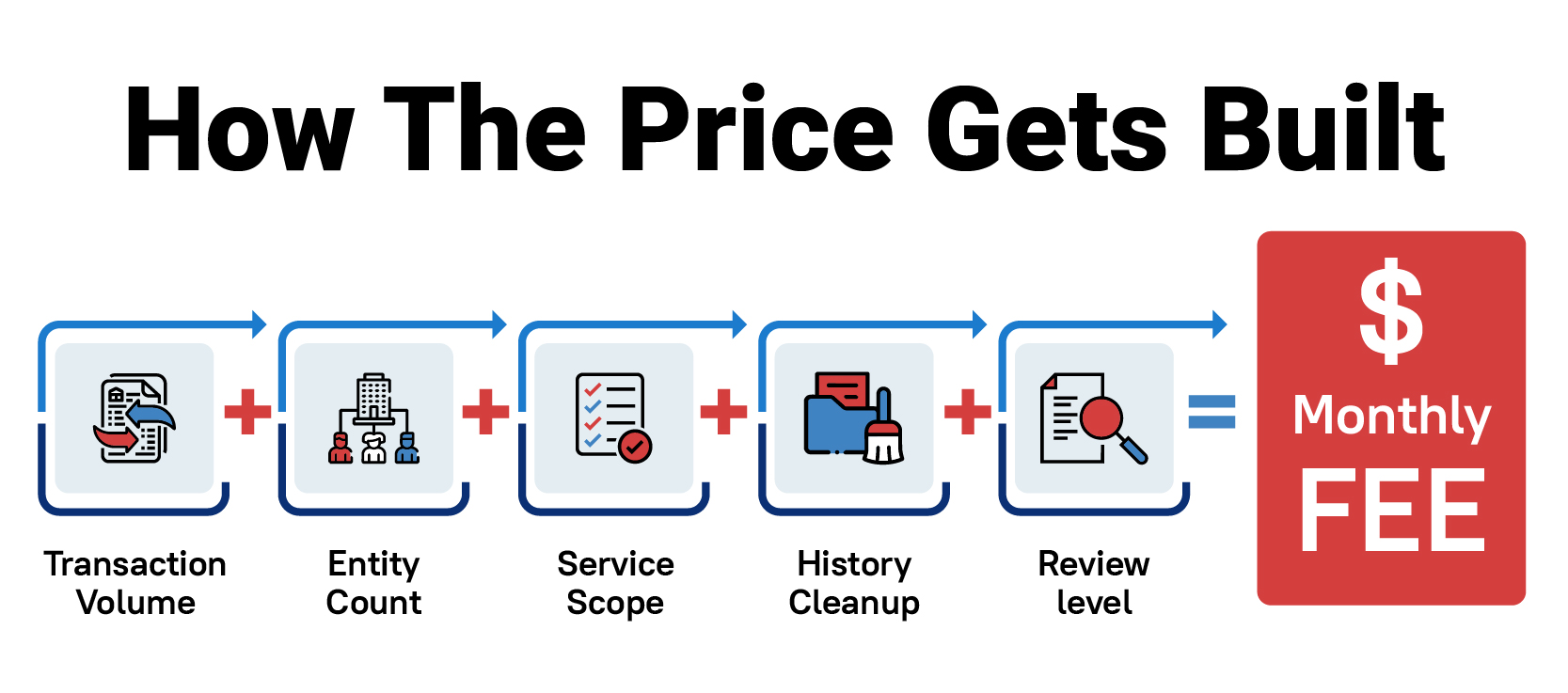
Outsourced bookkeeping costs vary widely because no two firms require the same level of support. Monthly fees are typically influenced by these five factors. As a result, two firms of similar size can receive very different quotes for what appears to be the same service.
Rather than focusing solely on the price itself, it is often more useful to understand the factors that drive it.
The Five Pricing Variables
1) Transaction volume
More transactions generally mean more coding, reconciliation and exception work. Ask providers to define the transaction assumptions behind the quoted price.
2) Number of entities or clients
A single straightforward entity is very different from a client with several entities, bank accounts, and credit cards. Make those assumptions visible in the proposal.
3) Service scope
Coding alone carries a different workload from coding plus reconciliations, month-end close, exception follow-up, and review sign-off.
4) Historical cleanup
Catch-up or cleanup work is often priced separately from recurring monthly bookkeeping. Confirm whether the proposal assumes clean books at transition.
5) Review level
A second review layer adds work, but it also changes what the firm receives. Ask who reviews the books, what they check, and when the review happens.
Choosing the Right Bookkeeping Support Level
Exact rates vary by provider and region, but this pattern holds across most outsourced bookkeeping services in the market today.
1. Small Firms
Best fit: Basic support
If the firm has one or two entities and bookkeeping is mainly a recurring maintenance task, the basic tier is usually the starting point.
Look for:
- Transaction coding
- Bank and credit card reconciliations
- Monthly financial reports
- A predictable monthly schedule
Choose this level if: the firm needs dependable bookkeeping capacity but does not need a dedicated resource, complex reporting, or accelerated turnaround.
The priority here is consistency. The provider should keep the books current and ready for review without adding another layer of management for the firm.
2. Growing Firms
Best fit: Standard support
This level makes sense when bookkeeping is becoming harder to manage as the client roster grows. The firm may still have straightforward accounting needs, but volume and deadlines now require more structure.
Look for:
- Month-end close support
- General ledger maintenance
- A named reviewer
- A defined escalation process
- Clear turnaround expectations
Choose this level if: the firm is spending more time managing bookkeeping; open items are carrying into the next month, or one person is becoming a bottleneck.
The added review and accountability create more capacity without moving the firm into a full-service arrangement it may not yet need.
3. Large and Scaling Firms
Best fit: Full-service support
A growing CPA firm needs more than additional bookkeeping capacity. It needs a setup that can maintain consistency across higher transaction volumes, a larger client roster, and increasing reporting demands.
Look for:
- A dedicated resource
- Faster turnaround
- Financial statement preparation
- Consistent processes across clients
- Expansion-ready support
Choose this level if: bookkeeping delays are affecting client capacity; internal staff are spending too much time coordinating work, or the firm needs support that can scale with continued growth.
At this stage, the question is less about adding bookkeeping capacity and more about building a reliable operating layer around it.
Once the appropriate level of support is identified, the next step is evaluating its cost in context.
Why Lowest Cost Often Is Not Lowest Effort
A full-time in-house bookkeeper carries a median salary of $53,560 a year, according to the BLS reports. That figure sits before payroll, tax, benefits, software, training, and the weeks a role sits open while the firm keeps interviewing. A firm weighing that math against a monthly fee can find the fuller picture in outsourced bookkeeping for CPAs.
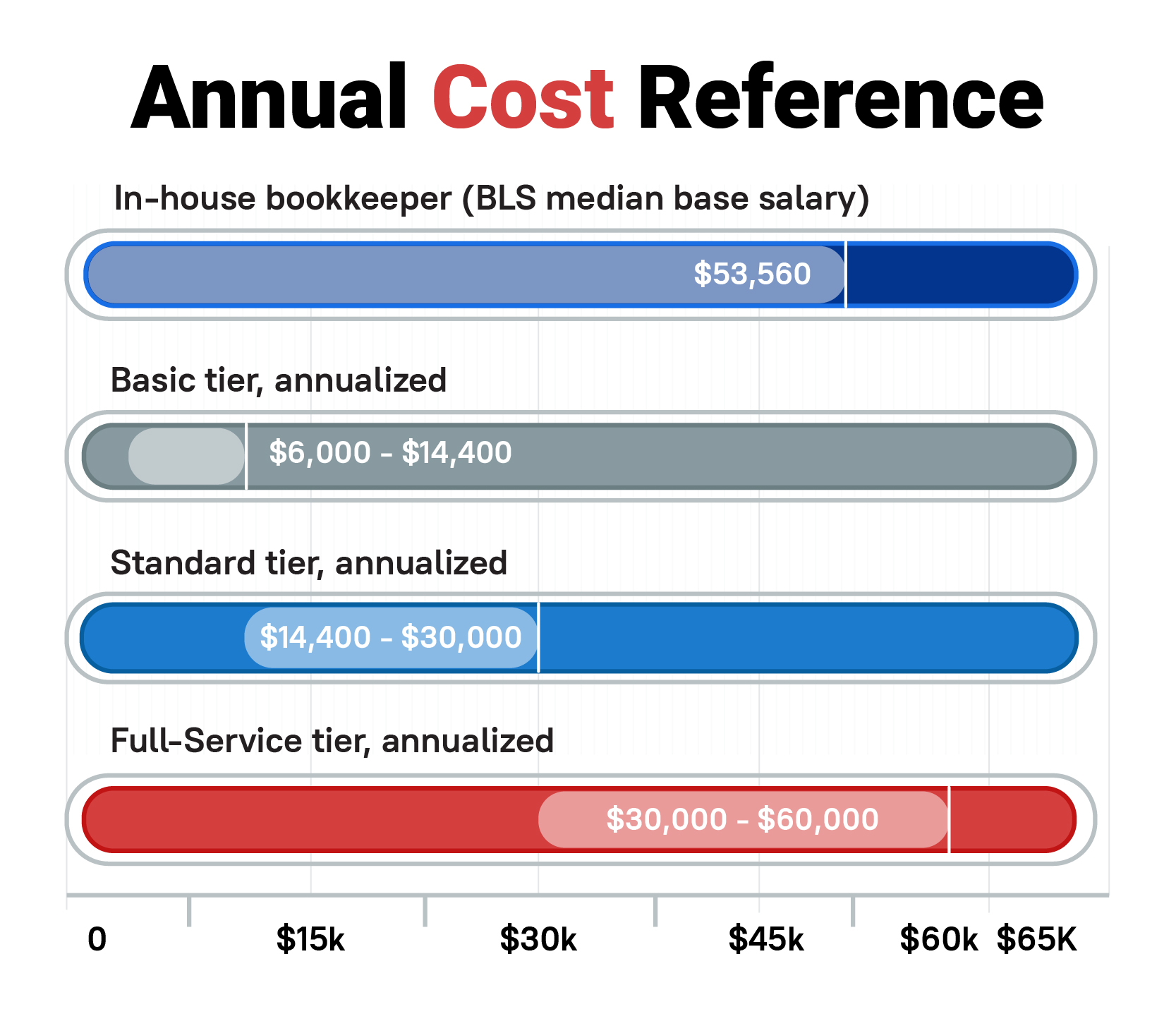
A lower monthly fee sometimes means a lighter review standard, and that gap often shows up later as rework. A firm chasing the lowest bid should look closely at what gets caught before a client sees it. That number matters more than the line on the invoice.
How Bookkeeping Support Works Day-to-Day
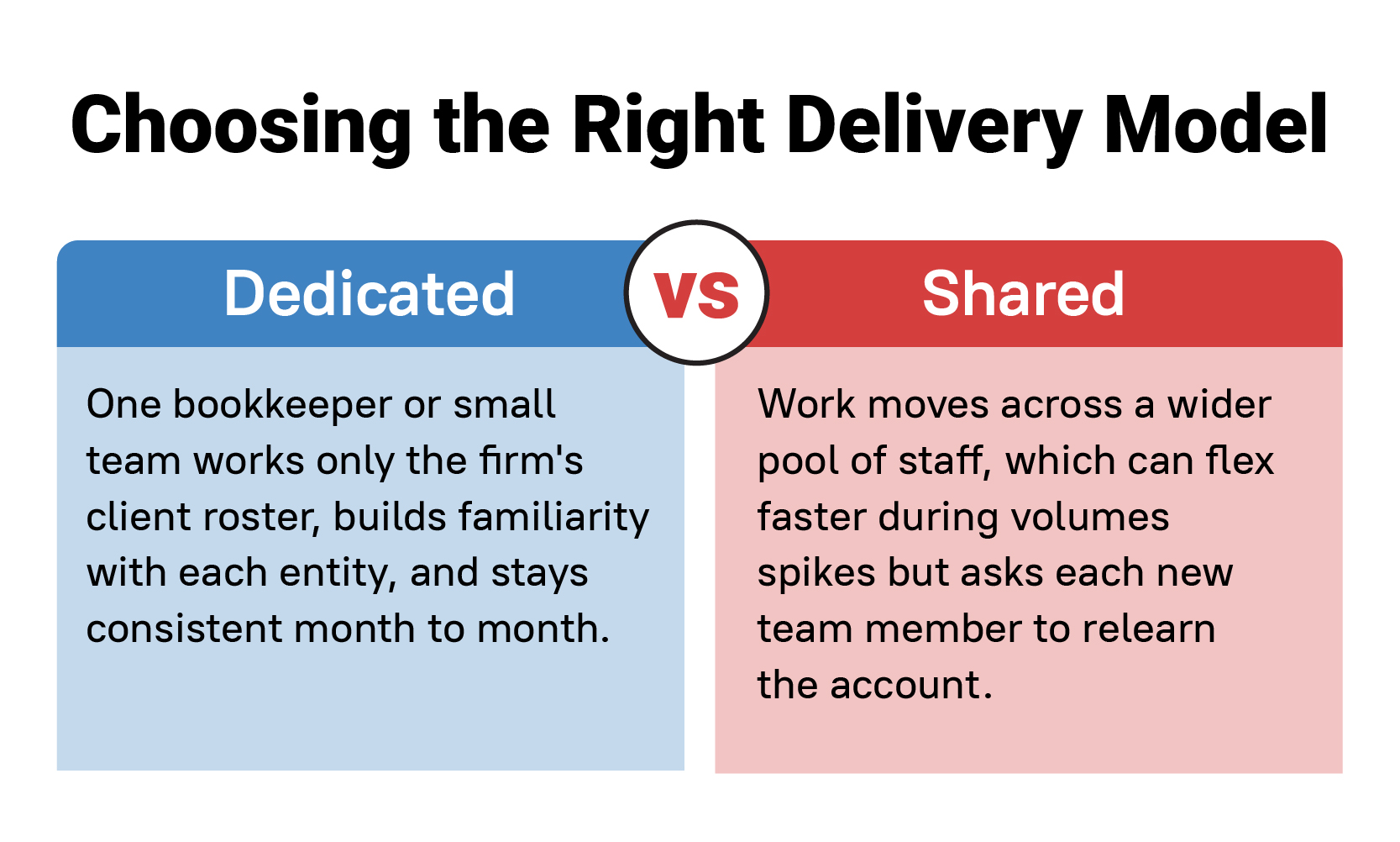
Firms that already understand scope and cost want to know what the relationship actually feels like once work begins.
Firms that are still weighing this option against an internal hire can use a decision framework for a clearer side-by-side comparison.
Communication Expectations
A clear communication cadence helps the firm know what to expect and prevents small issues from sitting unresolved.
- Daily: Flagged exceptions and unusual transactions that need a quick answer.
- Weekly: A short status check on open items and anything waiting on the firm.
- Monthly: A close package and a review call to walk through the numbers.
Turnaround Expectations
Do not accept vague language such as “timely support.” Put service levels into the engagement terms. The exact target should match scope, but a proposal should clearly state expected timing for bank reconciliations, month-end close, corrections and reporting requests.
A provider that cannot clearly commit to turnaround times like these may also struggle to keep pace as a firm grows, especially when its back office lacks the capacity to scale.
How Quietly Control Works Without an In-House Bookkeeper
One of the most common questions CPA firm leaders ask is how quality is maintained once bookkeeping work moves outside the firm. It is a reasonable concern. Handing off recurring bookkeeping responsibilities only makes sense if there is a clear process for reviewing and validating the work before it reaches the client.
The Review Layer
A second, credentialed reviewer checks entries against source documents before anything reaches the firm. The review should cover more than obvious data-entry mistakes. It should also catch unusual transactions, missing reconciliations, inconsistent account coding, and items that do not match the client's normal activity.
The reviewer should have enough separation from the person doing the bookkeeping to provide a genuine second set of eyes. This is what separates a documented quality-control process from one bookkeeper working alone with no backup or formal review.
Documentation and Process Controls
A strong provider works from a written standard operating procedure and a consistent chart of accounts for every client. The process should explain how transactions are coded, reconciliations are completed, month-end tasks are handled, and exceptions are documented.
This creates consistency even when the regular bookkeeper is unavailable, or a client's transaction volume changes suddenly. Strong providers should also use appropriate data security controls and established systems, so financial information is handled consistently, access is controlled, and the same process is followed from month to month.
Escalation Procedures
Something will eventually look off, whether it is a transaction that does not match the client's normal pattern, a reconciliation difference, or a balance that will not tie out. A defined escalation path should make clear who reviews the issue first, when it is raised to the firm, and how quickly a response is expected.
It should also explain how open questions are tracked until they are resolved. Without that structure, unusual items can sit unresolved or move forward without the firm's knowledge, creating avoidable rework later.
Signs an Outsourced Bookkeeping Relationship Is Working
These signs often show up before a firm can put a number on the improvement.
- You spend less time chasing updates
- Month-end close becomes more predictable
- Questions get answered faster
- Fewer corrections appear later
These improvements are often visible in the day-to-day workflow before they appear in formal reports. A close that once ran long begins landing on the same date each month. A question sent on a Tuesday receives an answer by Thursday instead of waiting until the following week.
These small changes are often the clearest signs that the process is working as it should.
Red Flags to Watch for in an Outsourced Bookkeeping Provider
Once scope, pricing, workflow, and quality control are clear, the risks are easier to spot.
1) Bookkeeping relies heavily on one person, with no documented backup.
2) There is no documented review process before work reaches the firm.
3) Pricing stays vague or shifts after the engagement starts.
4) Work remains heavily spreadsheet-driven with little system consistency.
5) Turnaround expectations are undefined or change from month to month.
6) The provider cannot explain its own escalation procedures.
The goal is not to find a provider with no limitations, but to understand how those limitations could affect the firm. Understanding these risks helps narrow the field. The next step is evaluating providers to determine which model, process, and level of support best fits your firm.
How CPA Firms Should Compare Outsourced Bookkeeping Proposals
Wrapping Up
Outsourced bookkeeping services exist to build consistency, visibility, and capacity. Cost is one part of that decision, not the whole of it. They sit inside the wider category of outsourced accounting services, but pricing and scope work differently once tax, controller, and advisory support get added to the mix.
The real questions go beyond the price tag. They cover what work is actually included, how the relationship runs week to week, and how quality holds up once the first few months pass.
Frequently Asked Questions
How much does outsourced bookkeeping cost for a CPA firm?
Outsourced bookkeeping typically costs $500 to $5,000 per month, depending on transaction volume, number of entities, reporting requirements, service scope, and the level of review and support required.
What is included in outsourced bookkeeping services?
Standard outsourced bookkeeping typically includes transaction coding, bank and credit card reconciliations, general ledger maintenance, month-end bookkeeping, and financial reports. Tax strategy, controller services, and CFO advisory are generally separate.
Is outsourced bookkeeping worth it for a growing CPA firm?
It can be valuable when client volume is increasing and internal bookkeeping capacity is becoming a constraint. The decision should be based on the capacity gained, quality controls, management time and total cost.
How quickly can an outsourced bookkeeping provider complete month-end close?
A reasonable expectation is 7 to 10 business days after month-end, depending on scope and tier. Providers should define turnaround times clearly and commit to them in writing.
How do outsourced bookkeeping providers maintain quality and accuracy?
Strong providers use documented procedures, consistent charts of accounts, and a second review before work reaches the firm. Clear escalation procedures also help resolve unusual transactions or unresolved items.
How do CPA firms choose the right outsourced bookkeeping provider?
Compare providers based on service scope, pricing, turnaround times, review procedures, communication, and scalability. The right provider should meet current bookkeeping needs while supporting additional client volume as the firm grows.


.svg)
.svg)