

Accounting Staff Shortage: 5 Warning Signs Your Firm Has Hit Its Capacity Ceiling



A firm may be facing this problem if it is:
- Struggling to fill accounting roles that have been open for months
- Watching the team work longer hours while the backlog keeps growing
- Delaying new client onboarding because there is not enough capacity
- Spending partner time reviewing work instead of growing the firm
This is not a temporary hiring problem. This is the accounting staff shortage reshaping how accounting and CAS firms operate.
It usually starts with small issues that do not seem like a big deal at first. You postpone a client onboarding, reviews begin taking longer, and advisory work gets pushed aside because everyone is focused on keeping up with daily client work.
Before long, those temporary adjustments become the way a firm operates. The real cost is not the open position. It is the clients a firm cannot take on. It is the revenue left behind, and the growth passed up because the team is already at full capacity.
Each of those decisions is defensible on its own. Stacked together, they describe a firm that has quietly stopped growing on purpose.
If this sounds familiar, a firm may have already reached its capacity ceiling without realizing it. This guide covers five warning signs that the accounting staff shortage has become more than a hiring challenge. It also offers a simple way to check whether a firm still has room to grow.
Before going deeper, here is the short version. If several of these patterns already look familiar, the problem is no longer a hiring cycle.
Those signs rarely arrive together. They build one quarter at a time, which is what makes them easy to explain away until client service starts slipping.
The Small Decisions That Build a Capacity Ceiling
A capacity ceiling is the point where a firm's delivery workload matches everything its current team can produce at an acceptable quality standard. Past that point, adding a client does not add revenue. It moves work from one queue to another.
A capacity ceiling rarely announces itself. It shows up as a series of small, reasonable-sounding decisions.
- Push a reconciliation to next week
- Tell a prospect the firm can onboard them "after busy season"
- Let a senior accountant carry two extra clients since the new hire has not started
Each decision is defensible on its own. Stacked together, they describe a firm that has quietly stopped growing on purpose.
The accounting staff shortage did not create this pattern. It made the pattern permanent. A firm short two staff accountants once expected to fill both roles within a quarter. Today that same opening competes against a shallower pool of experienced candidates while retirements pull senior people out at the other end.
So the problem is no longer a hiring delay. It is a structural gap between the work coming in and the trained people available to do it. That gap does not close because a partner works a few more Saturdays.
The 5 Warning Signs Your Firm Has Already Hit the Ceiling
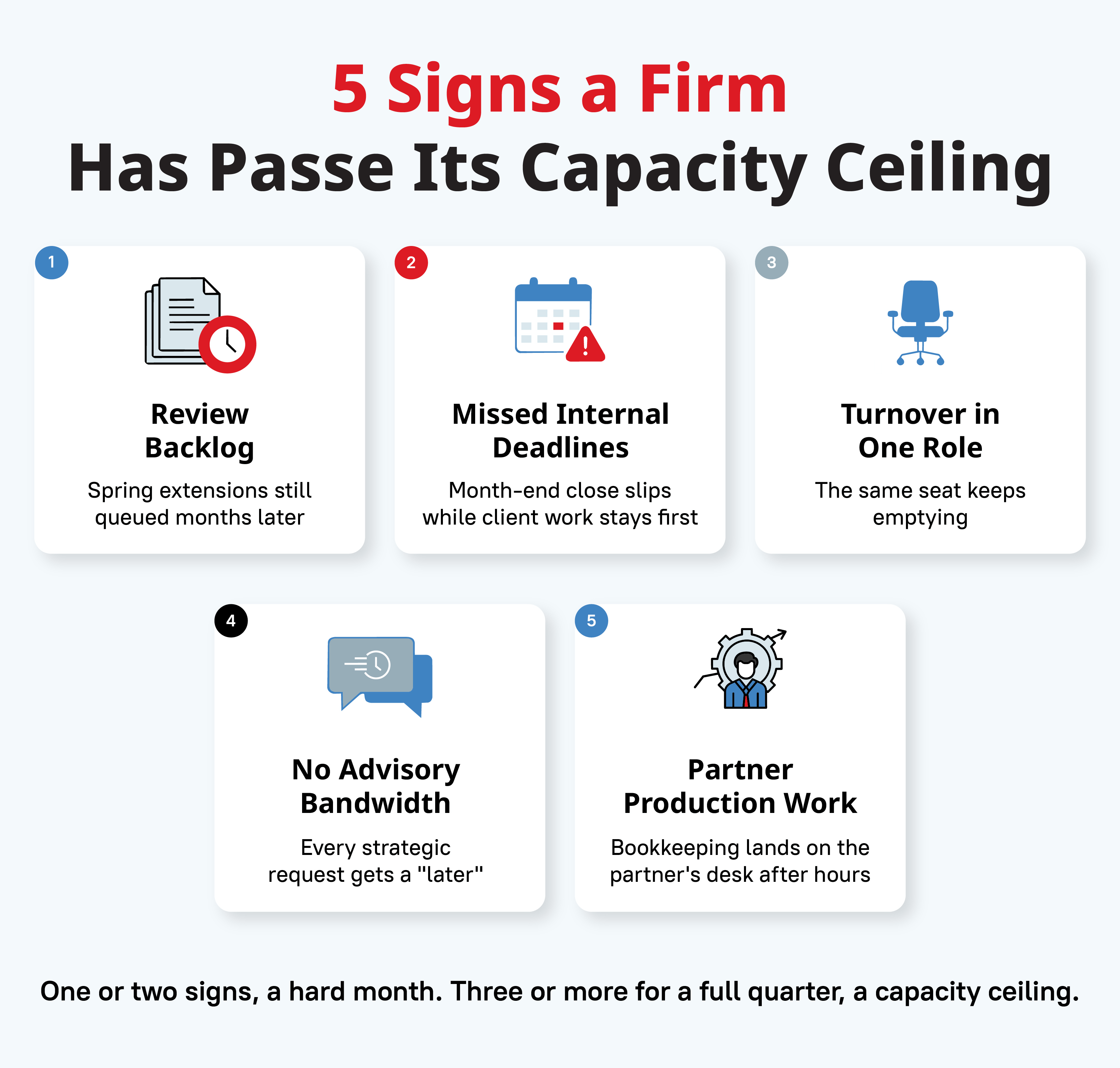
Every firm hits a rough patch during the busy season. The five signs below describe something different: a capacity problem that persists after the deadline passes.
1) Review Backlog That Outlives the Deadline
Extensions filed in the spring are still sitting in the review queue months later, with no clear completion timeline. What started as a busy-season backlog becomes a year-round bottleneck. It delays client deliverables and keeps the team in a constant catch-up cycle.
2) Missed Internal Deadlines, Not Just Client Ones
Month-end close slips by a week. Reconciliations pile up. Routine accounting work keeps getting pushed behind urgent client requests. When internal deadlines are consistently missed, the team's workload has exceeded its available capacity. Controller-level oversight is usually the first thing to go, because nobody outside the firm notices right away.
3) Staff Turnover Concentrated in One Role
The same position, whether a senior accountant or a bookkeeping lead, keeps becoming vacant. Every departure takes client knowledge, established workflows, and months of training with it. The remaining team shoulders a heavier workload.
4) Zero Bandwidth for Advisory Work
Clients ask for cash flow forecasting, key performance indicator (KPI) reviews, or strategic guidance, but the answer is always "later." When a team spends all its time on compliance work, high-value advisory services become difficult to grow.
5) A Partner Still Doing Production Work at Night
Bookkeeping, reconciliations, and return preparation that should belong to the team keep landing on the partner's desk after hours. When firm leaders are buried in production work, they spend less time on growth, client relationships, and strategy.
One or two of these signs might just mean a hard month. Three or more, showing up together for a full quarter, usually means a firm is past its capacity ceiling. Hiring one more person will not resolve the underlying accounting staff shortage driving it.
Why Hiring Alone Rarely Closes the Gap
Hiring feels like an obvious solution to an accounting staff shortage. And in many cases, it should be part of the answer. The problem is that hiring alone rarely increases capacity fast enough to keep pace with the work already coming in.
While you are recruiting, client work does not slow down. Reviews still need to be completed, month-end closes still have deadlines, and advisory requests continue to arrive. Existing staff absorb the extra workload, which increases pressure across the team.
Over time, that pressure creates a cycle that is difficult to break:
- Existing employees take on more work while the position remains open
- Review backlogs and client requests continue to grow
- Stress and burnout increase as the workload keeps piling up
- Team members begin looking for opportunities with better work-life balance
- Another position opens, and the hiring process starts over
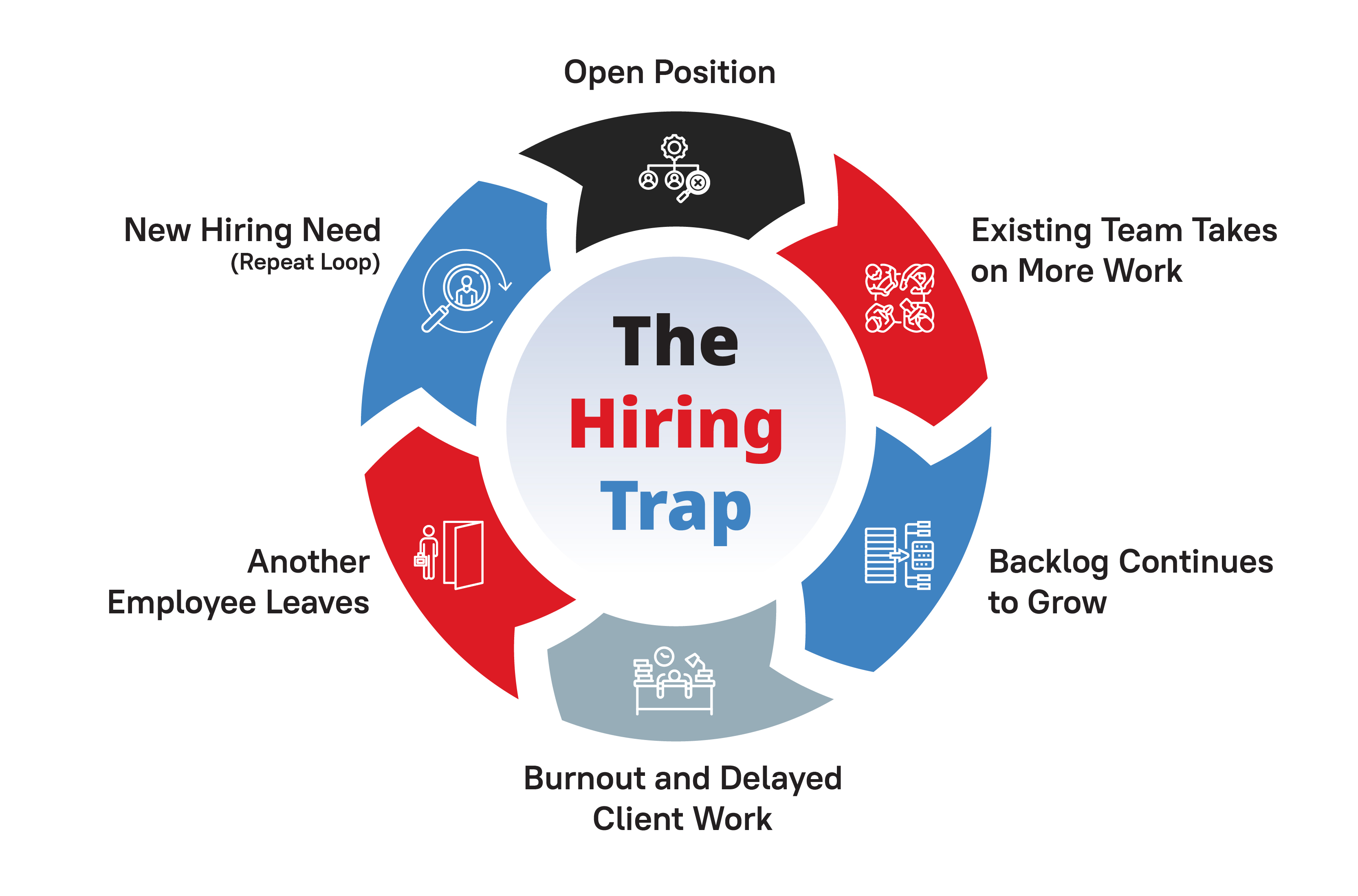
This is why many firms feel like they are always hiring but never truly catching up. Every new vacancy adds pressure to the team, and every delay in filling that role makes recovery harder. The result is a firm that is constantly reacting instead of creating the capacity needed to grow. The recruiting spend itself compounds too, which is why some firms look at reducing recruitment cost before they open another role.
Hiring is still important, but it works best as part of a broader accounting capacity planning strategy.
But solving today's workload is only part of the equation. The bigger question is whether your firm is adding clients at a pace your delivery team can realistically support.
The Capacity vs. Growth Tradeoff Firms Keep Getting Wrong
Here is the tradeoff many partner meetings skip past: growth and capacity are not the same conversation. Firms treat them like one anyway.
A firm signs five new monthly bookkeeping clients because the revenue looks good. Nobody checks first whether the current team has room to absorb them without stretching the review cycle for everyone else.
Here is a simple way to think about it. Divide a firm's total monthly recurring clients by the number of full-time staff doing production work; review included. Call it the client load ratio.
Example: a firm with 96 active monthly clients and 8 full-time production staff has a client load ratio of 12. Two quarters later it has 118 clients and still 8 staff, so the ratio is 14.75. That is a 23% climb with no added capacity, and it will show up in review turnaround before it shows up in the financials.
These ranges are a gut-check built from numbers a firm already has on hand, not a published industry benchmark. The value is in tracking the direction, not in hitting a specific figure.
Firms that manage this tradeoff well treat capacity as a resource to plan, the same way they plan cash flow. They flex delivery up during tax season and back down when volume normalizes. That beats hiring for peak load and carrying the cost through every slow month.
Picture two firms, both adding eight new monthly bookkeeping clients this quarter:
Neither column is wrong. Firm A builds something permanent and pays for it through the slow months. Firm B protects the quarter and takes on the work of documenting how the firm operates. Most growing firms end up running some version of both.
How Firms Are Covering the Gap Right Now
When firms recognize that hiring alone is not solving the workload challenge, they typically consider four approaches.
1. Hire and Wait
This works when the role is central to the firm's long-term strategy and the timeline allows for a complete recruiting process.
The challenge is that recruiting takes time. Client work continues during the search, and existing employees often absorb the additional workload while the position remains open.
2. Redistribute Work Internally
Moving work across the existing team can provide temporary relief.
However, this approach has limits. Once experienced reviewers and managers become the bottleneck, redistributing more work only shifts the pressure from one person to another.
3. Add Outsourced Accounting Services for Repeatable Work
Many firms use outsourced accounting services to support high-volume, repeatable processes such as reconciliations, transaction coding, write-up work, and month-end close support. This allows internal teams to protect time for higher-value responsibilities, including review, client relationships, and advisory work.
The key is finding a partner that can integrate into existing workflows while maintaining quality standards and communication expectations.
4. Use a Blended Model
A blended approach combines internal hiring with additional delivery support.
Firms continue hiring for roles that require long-term ownership while using additional capacity to manage recurring workload demands in the meantime.
This approach allows firms to continue serving clients, protect existing employees from overload, and avoid delaying growth opportunities while waiting for the perfect hire.
The right approach depends on the firm's goals, timeline, and workload structure. There is no single model that works for every accounting firm.
For firms considering outsourced support or a blended model, choosing the right partner matters. Learn what to look for in an accounting partner before making a decision.
What To Do When Capacity Becomes the Constraint
Not every firm facing an accounting staff shortage needs to completely change how it operates. Some firms are one strategic hire away from stability. Others have been trying to fill the same position for months while workload continues to increase.
The difference is recognizing when the issue has moved beyond a temporary hiring challenge.
A capacity ceiling appears when the same patterns continue: review backlogs remain unresolved, internal deadlines keep slipping, advisory opportunities are delayed, and partners spend time completing production work after hours.
At that stage, adding more clients without adding delivery capacity only increases pressure on the existing team.
Analytix Solutions works with growing accounting, bookkeeping, and CAS firms that need additional delivery capacity without changing how they serve their clients. Support fits within existing workflows and operates under the firm's brand, helping firms handle workload demands while continuing to grow.
The first step is understanding where capacity is limiting growth. Firms that identify these constraints early are better positioned to protect their teams, maintain client service quality, and create sustainable growth opportunities.
Want the fuller picture on how growing accounting firms add delivery capacity? Explore accounting firm support.
Frequently Asked Questions
1) Question: Is the accounting staff shortage actually affecting firms my size, or just large ones?
Answer: It is showing up at firms of every size. Smaller to mid-size firms often feel it harder. One open role represents a larger share of total capacity than it would at a large firm with deeper bench strength.
2) Question: I have raised pay and still cannot fill the accounting role. What am I missing?
Answer: Compensation matters, but it is competing against a shallower pool of candidates, not just other firms' offers. Accounting graduates fell to 55,152 in the 2023-24 academic year, according to the AICPA's "2025 Trends" report. A higher salary alone does not fix a shortage driven by fewer people entering the field. Enrollment is recovering, but those students are years away from being review-ready.
3) Question: Does using outsourced accounting services mean losing control of client work?
Answer: It is a fair question to ask any provider. Control comes from three specific things: a partner portal, defined review workflows, and a communication cadence agreed before work begins. Data security is a separate question with a separate answer. Analytix Solutions operates under ISO 27001 certification and SOC 2 compliance, with encrypted file transfer and documented access controls. Current documentation sits in the Trust Center. It is never a vague promise of "close collaboration."
4) Question: How do I tell the difference between a rough quarter and a real capacity problem?
Answer: Run the five-point self-assessment in this guide. A rough quarter usually shows one or two flags. A real capacity limit shows three or more, and it does not clear once the deadline passes.
5) Question: I want to grow my CAS practice. What should I check before adding clients?
Answer: Check the client load ratio before signing new monthly clients. If it has climbed without a matching rise in staff, add delivery capacity first, then take on the new roster. Controller services and CFO-level support are usually where a growing CAS practice runs short first, because both require review time the compliance calendar has already claimed.


.svg)
.svg)