



An owner emails you Wednesday asking why a specific vendor charge shows up on last month's statement. You already know the answer will take an hour to track down.
It sits inside three approval chains and two email threads, plus a six-week-old note from someone who has since left. This is a stretched real estate accounts payable function on any given Wednesday.
The break comes earlier than most portfolios expect, and it rarely comes from software or headcount.
This guide covers what breaks first in property management accounts payable and why software and hiring rarely fix it. It maps the three controls that hold real estate accounts payable together at scale: property-level workflow, expense coding standards and defined approval routing.
It shows how to bring the case to the executive team that signs the check. It is written for you, not to replace you.
4 Failure Modes That Break Real Estate Accounts Payable First
Accounts payable is the accounting function that shows portfolio strain earliest. By the time month-end close slips or Common Area Maintenance reconciliations run behind, the pattern has lived in your accounts payable inbox for months.
You already know this. The problem is that the CEO or CFO who signs off on the fix does not see it yet. What they see arrives later. It shows up on the owner call about a disputed vendor charge, or in the audit finding that traces back to a coding error.
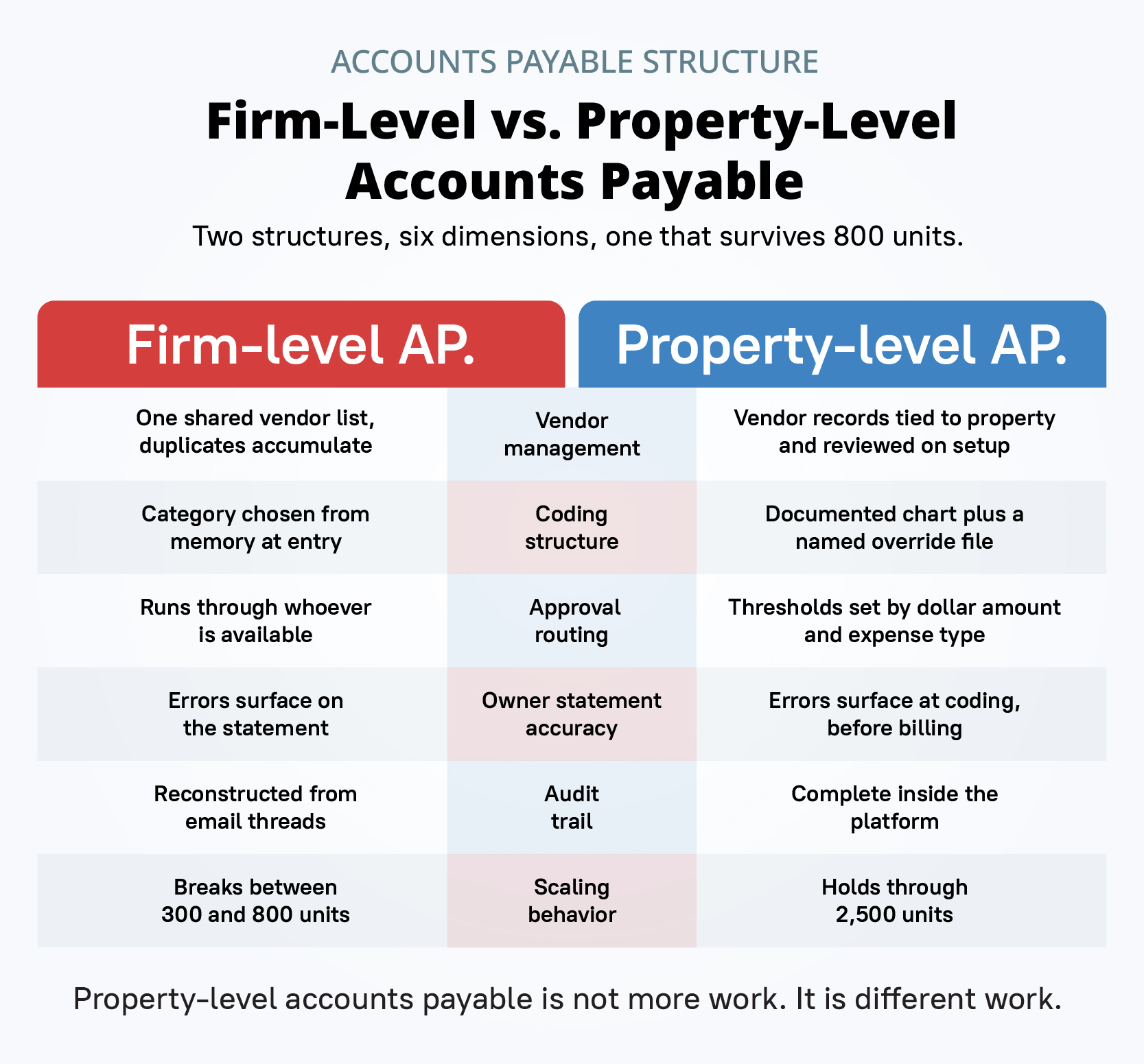
The break point tends to land between 300 units and 800 units under management. Below 300, a process built on tribal knowledge, individual email inboxes and manual property assignment usually holds. Above 800, it stops.
Four failure modes account for almost every real estate accounts payable breakdown at this scale. You have seen versions of all four. Naming them cleanly makes the fix defensible in a room where the CEO is asking why.
- Vendor sprawl: Every new property adds three to five vendors and reuses another four to six that already work across the portfolio. Vendor master data drifts. The same landscaping company shows up under three slightly different names because three property managers set it up differently. Payment terms fragment.
- Coding drift: New properties arrive with quirks. One owner wants utility recharges coded a specific way. A mixed-use building has tenant improvements needing capital expenditure treatment. A syndicated property allocates certain expenses to specific investor entities. Coding rules that lived in one person's head at 300 units stop scaling at 800.
- Approval bottleneck: Approval routing that ran through the office manager at 300 units breaks two ways. Either it creates a Controller queue that never clears, or it breaks down entirely as staff route around the slow lane.
- Visibility loss: The accounting team stops being able to answer basic questions in real time. When an owner emails asking why a specific vendor charge appears on their statement, the answer requires digging through three approval chains. Nobody logged the reasoning anywhere the next person could find it, so every inquiry becomes original research. This mode costs the most and shows up on no report at all, which is exactly why it survives the longest. It surfaces instead as the hour spent tracing a single charge, the owner who has to ask twice, and the growing reluctance to promise a same-day answer on anything.
None of the four is a software problem. Automation on top of a broken workflow accelerates the breakdown; it does not fix it.
Hiring alone does not solve it either, because the talent pool is thinner than the job posting suggests. Accounting degrees keep sliding: 55,152 students finished a bachelor's or master's in accounting in 2023-24, down 6.6% in a single year. Set that against roughly 115,300 openings for accountants and auditors every year through 2035 and the math stops working. Real estate then narrows the pool again, because the seat you are filling needs CAM reconciliation, multi-entity work and real hours inside AppFolio, Yardi, MRI or Buildium. That is most of the reason behind the shortage of real estate-trained accountants at firms this size.
The fix is process design, done deliberately, before the next 500 units arrive.
The 6-Stage Property Accounts Payable Workflow That Scales
The first control is workflow design. A real estate accounts payable process built at firm level puts invoices in a shared inbox where anyone can grab them and tag them by memory.
That breaks at 800 units. Property-level accounts payable gives every invoice a home the moment it enters the system, which is what holds at 2,500 units.
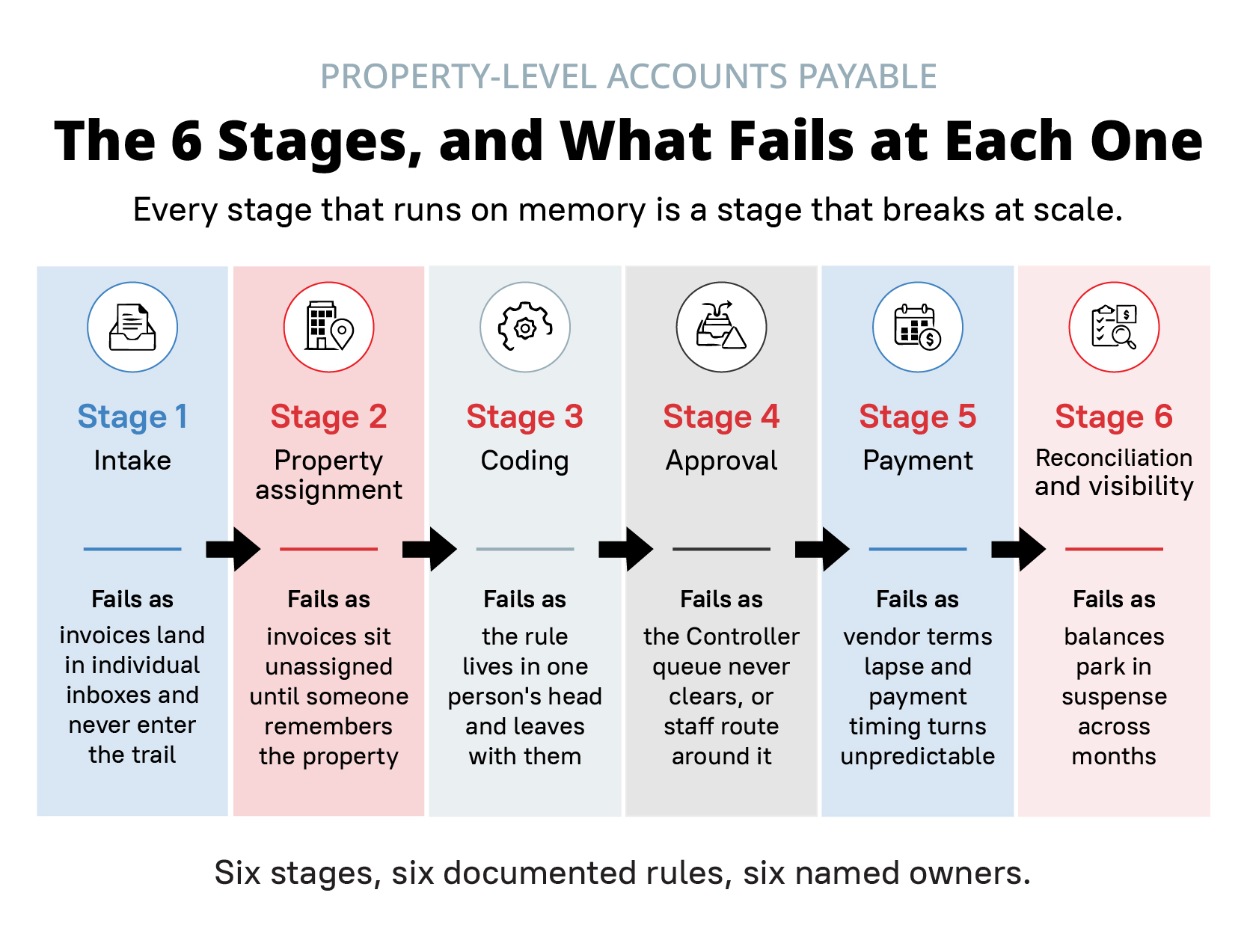
The workflow has six stages. Each stage has a specific failure mode when it runs on tribal knowledge.
Stage 1
Intake: Every vendor sends invoices to one centralized channel: an email address or a portal, never directly to an individual inbox. When intake fragments, invoices go missing and the audit trail starts before the invoice does.
Stage 2
Property assignment: Documented rules assign invoices to properties within 24 hours of arrival. Property assignment does not follow which manager submitted the request, and it does not follow which property manager is loudest that week.
Stage 3
Coding: Coding runs against a documented chart of accounts calibrated to owner statement categories, with property-specific overrides where the owner has requested them. Coding standards get their own section below.
Stage 4
Approval: Approval routing follows documented thresholds by dollar amount and expense type. Approval routing gets its own section below.
Stage 5
Payment: Payment scheduling respects vendor terms and firm cash position, not the date the invoice happened to clear approval. Payment run cadence needs to be predictable, so vendors can plan their own cash flow.
Stage 6
Reconciliation and visibility: Every payment reconciles to the property ledger and posts to the owner statement in the same close cycle. Nothing sits in a suspense account across months. This last stage is where visibility loss stops being a scaling problem.
The workflow runs inside your property management platform. AppFolio, Yardi, MRI and Buildium all support the six stages when configured deliberately. What breaks is not the platform.
What breaks is a configuration built for a smaller portfolio, still running on assumptions that no longer apply. All six stages also have to land inside a 10-day month-end close to be worth the effort of building them.
3 Expense Coding Standards That Prevent Owner Statement Disputes
The second control is coding. Every coding decision looks small when it happens: a category from a dropdown, an override on that category, an approval on the batch.
Three months later, one of those decisions surfaces as an owner asking why their statement includes a $3,400 charge they did not expect.
Real estate coding standards have three moving parts.
- Chart of accounts: The chart needs to map cleanly to owner statement categories, not to internal accounting preferences. If the owner sees a landscaping charge under operating expenses on their statement, the chart entry needs to route landscaping invoices there without translation. This is one place where real estate accounting fundamentals sit apart from general business bookkeeping: the owner-facing output drives the structure underneath. Charts built for internal reporting first create translation work at month-end that never fully clears. The fix is to design the chart around the owner-facing output, then verify that internal reporting still works underneath.
- Property-specific overrides: Some owners want utility recharges booked as pass-through revenue offsets rather than operating expenses. Some syndication structures require expenses to allocate against specific investor entities in specific ratios. Every override needs to live in a documented rules file the accounts payable clerk can reference without asking. A named owner on the internal team signs off when the override changes.
- Exception path: A minority of invoices will not fit the standard coding rules. The judgment on whether a $12,000 HVAC repair is capital expenditure or operating expense is a common one. Intercompany allocation on a shared vendor that services three properties is another. Every exception needs a documented escalation path with a named owner and a turnaround target. Without one, the exception queue silently becomes the default queue.
The top three coding failure patterns are recharge miscoding, capital-versus-operating misjudgment and allocation errors on syndicated properties. Each surfaces on an owner statement between two and four months after the coding decision.
4 Approval Tiers That Scale With Portfolio Size
The third control is approval routing. Approval routing lives at the intersection of speed and control.
Too many approval tiers slow the accounts payable function to the point where vendor terms lapse and property staff work around the system. Too few create control gaps that surface as audit findings and duplicate payments.
The framework that works at 500-2,500 units routes approvals by dollar amount and expense type, not by staff hierarchy.
For dollar amounts, four tiers cover almost every invoice a property management firm processes. Anything under $500 auto-approves when it matches a purchase order and a known vendor. From $500 to $5,000, the property manager approves within the property budget, and from $5,000 to $25,000 the Controller approves against both the property budget and the vendor master check. Above $25,000, the CFO or CEO signs off, and every capital expenditure routes there regardless of amount.
For expense types, three categories need special routing regardless of dollar amount. Capital expenditure always routes to the CFO or CEO, because owner distributions depend on the operating-versus-capital classification. Intercompany allocations always route to the Controller, because the allocation logic often needs judgment.
Owner-restricted expenses (marketing, legal reserves, capital improvements above threshold) always route to the Controller with a documented owner-consent trail.
The routing rules need to live in the property management platform, not in a policy document no one opens. AppFolio, Yardi, MRI and Buildium all support routing configuration by amount and expense type. The gap is almost always configuration, which is the same reason AppFolio bookkeeping run by a generalist drifts within two quarters. What most firms miss is the exception path. It matters when a vendor invoice does not match the purchase order, or when the property manager is out for a week. Approval queues accumulate quickly, and both scenarios need documented handling that does not depend on the Controller being available.
Outsourced Real Estate Accounts Payable: What Stays With You
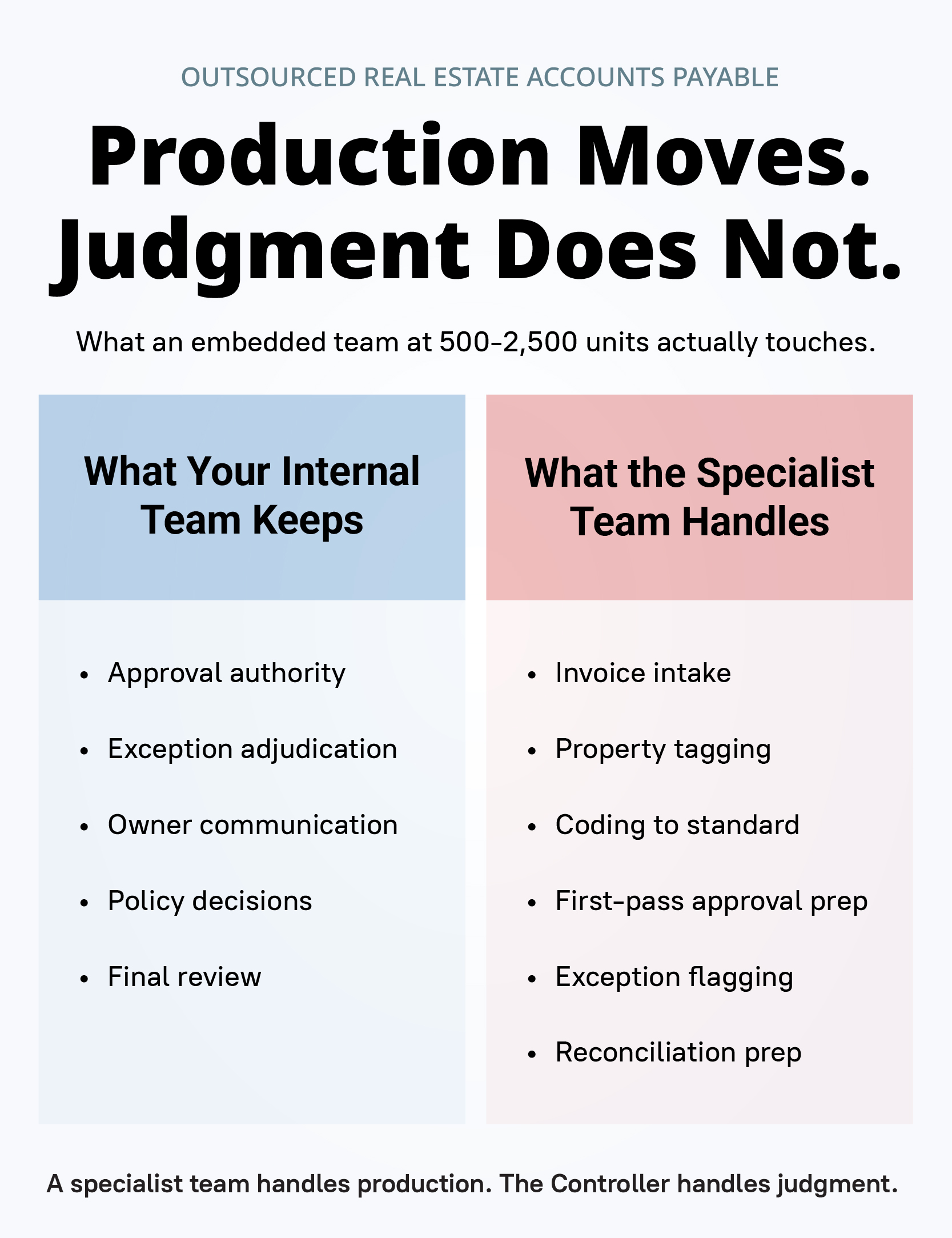
The word "outsourcing" changes the room. Before this section describes the specialist model, it names what stays with you. You keep approval authority, exception adjudication, owner communication and policy decisions. A specialist team handles production, not judgment.
The specialist model at the 500-2,500 unit range typically works like this.
The specialist team takes intake, coding and first-pass approval preparation. Invoices arrive at the centralized channel. The team tags them to properties, applies the coding standard and flags exceptions. It routes the batch for internal approval on an agreed turnaround.
Your internal team handles approval decisions, exception adjudication and the owner-facing conversations that follow. You approve the batches inside your property management platform using the routing rules the internal team owns. Exceptions the specialist team flags come to your desk for adjudication. Owner inquiries on specific line items route straight to you.
The RACI stays visible. Every task has one named owner on each side and a documented escalation path when either side misses. Nothing operates on assumption.
Not every firm at this scale needs a specialist team. Firms with a stable internal accounts payable function and 400 units of clean portfolio growth ahead may not. Firms scaling faster than that, or absorbing a new portfolio type, usually do. Plenty of firms answer the same pressure by deciding to hire a real estate accountant instead, and that works too. The question is which route your growth curve can actually absorb.
One thing to settle before any external team touches financial data: ask for current security certifications and compliance documentation in writing. A specialist provider produces them without being chased. Reluctance to share them tells you what you need to know.
This guide stops at whether the model fits your firm. Once you start comparing providers, the questions worth asking before you sign matter more than anything in this guide.
How Analytix Solutions Helps Property Management Firms With Accounts Payable
Analytix Solutions runs accounts payable production for property management firms at the 500-2,500 unit range.
Your internal team keeps authority, production moves off your desk, and judgment stays with you. What follows is what that looks like in practice.
Extension of Your Team
The engagement runs inside AppFolio, Yardi, MRI or Buildium, whichever platform your team uses. Communication happens directly with named individuals through your existing channels, not through an account manager. Turnaround cadence syncs with your close deadline. Final authority stays with your team on every batch.
Technical Depth
The delivery team brings property-management-specific accounting expertise: workflow design, expense coding, approval routing calibration and month-end reconciliation. Scope extends into cash management, expense recharges, month-end activities, tenant billing, reporting and controller-level review when the firm needs it. Accounts payable sits inside the wider real estate accounting services practice, so where CAM reconciliation runs alongside it in the same close cycle, both land on one delivery calendar.
Reliable Delivery
Delivery teams are pre-trained on AppFolio, Yardi, MRI, Buildium and Xero before an engagement begins, so most property management clients are fully operational within two to three weeks of the onboarding call. There is no ramp-up fee and no learning curve charged to you. Month-end accounts payable close lands within 10 business days of period close, and reconciliation accuracy runs at 99.9% across client portfolios.
How to Bring the Case to Your CEO or CFO
The Wednesday-morning owner email that opened this guide is not going away. Portfolios keep growing, vendors multiply alongside them and coding decisions accumulate with every new property.
The four failure modes described above show up in some form in every real estate accounts payable function that adds 500 units in a year. The three controls that address them do not install themselves.
When you name the pattern first, in language a CEO or CFO can act on, you change the conversation. It stops being a defense of why accounts payable keeps slipping and becomes a decision about which control to install first, on what timeline, against what measurable outcome.
A free accounting audit gives you the written evidence to bring to that conversation. It is a diagnostic, not a proposal.
You keep the authority, the deliverable and the decision on what to do next.
Frequently Asked Questions
What Is Accounts Payable in Property Management?
Accounts payable in property management means receiving, coding, approving and paying vendor invoices at the property level rather than the firm level. Every invoice belongs to a specific property, and that coding decision flows straight to the owner statement, plus CAM recovery on commercial space. The real estate accounts payable process moves through six stages: intake, property assignment, coding, approval, payment and reconciliation. Each stage needs a documented rule and a named owner, because property management accounts payable breaks on undocumented handoffs long before it breaks on software.
Where Do Bottlenecks Occur in Real Estate Accounts Payable?
Four failure modes cover almost every real estate accounts payable bottleneck at 500-2,500 units: vendor sprawl, coding drift, approval routing failure and visibility loss. Vendor sprawl leaves duplicate records and split payment terms. Coding drift surfaces as owner statement disputes two to four months later. Approval routing either backs up in the Controller queue, or staff route around the queue entirely. Visibility loss turns routine owner inquiries into hour-long research.
How Do You Set Up a Property-Level Accounts Payable Workflow?
Start by giving every invoice a property the moment it arrives, rather than assigning it later from memory. That means one centralized intake channel, documented property assignment rules with a 24-hour target, a chart of accounts mapped to owner statement categories, approval thresholds set by dollar amount and expense type, a predictable payment run, and reconciliation to the property ledger inside the same close cycle. Configure all six inside your existing platform. A property accounts payable workflow fails on undocumented handoffs far more often than on software limits.
How Do You Prevent Coding Errors in Property Management Accounts Payable?
Three controls prevent most of them. Build the chart of accounts around owner statement categories instead of internal reporting preferences, so invoices route without translation at month-end. Keep every property-specific override in a documented rules file the clerk can reference without asking anyone, with a named internal owner who signs off when an override changes. Give exceptions a real escalation path with an owner and a turnaround target, because the three patterns that cause the most disputes, recharge miscoding, capital-versus-operating misjudgment and allocation errors on syndicated properties, are all judgment calls rather than clerical slips.
How Do You Maintain Control When Outsourcing Accounts Payable?
Through a documented RACI that keeps approval authority, exception adjudication, owner communication and policy decisions with your internal team. The specialist team handles intake, coding, first-pass approval preparation and reconciliation prep. Every batch runs through your internal approval before payment. Every exception routes to your internal team for adjudication. When you document and follow the split, control gets stronger because the workflow becomes explicit.
What Has Worked and Not Worked When Property Management Firms Outsource Accounts Payable?
Two patterns hold at this scale. Engagements that work share a common shape: production-layer support with the Controller keeping authority, and an explicit split between who handles production and who holds judgment. Engagements that fail share a different shape: full delegation without a documented RACI. The strongest failure signal is loss of visibility on exceptions, which usually means the RACI was never really operational.


.svg)
.svg)