



A bookkeeping position that once took six weeks to fill now remains open for months. Many CPA firms initially view that challenge as a recruiting issue. The instinctive response is to focus on finding better candidates, posting the role in more places, or extending the search timeline until the right hire appears.
Yet filling the position does not always resolve the pressure created by the vacancy.
By the time a new hire joins, workloads may have grown, review queues may have expanded, and existing team members may have spent months carrying additional responsibilities. The role is filled, but the capacity gap can remain.
That is because the bookkeeping talent shortage is more of a capacity challenge. It comes from a lack of skilled professionals rather than a recruitment challenge. Both may seem similar but are way more different. Because the issue is not simply whether an open role gets filled, it is whether a firm can consistently create the accounting capacity needed to support the fast growth when experienced talent becomes harder to find.
This creates two distinct ways:
1) Treat the shortage as a hiring problem,
2) Recognize the capacity challenge behind the hiring problem.
Before looking at what those approaches mean in practice, it is important to understand why filling bookkeeping roles has become increasingly difficult in the first place.
Why Firm Growth Is Colliding With Capacity Limits
The pressure shows up hardest at firms with 5 to 50 employees. The group that actively expanding client accounting services (CAS), adding advisory work, and taking on new bookkeeping engagements. Every new client adds:
- More transaction to process
- More accounts to reconcile
- More financial statements to prepare
Historically, firms handled that spike with a simple formula: more work meant more people. The talent market has made that formula harder to execute. A firm can have a full pipeline of new business and still be unable to take it on, because the team is already stretched past capacity.
The Talent Pipeline Is Not Keeping Pace
Every managing partner already feels this in longer recruiting cycles and thinner candidate pools. The labor data backs up what the calendar already shows.
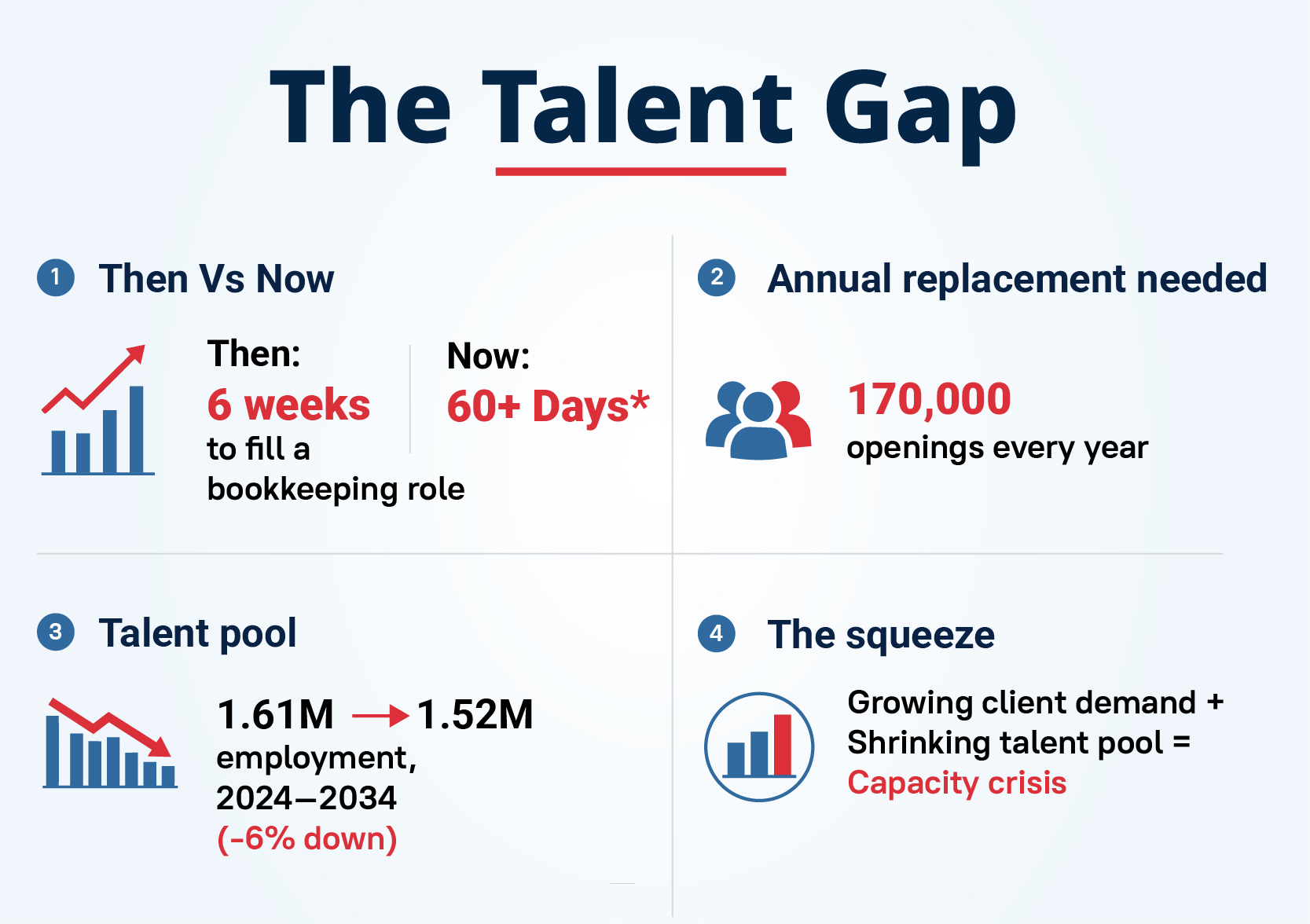
According to the BLS, employment of bookkeeping, accounting, and auditing clerks is projected to decline by 6% between 2024 and 2034. Read on its own; that number suggests falling demand.
The workforce reality is more complicated.
Although automation continues to reduce some routine accounting work, the profession is still expected to generate 170,000 openings annually. Much of this demand comes from retirement, career changes, and employees leaving the workforce. Firms need fewer bookkeeping professionals in total, but they still need experienced people who can do the work sitting in front of them today.
The pressure extends past bookkeeping roles. According to the AICPA, the accounting talent pipeline has come under increasing pressure in recent years. New CPA exam candidates fell from 42,626 in 2023 to 28,082 in 2024, reflecting both the transition to a new CPA exam format and a smaller number of students choosing accounting majors. At the same time, accounting degree completions declined to 55,152 during the 2023-24 academic year, marking the third consecutive year of decline.
This creates a gap between present-day demand and future talent availability.
Why More Recruiting Delivers Less Value
Recruiting harder is a reasonable first instinct of CPA firms, and it remains part of any real growth strategy. But it is becoming a less reliable source of capacity on its own. Wider searches, recruiting partners, and higher pay ranges do not change how many experienced bookkeeping professionals exist in the market.
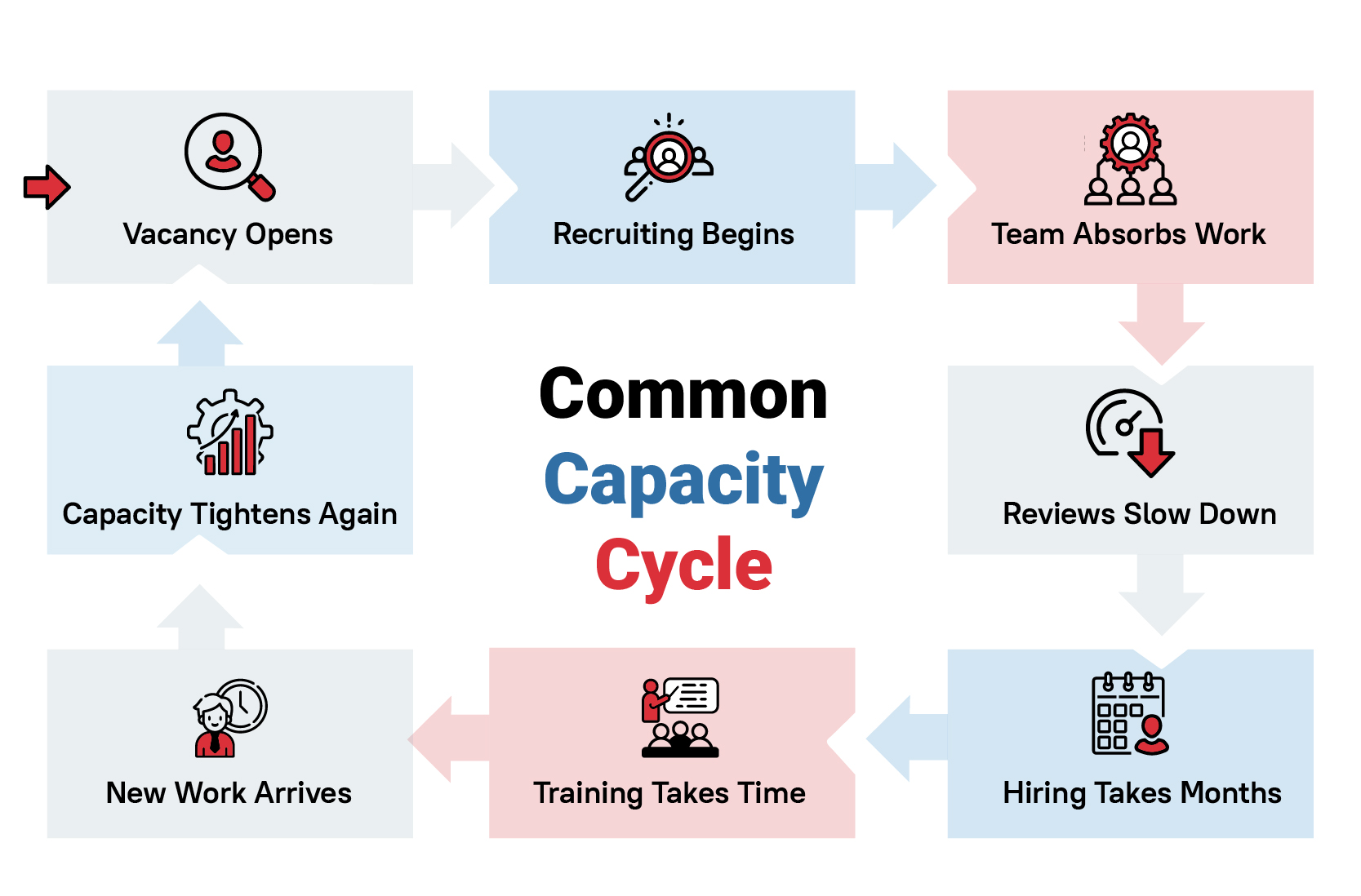
Firms that rely on recruiting alone tend to land in the same cycle: review bottlenecks, delayed turnaround, manager overload, and workloads that keep climbing. These are often among the earliest accounting staff shortage warning signs, while the impact highlighted in the cost of a vacant bookkeeper role extends well beyond compensation and recruiting expenses.
Those challenges point to a broader pattern. What I see repeatedly is firms under the heaviest pressure are rarely recruiting poorly. They are running a capacity problem through a recruiting-only strategy.
How Growth-Oriented Firms Are Rebuilding Capacity
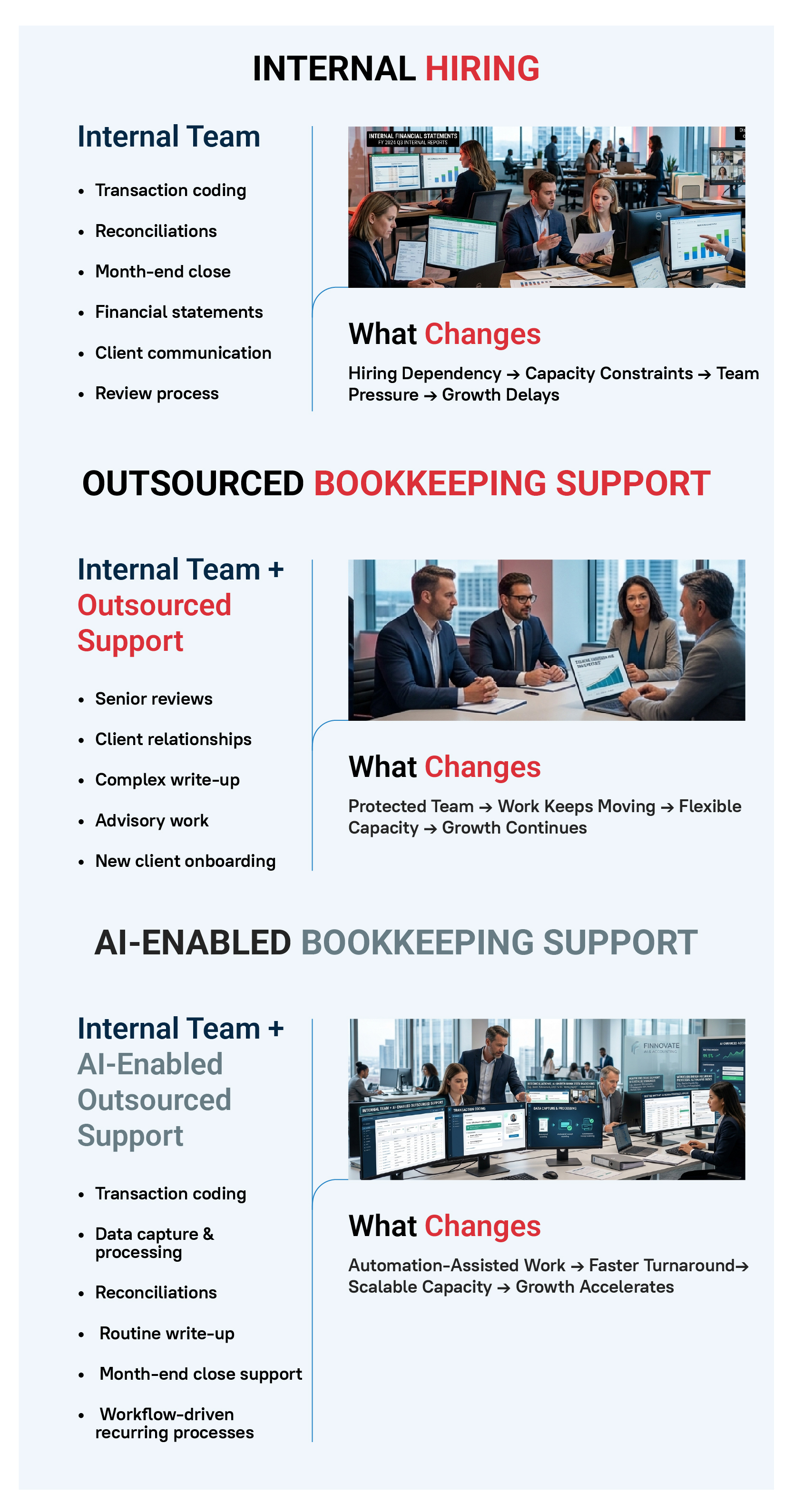
As hiring alone falls short, the conversation shifts from staffing to scalability. Capacity can come from more than one source, and growing firms are weighing three of them:
- Continue relying on hiring
Firms build capacity by recruiting, onboarding, and developing bookkeeping talent internally as client demand grows.
- Expand capacity through technology
Automation and AI-assisted tools help streamline repetitive bookkeeping activities, improve efficiency, and support larger workloads with existing teams.
- Build a broader capacity model
Bookkeeping support helps firms expand capacity beyond local hiring markets while internal teams focus on review, client communication, and advisory work.
Where Technology Fits
A growing share of bookkeeping work, including transaction coding, receipt processing, bank feed management, and first-pass reconciliations, is repetitive and rules-based. That makes it well suited for automation, part of a broader shift already reshaping how CPA firms operate.
This becomes easier to understand when looking at the types of activities that make up a typical bookkeeper's workload:
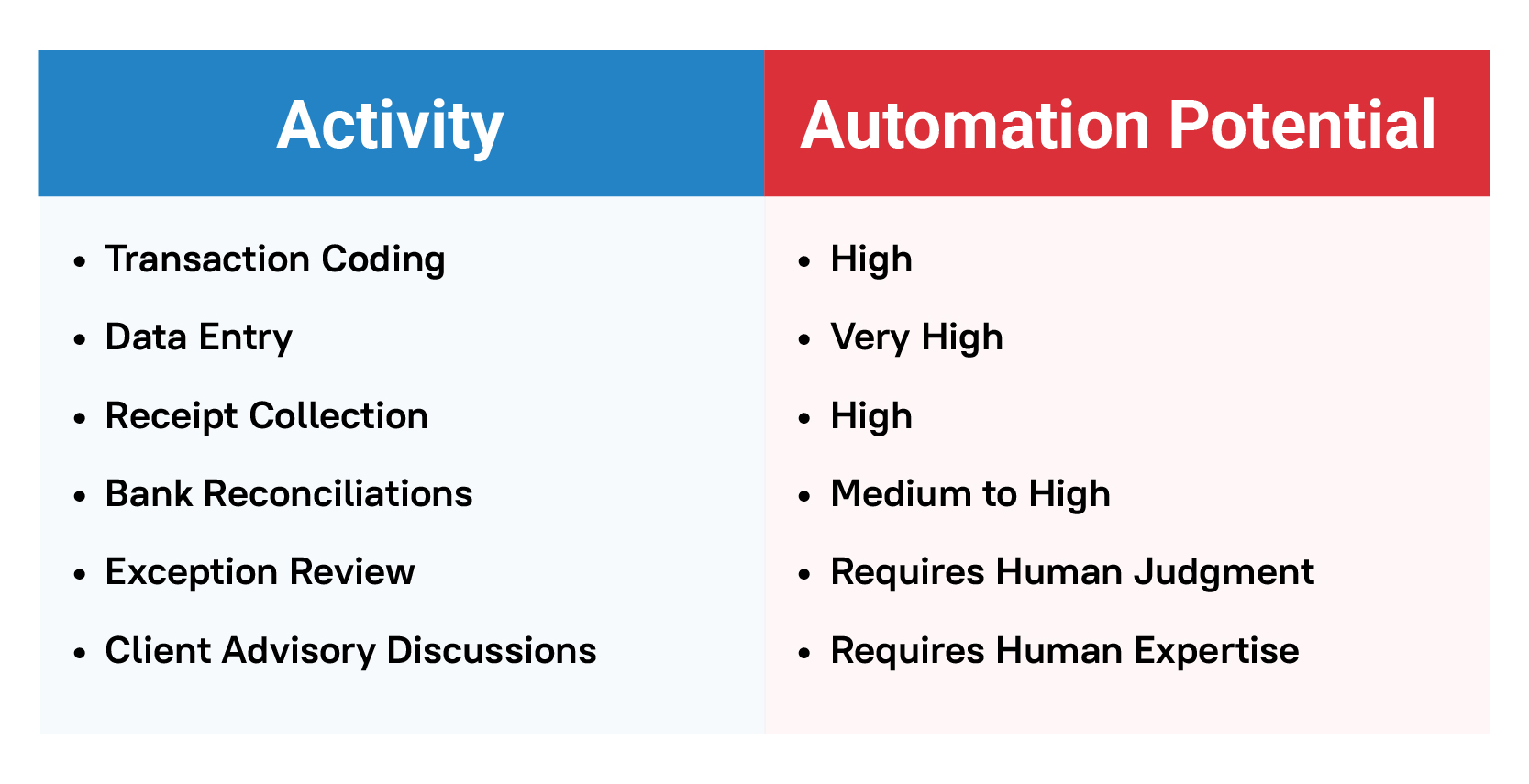
The pattern is not “automate everything”. A firm can support more client work without a proportional increase in headcount once repetitive tasks move onto systems built to handle them efficiently. That is why option two stands for a capacity-constrained firm. A combined approach will solve both problems at once.
Internal Team + AI-enabled outsourced capacity = Scalable growth
The outsourced layer is often where automation delivers value fastest because the processes, review structures, and specialized expertise are already in place. With the new approach:
- Transaction coding and reconciliations move faster
- Routine bookkeeping work becomes more efficient
- Exceptions get flagged and routed for review instead of being missed
- Internal teams spend less time on production work
- More time becomes available for advisory conversations and client relationships
The result is greater capacity without requiring firms to match every increase in workload with additional headcount.
The Capacity Questions Every Firm Should Be Asking
As firms plan for future growth, a more productive question may not be: "how do we fill a position?" Instead, leaders may benefit from asking these capacity planning questions.
- Which responsibilities require permanent in-house ownership?
- Which recurring bookkeeping activities could be supported through a broader delivery model?
- Where do capacity bottlenecks currently exist?
- Which processes could benefit from automation?
- How could an AI-enabled outsourced model improve efficiency?
- What happens if a key team member leaves unexpectedly?
- How quickly can additional capacity be added when demand increases?
These questions shift the discussion from staffing to scalability.
Many firms discover that certain responsibilities must remain firmly within the organization, while other recurring accounting functions can be supported through specialized resources operating within firm-defined processes and standards.
Evaluating work through this lens often reveals opportunities that traditional hiring discussions overlook. It also helps firms assess where outsourced bookkeeping support can strengthen capacity while allowing leadership to remain focused on growth, client experience, and strategic priorities.
The Firms That Adapt Will Outgrow the Shortage
The firms that adapt will not win because they recruit faster. The reason is their capacity shift. That capacity comes from a combination of skilled people, outsourced support, automation, and AI.
The most scalable firms are redesigning operating models where:
- Technology handles routine work
- Specialized teams provide execution support
- Internal teams focus on client relationships and advisory services
Those firms are far less dependent on the availability of local bookkeeping talent and far better positioned to sustain growth.


.svg)
.svg)