



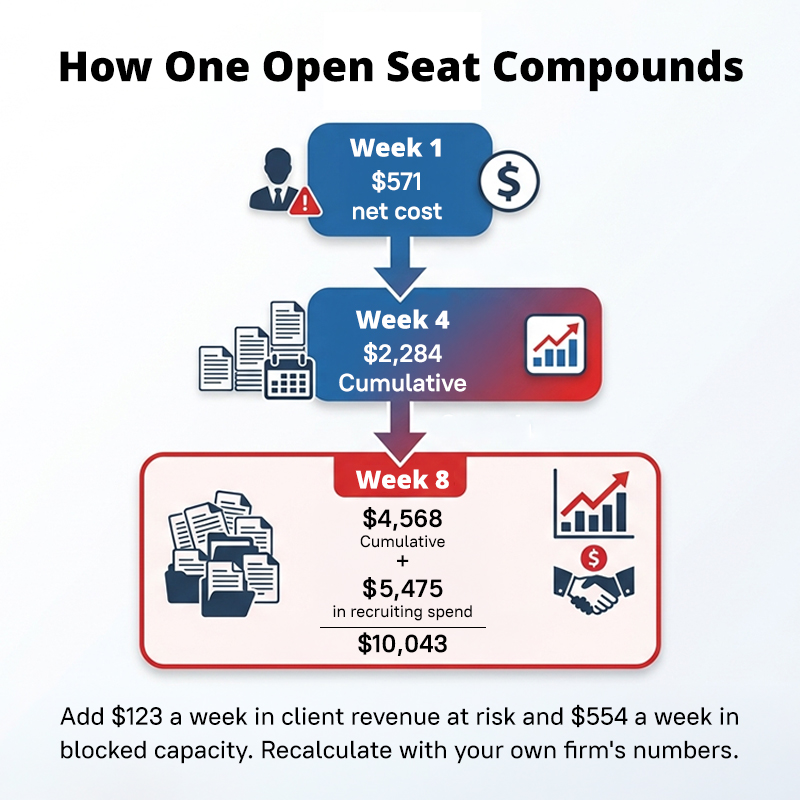
One open bookkeeping seat costs a small accounting firm about $571 a week, even after the payroll savings. Count client revenue at risk and the work the firm turns away, and weekly exposure climbs past $1,200. Across an eight-week search, the total lands near $15,000.
That number surprises most practice managers, and there is a reason why. After working alongside accounting firms on bookkeeping coverage and staffing gaps, one pattern shows up again and again: the payroll line looks better with the seat empty. Salary stops, benefits stop, and the month-end close still happens because the team absorbs it.
So, the cost moves somewhere the profit and loss statement does not show it.
This guide breaks down where it goes, using seven formulas built for firms that want a real number on an open seat instead of a guess.
What a Bookkeeper Shortage Actually Costs Your Accounting Firm
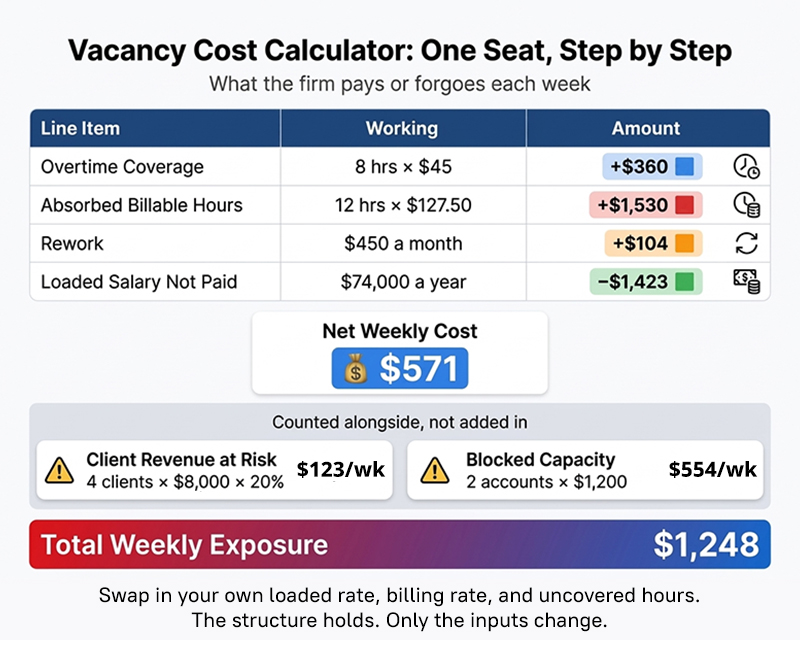
Start with the part most firms get right. A vacant bookkeeper seat does save money. A $58,000 base salary carrying benefits, payroll taxes, software, and overhead runs about $74,000 a year fully loaded, or roughly $1,423 a week. That saving is real, and it is exactly why seats stay open.
The question is what the saving costs you. Four things happen next at an accounting firm, and payroll captures almost none of them.
Before running any formula below, get one input right.
Your Team Takes on More Than It Should
Reconciliation, payroll, and month-end close still have to happen. That work splits two ways. Some lands with non-exempt staff at overtime rates. A senior accountant or manager absorbs the rest during hours they would otherwise bill to clients.
The second half is where the real money sits, and it is the part generic vacancy calculators miss. At an accounting firm, senior time is inventory. Every hour a manager spends categorizing transactions is an hour that does not reach a client invoice.
Small Reconciliation Errors Become Bigger Problems
When a generalist or an already stretched team member takes bookkeeping along with their regular role, the error rate climbs. Missed deadlines, miscategorized transactions, and reconciliation mistakes become more common. Most of those issues land back on someone's desk for cleanup, usually that of a more senior, more expensive team member.
Client Confidence Starts to Slip
This is the one cost that does not reverse when the seat gets filled. A client who receives a delayed answer or late financials during a filing deadline starts to wonder if your firm has the capacity to serve them well.
Picture a client emailing twice about a loan application deadline and getting a reply three days later instead of the same day. That single delay is often the first crack, long before the client says a word about switching firms.
That doubt looks small at first. Over time, it can lead to the client requesting quotes from other firms. In a business built on client retention, that is the most expensive outcome of a single unfilled seat.
Keep this figure separate from your cost total. Overtime and rework are dollars already spent. Churn exposure is probability-weighted future revenue. Blending the two produces a number a partner group will discount on sight.
The Work You Turn Away
The three costs above are what the vacancy takes. This one is what it prevents. A firm running at capacity with an open bookkeeping seat cannot onboard new bookkeeping clients, which means the shortage caps revenue at the same time it raises cost.
The Hidden Cost of a 30+ Day Open Role
Thirty days is where most firms stop noticing. It is also where the math turns.
Hiring timelines across accounting have stretched well past that mark. Personiv's 2026 survey of finance and accounting leaders, reported in Accounting Today, found that 42% of organizations now need 60 days or more to fill an open accounting role. Staff accountant sits second on the list of hardest roles to hire, named by 26% of respondents. The average number of open accounting and finance roles per company jumped to 17, up from five a year earlier.
Two honest caveats belong here. That 42% figure is actually down from 49% the year before, so timelines eased slightly even as open headcount climbed. And bookkeeping still fills faster than credentialed work: CPA-required roles average 73 days nationally in 2026, 41% longer than comparable roles without the credential, according to Talentfoot's hiring data. The same thin pipeline stretches both timelines. Bookkeeping just starts from a shorter one.
Eight weeks is a reasonable planning assumption for a bookkeeping search in this market, but your own hiring history is the better number. If your last two bookkeeping searches each took 11 weeks, build the math around 11 weeks.
The firm loses more than hours at this point. It loses the client knowledge held by the outgoing bookkeeper and the time needed to onboard the eventual new hire.
Teams adjust, which can make the gap feel manageable even as it steadily gets more expensive. This is the point where the shortage stops being a hiring story and starts being a capacity story that shapes what the firm can accept next.
Accounting firm staffing costs rarely stay contained to one seat. When a bookkeeper role goes unfilled, nearby roles absorb the spillover: a staff accountant covers reconciliations, a manager reviews work they should not need to review.
Spillover like that spreads the cost across the whole team instead of holding it to a single line item. By the time a partner notices the pattern, it shows up as a slower month-end close, not a clean number on a spreadsheet.
Calculate Your Own Bookkeeper Shortage Cost
Putting a number on the cost of a vacant bookkeeper role takes less work than most firms expect. Most firms building a vacancy cost formula themselves make the same two mistakes.
The first is double counting. They charge the uncovered hours once, then add overtime on top, which bills the same work twice. The 20 hours are already priced inside coverage cost, eight at the premium rate and 12 as lost billings.
The second is skipping the salary credit. While the seat is empty, the firm is not paying for it. Leaving that out produces a number any partner will reject in about 10 seconds, and it costs you the argument.
That is the honest weekly figure. To bring it to a partner group, extend it across the length of the search and add what the search itself costs.
Once a managing partner sees that next to the client work it protects, the numbers usually speak for themselves. It beats saying, "We are a bit short-staffed right now."
Why Replacement Hiring Keeps Failing in This Market
The obvious answer to a number like that is to fill the seat faster. Most firms try, but the market rarely cooperates.
If a firm is struggling to fill a bookkeeping role, the problem is rarely the job posting. It is the hiring market behind the bookkeeper shortage.
More than 300,000 accountants and auditors left the U.S. workforce between 2019 and 2022, according to a Wall Street Journal analysis of Bureau of Labor Statistics data, a decline of roughly 17% from the profession's peak. The Bureau of Labor Statistics projects about 124,200 openings for accountants and auditors each year through 2034, most of them from retirements and career changes rather than new growth. Accounting firms compete for that pool against corporate finance teams and tech employers who often pay more and offer more flexibility.
The accounting talent shortage is not unique to bookkeeping, but bookkeeping feels the impact first. Tax and audit roles can often be covered with contractors or extra overtime during busy seasons. Bookkeeping has no busy season that hides the gap. That is why the gap surfaces in client deliverables faster than it does anywhere else in the firm.
The pipeline is the problem, and no job post fixes a pipeline. What a firm does control is how wide it casts. Broadening candidate criteria, offering training, allowing remote work, or rethinking credential requirements all shorten a search. Holding out for a perfect match stretches it.
None of this changes what the seat costs while the search runs. Hiring pressure is one of several challenges facing accounting firms, and it is the one that keeps billable hours on the wrong desk. So the question worth asking is not how to hire faster. It is what covers the work until someone starts.
The Bridge Option Most Firms Skip
Faced with a vacancy, most firms default to one of two moves: rush a permanent hire or stretch existing staff further while the search continues. Both lead to the costs covered above.
There is a third option most firms skip. Bring in coverage for the seat while you run a proper search for the permanent hire.
Why It Works
It separates two problems that often get bundled together.
A rushed permanent hire tries to solve an immediate capacity problem and a long-term hiring decision at the same time. It often solves neither well.
Coverage solves the capacity problem first. That gives the firm time to hire carefully instead of hiring under pressure.
It also protects hiring standards. Firms rushing to fill a seat often lower those standards without realizing it. That can lead to another vacancy within a year.
Firms in this position usually weigh three routes: a permanent hire, more hours from the existing team, or outsourced bookkeeping brought in as interim coverage. The costs separate quickly.
Compare the 3 Options Side by Side
How It Helps
Go back to the biggest line in the model: 12 manager hours a week, priced at $1,530 in billings the firm never issues. Interim bookkeeping support takes those hours back first, and it does so in weeks rather than months.
Every hour returned to a manager is an hour that can reach an invoice again. Overtime stops in the same week. Rework drops once the work sits with someone who does it daily. Churn exposure eases last, after clients stop waiting on replies.
The principle is not complicated. Bookkeeping support for accounting firms keeps credentialed people on billable client work, which is where firm margin actually lives.
When to Consider It
This option works best in three situations:
- A resignation with no internal backup.
- A search that has already passed the 30-day mark with no strong candidates.
- A seasonal workload spike on top of an existing staffing gap. If January through April is where your capacity breaks, tax season preparation math belongs on the calendar well before January.
Firms that use interim bookkeeping support during these periods are more likely to keep month-end close on schedule while the permanent search continues.
Make the Bookkeeper Shortage Cost Visible Before It Compounds
A bookkeeper shortage will not resolve itself on your firm's timeline. The accounting talent shortage behind it took years to build, and it will take years to unwind. Waiting is not a plan.
What your firm controls is whether the cost stays visible while the search runs. That is the purpose of the seven formulas above. They are not built to produce an alarming number. They are built to move a real one out of the places it currently hides: a manager's calendar, a rework queue, a client who has gone quiet.
Three things change once that number sits on paper. Partner conversations shift from how busy everyone feels to what the gap costs each week. The choice between bridging and waiting becomes a comparison instead of a hunch. And hiring standards hold, because nobody is picking a candidate under pressure.
Run the math on your own seat this week, using your loaded rates, your billing rate, and your own average time-to-fill. If the weekly number comes back small, keep searching and let the search run its course. If it does not, you now know what a bridge is worth, and what a rushed hire would cost instead.
The formulas here are not a hiring plan. They make sure the cost of a vacant bookkeeper role is in that plan from the first week, instead of surfacing months later as a client who quietly left.
Put a number on your open seat this week, then decide what to bridge. See how Analytix Solutions supports accounting firms, or book a 15-minute capacity review.
Frequently Asked Questions
1) Question: How long does a bookkeeper shortage typically last at an accounting firm?
Answer: Plan for six to eight weeks, and longer in tight markets or for roles needing specific software experience. Personiv's 2026 survey found that 42% of organizations now need 60 days or more to fill an open accounting role. Bookkeeping still fills faster than credentialed work, where CPA-required roles average 73 days.
2) Question: What does the cost of a vacant bookkeeper role add up to, and how do I calculate mine?
Answer: Add your coverage cost and rework, then subtract the loaded salary you are not paying. For a firm with 20 uncovered hours a week, that nets to about $571, or just over $10,000 across an eight-week search once recruiting spend is counted. Track client revenue at risk and blocked capacity separately. The vacancy cost formula above gives you the structure; your own loaded rates give you the number.
3) Question: Why does my payroll look fine if the vacancy is so expensive?
Answer: Because most of the cost never touches payroll. The largest line is billable hours a manager spends on bookkeeping instead of client work, which shows up as softer revenue rather than higher expense. Rework, client risk, and blocked capacity behave the same way.
4) Question: Can a bookkeeping partner fill the gap during a bookkeeper shortage?
Answer: Yes. A support partner can handle reconciliations, month-end close, and transaction processing while recruitment continues, which keeps service levels steady without overloading the internal team.
5) Question: What does interim support cost against the vacancy it covers?
Answer: Scope pricing to the hours and tasks you need covered, then weigh it against your weekly vacancy cost rather than against a full salary. The relevant comparison is the $571 a week the gap already costs, plus the work the firm is turning away, not the base pay of the seat you are trying to fill.
6) Question: Is outsourced bookkeeping the same as interim support?
Answer: Not quite. Outsourced bookkeeping usually describes an ongoing arrangement where a partner runs a defined set of books month after month. Interim support is scoped to a gap: it covers a seat while a search runs, then steps back or converts. Firms often start with the second and move to the first once the workflow proves itself. Both compare against the same number, which is what the open seat is already costing each week.


.svg)
.svg)