
Does Remote Bookkeeping Services Deliver the Same Reliability as In-House Teams?


Firms are not turning to remote bookkeeping services because the idea sounds modern. They are turning to it because the local talent pool that used to fill an open seat within a few weeks now sits empty for months, if it fills at all.
Robert Half's 2026 research puts the average time to close a permanent accounting hire at seven weeks, and unemployment among accountants has held near 1% to 2%, a level that usually signals a candidate's market, not a firm's market.
That leaves a Senior CPA or Tax Manager holding one real question:
If the bookkeeper is not sitting down the hall, how do you know the work is being done correctly?
It is a fair question, since the books behind a remote engagement still feed tax returns, financial statements, and client conversations.
A weak remote model can create real problems. A well-designed one can make the control environment more visible than an informal in-house process ever was, because the difference sits in the system built around the people doing the work, not their zip code.
Why Many CPA Firms Question Remote Bookkeeping Services
The hesitation around remote bookkeeping services has less to do with bookkeeping itself and more to do with visibility. Inside a firm's own office, strange transactions get discussed in real time, team capacity is easy to gauge just by walking the floor, and client conversations happen within earshot of a manager.
That environment feels easier to manage. The real question is whether that visibility is actually producing control, or just the comfortable feeling of it.
Where Concerns About Control and Quality Begin
A bookkeeper reconciles a client's bank account and the balance looks right. An in-house manager glances at the reconciliation, asks one question, and moves on to the next fire.
What actually established quality there.
Every reconciling item should have been investigated, old uncleared activity reviewed instead of carried forward again, and supporting documentation attached. Did the close follow a checklist, or did it follow memory?
Those questions matter whether the preparer sits ten feet away or ten time zones away. A remote model simply removes the option of relying on informal supervision to answer them, which forces a firm to make its expectations explicit, something a surprising number of in-house teams have never actually done.
Firms weighing this tradeoff are often reassessing cybersecurity for CPA firms at the same time, since remote delivery and data protection raise the same underlying question: who can see client data, and who answers for protecting it.
A firm waiting indefinitely for the perfect in-house hire is still making a delivery decision, just through delay, while the backlog compounds.
Common Misconceptions About Remote Delivery
Four assumptions keep resurfacing in partner meetings, and none of them hold up against how a mature provider actually runs its practice.
Misconception 1: Remote Means Unsupervised
A properly structured engagement defines responsibilities, review points, escalation rules, and access controls before the first transaction is ever touched.
Misconception 2: In-House Automatically Means Higher Quality
Physical presence does not eliminate errors. An overloaded internal employee can miss the same item a remote preparer would, especially when meaningful separation of duties is absent.
Misconception 3: Remote Delivery Means Slower Communication
Distance does not automatically create delays. Email-only communication can quickly become frustrating, while defined response windows, scheduled reviews, and structured communication processes make geography far less important.
Misconception 4: Technology Alone Can Replace the Delivery Model
A software platform is not the same as a bookkeeping function. The shutdown of a well-known automated bookkeeping tool in early 2026 highlighted the importance of pairing automation with accountable professionals who provide oversight, review, and continuity.
Firms that combined technology with experienced accounting teams were generally better positioned to navigate the transition.
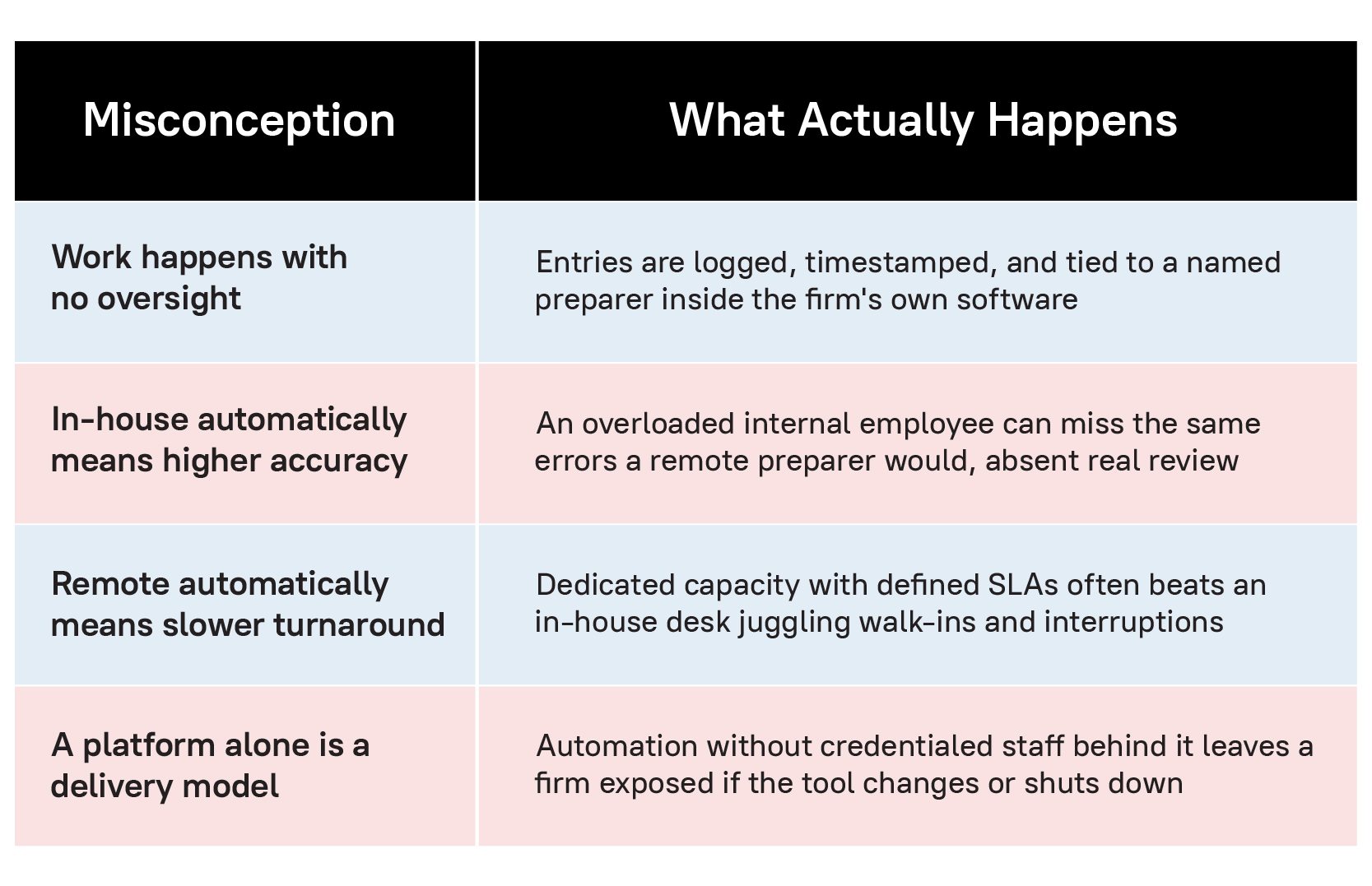
Once those four assumptions are set aside, the conversation gets more useful. The question stops being whether remote bookkeeping services can work at all, and becomes what makes them work consistently.
How Remote Bookkeeping Services Maintain Quality Without In-Person Oversight
Quality is not a personality trait a bookkeeper happens to have. It is an outcome of a process, which is the single most useful reframe for a partner evaluating remote bookkeeping services.
A reliable model traces work from assignment through completion, review, correction, and sign-off, and that traceability comes down to three mechanisms in practice.
1. Standardized Workflows and Documentation
A strong workflow turns institutional knowledge into something repeatable. Take a documented monthly close:
- Bank and credit-card feeds reviewed
- Reconciliations completed
- Outstanding items investigated
- Payroll entries posted
- Accruals checked
- General ledger exceptions identified
- Financial statements generated
- Variance items flagged
- Reviewer sign-off recorded
That sequence creates value because it establishes a clear trail, not because it looks organized on a slide. A recurring issue with the same client every month should surface through the process rather than repeat quietly month after month. When a deadline slips, the firm should be able to identify exactly why. When a reviewer catches an error, the correction should become part of a documented feedback loop rather than a private conversation between two people.
2. Multi-Level Review and Quality Control Processes
Preparation and review are not the same activity, and a credible provider never treats them as interchangeable.
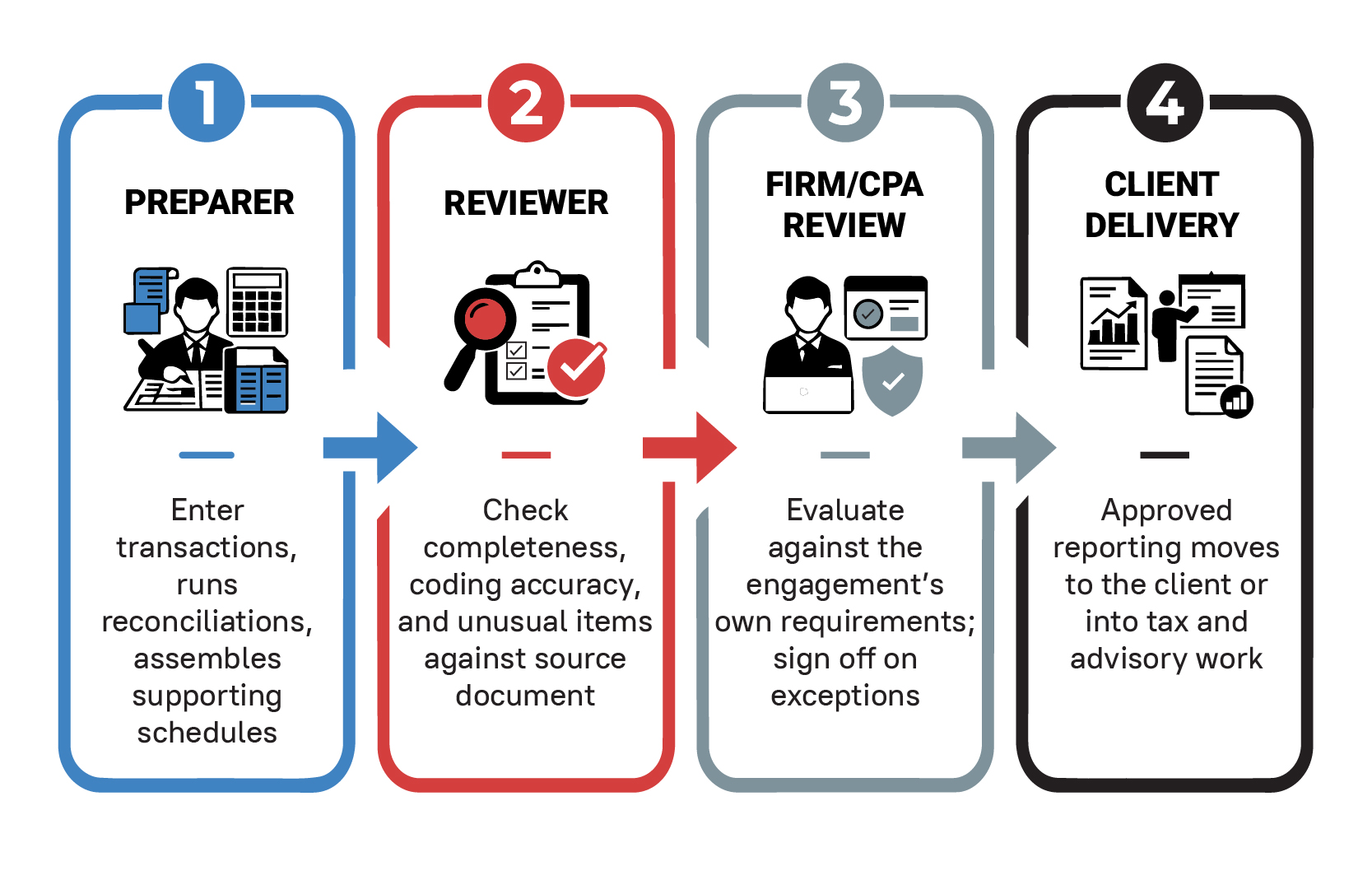
For higher-risk work, a sensible structure typically includes four levels:
- Preparation: Transactions, reconciliations, supporting schedules, and routine adjustments are completed.
- Accounting Review: A senior team member reviews the work for completeness, reconciliation quality, coding accuracy, and supporting documentation.
- Firm Review: The CPA, manager, or designated reviewer evaluates the information against the engagement's requirements and review standards.
- Client Delivery: Approved reporting is delivered to the client or used to support tax, advisory, and other downstream services.
Not every client needs all four layers spelled out formally, but a credible virtual bookkeeping services provider can always name who prepares, who reviews, what gets escalated, and exactly where the firm's own authority sits in that chain.
This is not a remote-specific invention. It is the same logic behind AICPA's Statement on Quality Management Standards. Which moved every firm from a checklist-based approach toward a risk-based system where quality objectives, checkpoints, and root-cause review get documented and monitored on an ongoing basis.
A provider already running a structured review chain is not fighting that standard. It is living inside its spirit, and the payoff shows up at scale: more than 70% of the top-performing CAS practices in AICPA's 2024 benchmark survey cited standardized processes as central to their growth, with median CAS revenue per professional climbing 29% over the prior survey cycle.
3. Technology That Improves Visibility and Accountability
Skepticism about oversight assumes a reviewer has less visibility into remote work than in-house work.
In a properly built system, the opposite is usually true. Cloud ledgers log every entry with a timestamp and a user ID. Task tools show exactly where an engagement sits in the pipeline rather than simply whether it is "done." Centralized partner portals give managing partners a live view of deliverable status without a single status-check email.
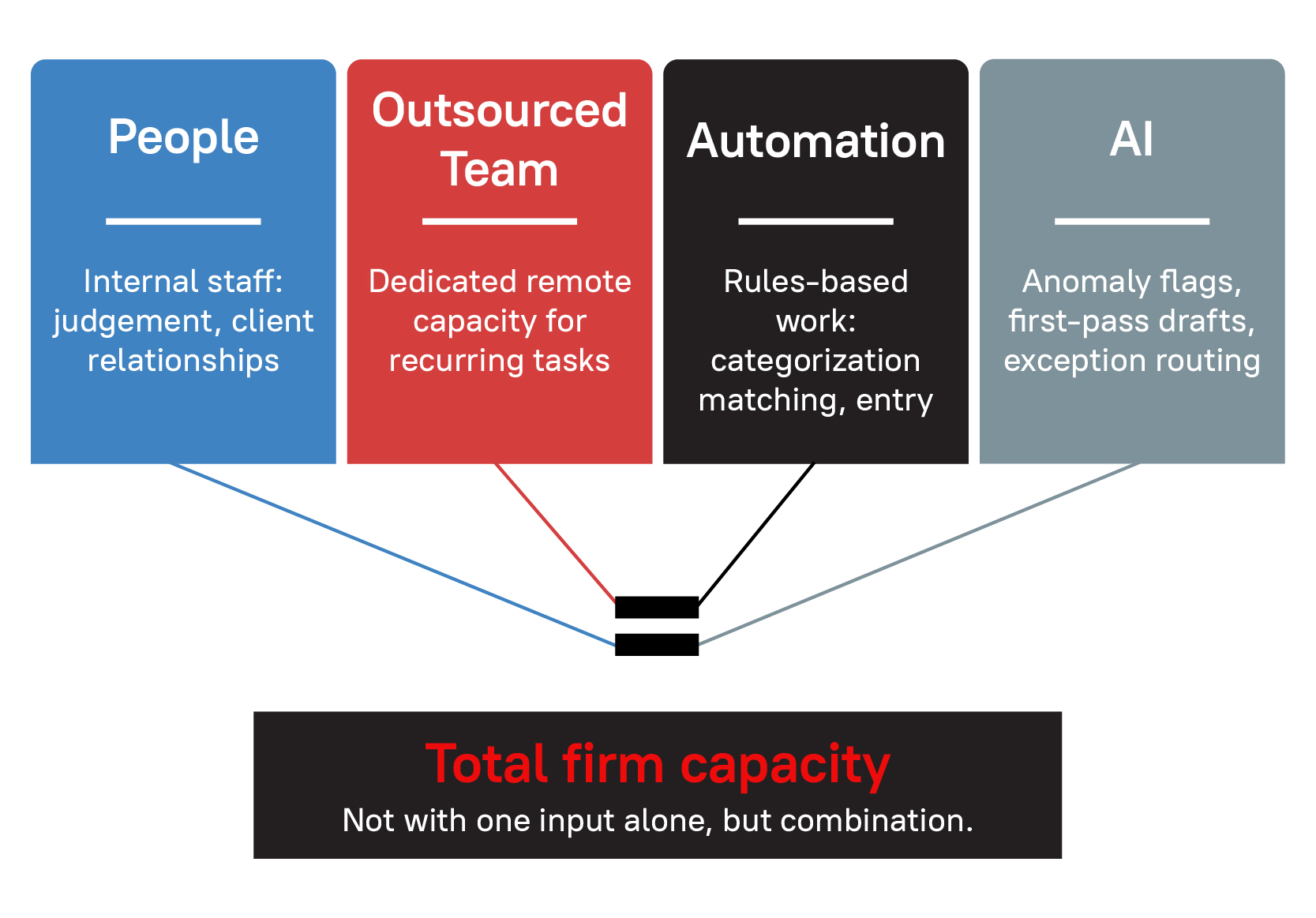
AI's growing role in accounting and CPA firms is changing that picture too, not by replacing the review chain but by narrowing what a human reviewer has to look at: flagging anomalies, drafting first-pass reconciliations, and routing exceptions automatically, so a senior accountant spends time on judgment calls instead of hunting for the transactions that do not fit.
The strongest capacity models combine internal staff, a dedicated remote team, and automation for the rules-based parts of the ledger, letting technology absorb repetitive work while people focus on judgment. That combination is what makes sustainable growth possible.
What Effective Communication Looks Like in a Remote Bookkeeping Model
Quality control answers whether the work is right. Communication answers whether the firm knows it is right without having to ask.
Firms that struggle with remote accounting services almost always trace the friction back to communication design, not the accuracy of the underlying work.
Establish a Clear Communication Cadence
A dedicated remote accounting services team should operate on a published cadence, not an as-needed basis: a standing weekly or biweekly check-in for open items, a defined response window for questions, and an immediate escalation path for anything too material to wait for the next touchpoint.
A small client with straightforward monthly books does not need daily meetings, while a complex, multi-entity client approaching a transaction probably does.
When a cadence exists but goes unused, even flawless work starts to feel unreliable. It is simply because nobody can predict when the next update is coming.
Keeping Stakeholders Informed Through Reporting
A status update that says "books are in progress" tells a partner almost nothing. Breaking the month into completed work, pending items, exceptions requiring attention, and upcoming deadlines provides far more useful visibility. Bank reconciliations and payroll posting may be complete, two client documents may still be outstanding, an unusual expense may be flagged for clarification, and draft financial statements may be targeted for a specific date.
That single habit changes the relationship. The CPA stops supervising every transaction and starts supervising the exceptions, a far more scalable use of a senior professional's time.
Creating a True Extension of the Existing Team
The phrase "extension of your team" gets used too loosely in outsourcing pitches, but it should mean something operational. A genuine extension understands the firm's chart-of-accounts conventions, close calendar, reporting formats, and reviewer preferences well enough to anticipate a question before it gets asked.
That level of familiarity is built over time, particularly during the first 30 to 60 days of an engagement. Firms that experience the smoothest transitions typically invest in onboarding, knowledge transfer, and process alignment from the outset.
Rather than operating as a vendor working behind a ticketing system, the provider becomes part of the delivery process, participating in the same client kickoff calls, workflows, and communication channels.
That alignment creates the conditions for success, but firms ultimately evaluate the relationship through the outcomes it produces over time.
What CPA Firms and Their Clients Actually Experience After the Transition
The first surprise for most firms is that the transition itself feels more disruptive than the steady state that follows. That is normal.
The provider has to learn the client portfolio, and the firm has to spell out standards it may never have fully written down. Once that ramp is behind them, the work gets less personal and considerably more measurable.
1) The Change Firms Notice Internally
A successful transition to outsourced bookkeeping services changes what a firm's senior staff actually spends their day doing.
Before: "Have the books been done"
After: "Why is gross margin down 4.2% this month?"
BLS data points the same direction industry-wide, with technology expected to automate a growing share of routine bookkeeping while shifting the remaining workforce toward analytical and advisory work.
The goal was never to relocate data entry. It is to move routine production into a controlled workflow so valuable senior capacity gets spent where judgment actually creates value.
2) What Clients Typically Do Not Notice
Clients generally do not care whether a reconciliation happened in an office across town or a team room across the country. They care whether financials arrive on schedule, numbers hold up, questions get answered fast, and their CPA still knows what is happening in their books.
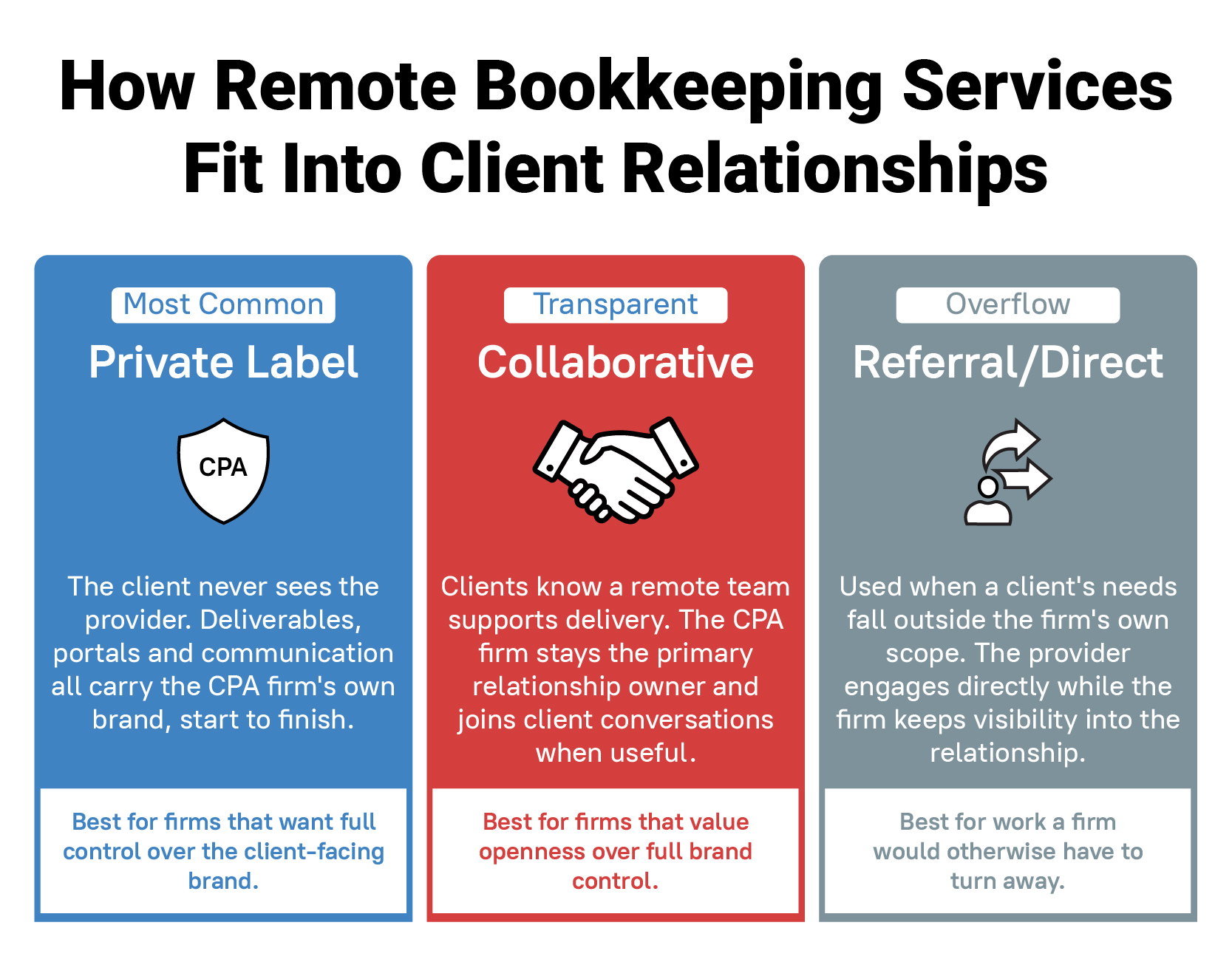
In a properly run private-label or collaborative engagement, deliverables arrive under the firm's own branding and timeline, with the remote team working behind that relationship rather than in front of it.
If output stays consistent, most clients have little reason to think about where the work happened at all.
3) Outcomes That Build Long-Term Confidence
Confidence compounds over a few close cycles, not a single month. The pattern is consistent: the first close gets watched closely, the second raises fewer questions, and by the third or fourth cycle the remote bookkeeping services relationship functions less like an experiment and more like a fixed part of the delivery model.
That is usually when firms start layering in adjacent work, moving from monthly bookkeeping into write-up support and eventually tax preparation outsourcing or controller-level review, creating a natural progression from bookkeeping to tax and advisory services as the practice grows.
How to Set Client Expectations When Using Remote Bookkeeping Services
A CPA firm does not need to hide the fact that some bookkeeping work is handled by a remote partner. What matters is how the firm explains it. Clients usually take their cues from the firm's confidence and clarity.
Addressing Questions About Oversight and Accuracy
When clients ask who is doing the bookkeeping, they are usually asking who remains responsible for the results. They want to know that questions will be answered, financial information will be protected, and the work will be reviewed properly.
The answer is straightforward.
The work follows the firm's standards and review process. The delivery model may change, but accountability does not change. The CPA firm still owns the relationship, oversees the work, and remains responsible for the outcome.
Explaining the Delivery Model Without Creating Concern
Most clients do not need a detailed explanation of workflows, systems, or review layers. A simple explanation is often enough. The firm has added dedicated bookkeeping capacity to support growth and maintain turnaround times. Every deliverable still goes through the same review process.
Clients rarely focus on outsourcing itself. They focus on whether communication stays consistent and work is delivered as expected. When expectations are clear, the delivery model becomes a much smaller part of the conversation.
The engagement is also structured to support the client relationship. The provider works within the firm's process and standards. The goal is to strengthen service delivery, not change the client experience.
Reinforcing Confidence Through Results
Results build confidence faster than explanations.
- Books are closed on time
- Reports arrive when expected
- Questions receive timely responses
- The quality stays consistent every month
Firms that focus on delivering those outcomes usually receive fewer questions about how the work gets done. Attention naturally shifts from the delivery model to the value being delivered. That is where long-term trust is built.
What to Look for in a Remote Bookkeeping Services Partner
Not every provider offering virtual bookkeeping services works the same way. Most firms sound similar during a sales conversation. They talk about experience, technology, quality, and support. The real difference becomes clear when you look at how the work is actually delivered.
Indicators of a Reliable Provider
A reliable partner can clearly explain how work is prepared, reviewed, and approved. They can show who is responsible for each stage of the process and what happens when issues need to be escalated.
Strong providers are also transparent about security, credentials, and business continuity. Rather than making broad claims, they can point to specific certifications, trained accounting professionals, documented workflows, and a clear backup plan if a key team member becomes unavailable.
They should also be able to share sample deliverables, relevant client experience, or examples of similar engagements. That gives CPA firms a clearer picture of what to expect before making a commitment.
Firms evaluating offshore and domestic options should take a closer look at areas such as communication, staffing structure, time-zone coverage, security controls, and long-term support. These factors often have a greater impact on success than location alone.
Questions CPA Firms Should Ask Before Engaging a Partner
A short list of direct questions can quickly separate a well-prepared provider from a polished sales pitch. Consider asking:
- Who reviews the work before it reaches my desk?
- What qualifications and experience does that reviewer have?
- What happens when a reconciliation does not balance?
- How are unusual transactions escalated and resolved?
- Is there a guaranteed response time for accounting questions?
- Who should we contact when an urgent issue arises?
- Can we see a sample month-end package before signing?
- Can you walk us through your review and quality-control process?
Providers that answer these questions clearly and confidently have usually invested time in documenting their processes, defining responsibilities, and establishing service standards before the engagement begins.
Why Process Matters More Than Location
Remote bookkeeping services are not inherently more or less reliable than an in-house team. Reliability is determined by the operating model behind the work.
Throughout this discussion, a consistent pattern emerges. Firms achieve stronger outcomes when work follows documented processes, moves through defined review stages, operates within clear communication standards, and remains visible to the people responsible for oversight. Those fundamentals support quality regardless of where the preparer sits.
For CPA firms facing capacity constraints, the decision is becoming increasingly practical. The question is no longer whether remote delivery can work. The more useful question is whether the provider's controls, review process, and accountability standards are strong enough to support the firm's client commitments.
The reliability equation:
Reliability = Process + People + Review + Visibility + Accountability.
A remote bookkeeping partnership should never be evaluated as a lower-cost substitute for an employee. The more meaningful comparison is between two operating models:
- One built around a single individual inside the organization
- One built around a distributed team supported by documentation, structured review, visibility, and clear accountability
Once the conversation moves from location to operational effectiveness, the decision gets a great deal easier to make on the merits.
Frequently Asked Questions
Are remote bookkeeping services reliable for CPA firms?
Yes, they can be. Reliability depends on having clear processes, proper reviews, secure systems, and good communication. The quality of the work matters more than where the person is sitting.
Do remote bookkeepers work directly with clients?
It depends on how the engagement is set up. Some CPA firms keep all client communication in-house, while others allow the remote team to interact with clients for specific accounting tasks.
How does a CPA firm maintain control over remote bookkeeping?
CPA firms maintain control through defined processes, regular reviews, reporting, access controls, and clear approval responsibilities. The firm remains responsible for oversight and final decisions.
Are virtual bookkeeping services slower than in-house bookkeeping?
Not necessarily. Turnaround times depend more on the process, staffing, communication, and technology being used. A well-managed remote team can be just as responsive as an in-house team.
What should a CPA firm review before choosing a provider?
Review the provider's quality checks, security practices, communication standards, review process, business continuity plans, technology, reporting capabilities, and overall experience before making a decision.
What is the difference between remote bookkeeping and outsourced bookkeeping?
Remote bookkeeping refers to where the work is done. Outsourced bookkeeping refers to who is doing the work. A remote bookkeeper can still be your employee, while an outsourced team works for an external provider.
Should a CPA firm outsource all bookkeeping at once?
Usually not. Many firms start with a small group of clients or a specific process first. This allows them to test quality, communication, and workflow before expanding the engagement.
What is the biggest mistake firms make when moving to a remote model?
The biggest mistake is treating it as a hiring decision instead of a process decision. Success depends on clear workflows, communication, review procedures, and accountability, not simply where the work is performed.


.svg)
.svg)