

Tax Season Burnout: How High-Performing Accounting Firms Stay Ahead of Busy Season



It is 11:47 p.m. on April 15. The coffee has gone cold. Somewhere in the office, a printer is still running the last extension request, and nobody has eaten a real meal since noon. That scene plays out in accounting firms across the country every busy season.
Tax season burnout has become part of the job. What most firms still do not understand is what it actually costs.
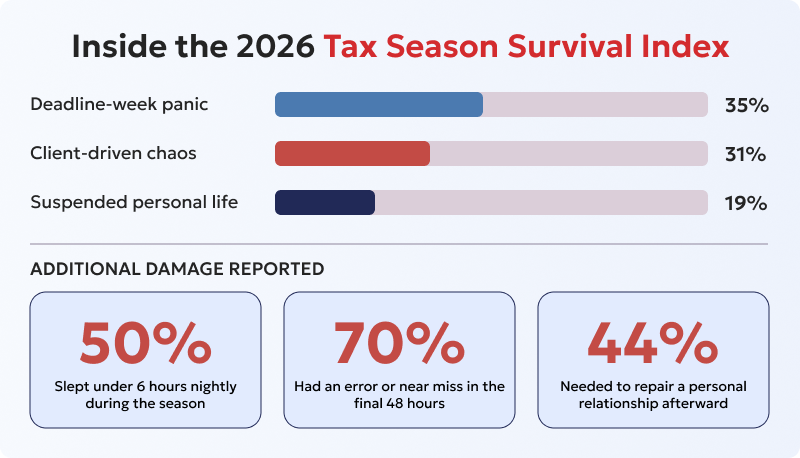
A 2026 survey of 438 United States accountants and tax professionals was conducted in the four weeks after the tax filing deadline. The average respondent scored 55.6 out of 100 on the Tax Season Survival Index, a new benchmark built to measure the impact of tax season on sleep, health, relationships, and decision-making.
Tax season burnout is usually described as a workload problem: too many returns, too little time, and too few people. The data tells a different story.
Firms with 51 to 200 employees scored much better on the index than firms with 6 to 15 employees. Both groups worked through the same filing deadline, the same regulatory changes, and a similar client workload per person.
The difference was not effort. It was structure.
This piece breaks down what actually drives tax season burnout; the three root causes firms most often misdiagnose, and what a genuinely sustainable tax season requires before the next one starts.
Why Tax Season Burnout Keeps Happening Every Year
Tax season burnout is not a new complaint. Every firm has heard it, said it, or lived through it. What changes very little from year to year is the response:
- Bring in a few contractors
- Push through the last two weeks
- Promise things will be different next April
Then April arrives, and the same pattern repeats.
The instinct is to treat tax season workload as fixed and unchangeable, something that arrives every February and cannot be reshaped. Research tells a different story. Workload alone is not what separates firms that recover quickly from firms that do not.
Part of the reason burnout keeps coming back is that firms treat it like the weather. It arrives on schedule, causes disruption, and eventually passes. That thinking feels reasonable during the busy season, when every week from February through mid-April becomes more demanding. But the Tax Season Survival Index highlights something important: not every firm experiences the same level of burnout during the same tax season.
Firms with more employees, working the same deadline as everyone else, scored meaningfully better than firms with fewer employees. That gap is the real subject of this piece, because it means tax season burnout is not simply a function of how much work exists between February and April. It is a function of how that work is designed to move through a firm.
"The profession has normalized something that should not be normal. BURNOUT."
Public accounting burnout has been documented for years, survey after survey confirming that nearly every tax professional feels it in some form. That research typically measures how bad busy season burnout gets.
A firm that believes tax season burnout is inevitable keeps treating it as a cost of doing business, something to survive rather than something to redesign. A firm that recognizes the gap between high scorers and low scorers is a design gap; starts asking a more useful question: what exactly is different about how the work moves.
A Few Things Worth a Second Look
Some assumptions about tax season burnout have been around for years. Here are three worth rethinking.
1) Hours Alone Do Not Explain It
Firms working the same number of hours report very different levels of burnout. The real difference is whether the hours were planned for or came as a surprise. A long week seen coming is far easier to handle than one that lands on top of an already full plate.
2) Burnout Does Not End on April 15
Tiredness and low motivation carry into the following months. Staff turnover at accounting firms tends to spike right after the deadline. That is a sign the damage builds up and shows itself later, not that it disappears the moment the last return goes out.
3) Extra Staff During the Season Is Not a Full Fix
New hires still need training and oversight, and that job falls on the same senior staff who are already stretched thin. Short-term help can ease the load, but only after it adds a bit more work to the people it was meant to help.
The Three Root Causes Most Firms Get Wrong
Ask a partner why tax season was brutal this year. The answer is almost always the same: not enough people, not enough hours. That answer is rarely wrong, but it is incomplete. Underneath the staffing story sit three specific causes, and they keep resetting the season back to zero every year. This is where accounting firm burnout actually starts.
Root Cause 1: Document Timing Gets Blamed on the Client
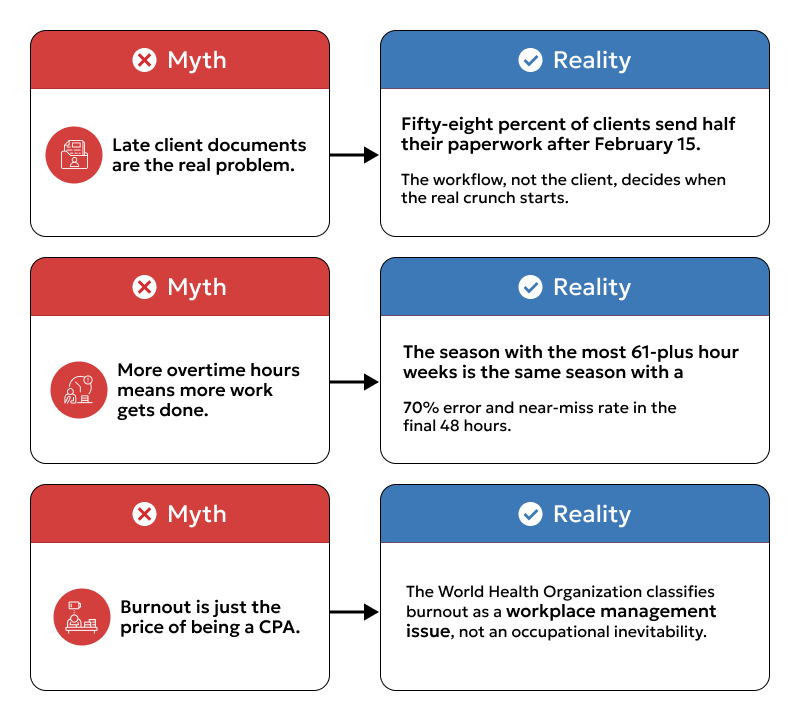
Every firm has this complaint: clients wait too long to send paperwork. The data backs this up, but not in the direction most partners assume. In the 2026 Survival Index, 58% of respondents said more than half their clients sent documents after February 15. That means the real crunch window is not January through April. It is the final six weeks; a period meant to be spread out that gets compressed instead.
Treating this as a client behavior problem misses the fix. It is a workflow gap, not a client habit. Firms without a structured intake system absorb the full cost as unplanned overtime in March and April. See Analytix's guide to keeping clients updated on accounting and tax law changes.
Root Cause 2: Overtime Gets Treated as the Fix, Not the Symptom
The instinct during a backlog is to add hours. More hours feel like progress. The Survival Index data says otherwise. In the same season, 70% of respondents admitted errors or near-misses in the final 48 hours. That is also the season where nearly a third of the profession logged 61 hours a week or more. Long hours and rising error rates show up in the same window, on the same returns. Tax season burnout compounds fast once weekly hours climb past a certain point.
Root Cause 3: Burnout Gets Treated as Inevitable, Not Preventable
The most common line in public accounting is some version of this is just the job. The World Health Organization disagrees. It defines burnout as an occupational phenomenon caused by chronic workplace stress that has not been managed well. That definition puts responsibility on management, not individual stamina. This distinction matters more than most firms realize when accounting firm burnout gets treated as a personal failing instead of a planning gap.
The desire for a better way is already there. Eighty-eight percent of public accountants say they want a better work-life balance. Eighty-seven percent want to work fewer hours. That is not a fringe complaint. That is close to nine in ten people doing the work.
"A missed deadline gets noticed within a week. A burned-out senior accountant gets noticed in March, when it is already too late to fix the season."
What a Better Tax Season Actually Needs
A tax season that does not overwhelm your team gets built long before January. A few simple things tend to separate firms that get through it smoothly from firms that struggle to the finish line.
Start Planning Before the Season
Nearly every firm already has a good idea how much work is coming, months in advance. Matching that expected work against actual staff hours turns tax season from a guessing game into a plan with a clear ceiling.
Give Every Person a Fair Workload Cap
When each preparer and reviewer has a clear cap, extra work becomes visible early, while there is still time to shift it around, instead of showing up as a missed deadline in the final week.
Send Client Requests Earlier
Sending engagement letters and document requests in December changes when documents actually show up. Firms that set an earlier deadline and follow up see far fewer clients sending documents in the final two weeks.
Spread Review Out Across the Season
When review only happens at the very end, it lands on the same few senior people at the same time, right when mistakes are most likely. A first review in February and a second in March keeps that pressure from building up all at once.
Let Technology Handle Repeat Tasks
Collecting documents, entering data, and doing a first pass on returns is where the most hours disappear. Automation can take on this repeat work, so senior staff can spend their time on the calls that need their judgment. This fits into a broader shift toward using better technology inside accounting firms, not just to save time, but to protect the team.
Review What Happened Once the Season Ends
Firms that pair better planning with real attention to staff well-being tend to see burnout drop significantly the following season, along with steadier output. That kind of result comes from reviewing the season while it is still fresh.
There is also a real cost of skipping all this. Replacing an experienced accountant costs somewhere between half and double their yearly pay once hiring, training, and the client knowledge that walks out the door are all counted. Fixing tax season burnout is not just about morale. It protects a real cost sitting on the firm's own books.
Where Outsourced Support Fits Without Disrupting Client Relationships
Real capacity needs to flex before the crunch, which raises the obvious next question: where does that capacity come from.
Hiring a permanent tax preparer to cover eight weeks of peak volume rarely works financially, and the pool of temporary, credentialed help shrinks every year along with the rest of the accounting talent pipeline.
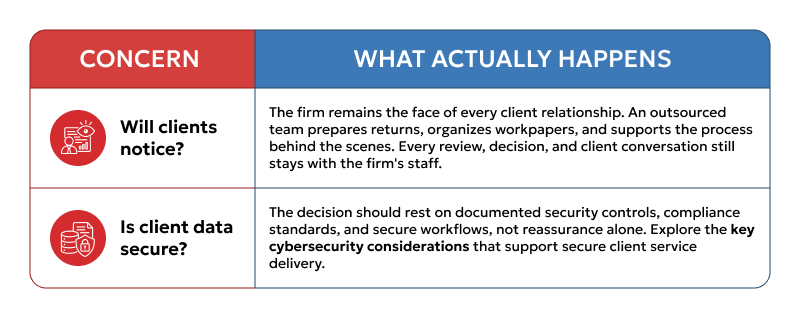
This is where many firms consider outsourced tax preparation support. The disruption they worry about, however, is usually the wrong one.
Technology Makes the Handoff Easier
Modern workflow and automation tools make it easier to assign defined preparation tasks without losing visibility into where a return stands. Instead of adding another communication layer, current accounting technology keeps work moving while letting firm leaders keep review control. Analytix's look at the role of AI in accounting and CPA firms explains how much of that coordination now happens automatically instead of manually.
Timing Determines Whether It Becomes a Strategy
The biggest difference is not whether a firm outsources. It is when the decision happens.
Analytix works with accounting and CPA firms on this kind of seasonal capacity planning. The Analytix accounting firms page outlines how that support is structured for firms that want to plan ahead rather than react in March.
Planning for Next Season Starts Now
Next tax season starts long before the first W-2 arrives. It starts with an honest look at where this season broke down: when client documents actually arrived, when review queues actually backed up, and when the team actually stopped sleeping well. That review carries more value in May, while the details are still fresh, than in December, when nobody wants to relive it.
Tax season burnout will not disappear because a firm wants it to. The data makes that much clear. What the same data also makes clear is that it is not fixed either. The firms that scored well on the 2026 Tax Season Survival Index did not work less. They worked inside a different structure. That structure is buildable, and the best time to start building it is now, while this season is still recent enough to remember exactly where it hurts.
Public accounting burnout studies will keep repeating the same headline every year unless firms act on the structural half of the story. Busy season burnout is not a fixed cost of the profession, and tax season workload is not the villain most partners assume. The real issue is how the work moves through the firm.
"Firms that scored well did not work less. They worked inside a different structure."
Frequently Asked Questions
1. Que: What is the Tax Season Survival Index?
Ans: The Tax Season Survival Index is a 2026 benchmark that scores accountants across five dimensions, caffeine dependency, sleep erosion, client-driven chaos, suspended personal life, and deadline-week panic, based on responses collected in the four weeks after the April filing deadline. A score above 50 indicates measurable cost to health and personal life.
2. Que: Is tax season burnout the same as ordinary workplace stress?
Ans: Not exactly. The World Health Organization classifies burnout as an occupational phenomenon resulting from chronic workplace stress a person has not been able to manage successfully, which is distinct from short-term stress. Tax season burnout, a seasonal form of accounting firm burnout, follows that same pattern on an annual cycle, and firms that treat it as ordinary stress rather than a structural pattern tend to see it recur every year.
3. Que: Why do smaller firms report worse burnout scores than larger firms?
Ans: According to 2026 Tax Season Survival Index data, firms with 6 to 15 employees scored worse than firms with 51 to 200 employees, despite working the same deadline. Larger firms are more likely to have distributed review processes and earlier client intake, which spreads the workload instead of creating a single review bottleneck at the end.
4. Que: Can outsourced tax preparation support actually reduce tax season burnout?
Ans: Yes, when it is planned ahead of the season rather than added during a crisis. This kind of support can absorb return preparation and documentation work behind the scenes, which reduces the volume compressed into the final weeks without changing who owns the client relationship.
5. Que: When should a firm start planning for the next tax season?
Ans: Firms that build seasonal capacity plans, including outsourced support, engagement letter timing, and review checkpoints, in the fall tend to fare better than firms that start planning in February. The planning window closes faster than most partners expect.


.svg)
.svg)