

Property Management Bookkeeping Services: 7 Functions That Break as Portfolios Scale



Your books close on the 12th instead of the 5th, and no one on your team can point to the exact reason.
Trust reconciliation shows a $340 variance you cannot trace. An owner has emailed twice asking why their statement runs longer than last month. Your senior accountant is out for a week, and half the workflow paused with her.
None of these is a crisis on its own. Together, they say your bookkeeping model has outgrown the setup that used to hold it.
This guide covers what property management bookkeeping actually has to do. It maps where the setup breaks first as a portfolio scales past 500 units. It shows how to bring the case to your CEO or CFO in language they will recognize. It is written for you, not to replace you.
The 7 Core Functions of Property Management Bookkeeping
Property management bookkeeping is not general bookkeeping done for a property firm.
Every function ties to a property, a unit, an owner, or a trust obligation. When any of these connections drifts, the error surfaces on an owner statement, in a trust reconciliation, or in an audit finding weeks later.
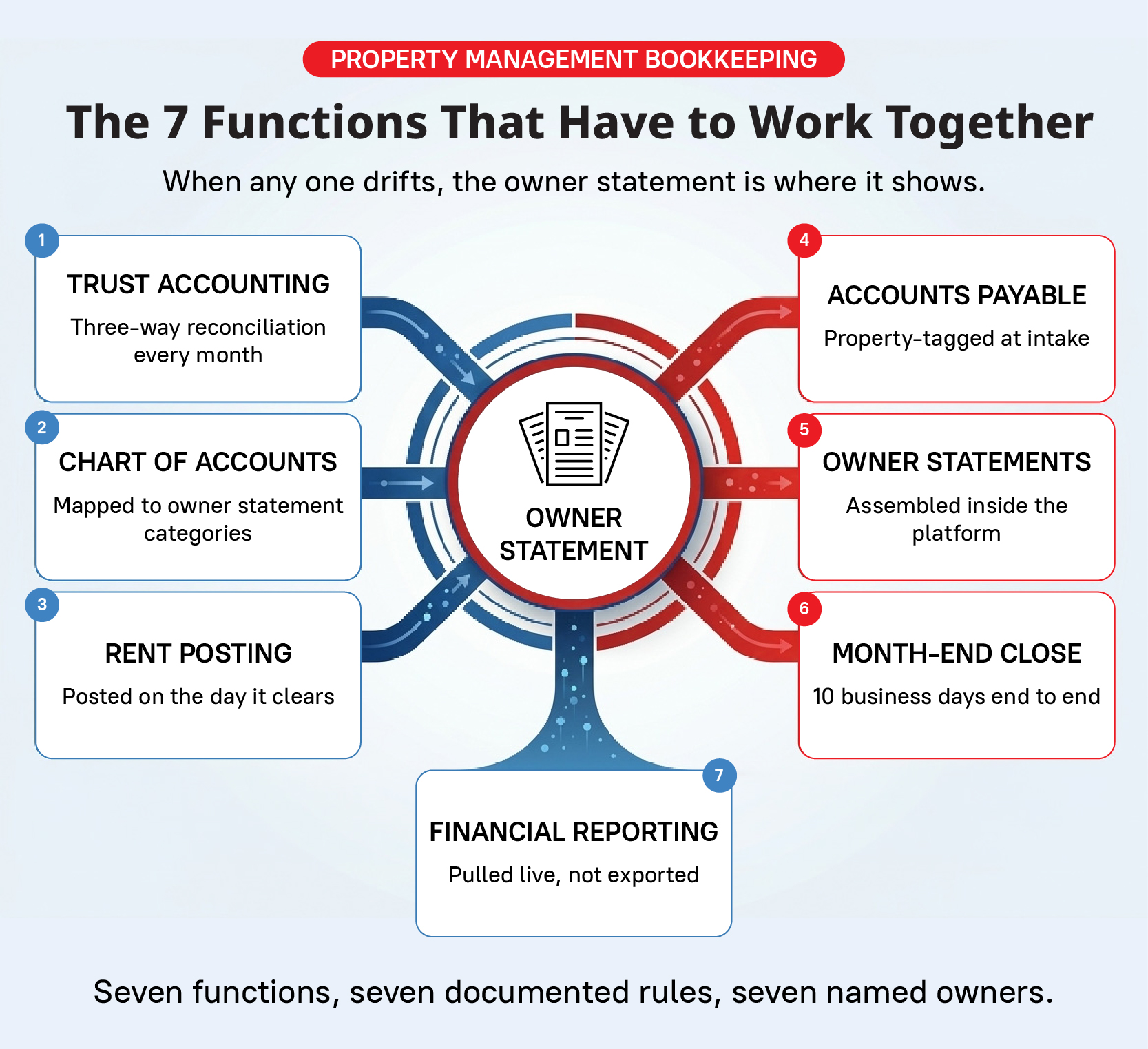
There are seven functions that usually carry the weight. When they are documented and owned, the books hold. When they run on tribal knowledge, the books drift.
1. Trust accounting and three-way reconciliation
Tenant deposits and owner reserves cannot mix with operating cash.
State real estate commissions require a monthly three-way reconciliation. Three balances have to match on the same date. The bank statement, the trust ledger inside your property management platform, and the sum of all individual owner and tenant sub-ledgers. Commission auditors examine exactly this reconciliation, and failures are among the fastest ways to trigger license discipline.
A generalist bookkeeper often treats a trust account like an operating account, which is where compliance exposure begins.
2. Chart of accounts and general ledger management
The chart of accounts is the spine of every report. In property management, it needs to map cleanly to owner statement categories rather than to internal reporting preferences. Charts built for internal use first create translation work at month-end that never fully clears.
General ledger discipline sits alongside it: journal entries posted daily, not batched at month-end, and property tags applied at entry rather than reconstructed later.
3. Rent posting and accounts receivable
Rent receipts are posted on the day they clear, directly to the correct property and tenant ledger.
When posting slips by a week, false delinquencies appear on rent rolls. Tenants get notices they should not have received, and your team spends the next month explaining.
Late fee accruals, prepayments and security deposit applications all flow through this function.
4. Accounts payable and vendor management
Every invoice needs to know which property it belongs to the moment it enters the system.
The specific failure modes and controls for accounts payable are covered in a companion accounts payable guide, so this guide will not repeat them. What matters here is that bookkeeping treats accounts payable as one function among seven, not as the whole job.
5. Owner statements and distributions
Owner statements are the output most of the other six functions feed. Reserve withholdings, management fee calculations, expense recharges and pass-through revenue offsets all show up on the statement.
When any upstream function breaks, the owner sees it here first. Distributions run on a predictable calendar, or they do not run at all.
6. Month-end close
Closing the books inside your property management platform, not next to it, is the difference between a 10-day close and a 20-day close.
The cluster benchmark is 10 business days end to end. Every other function has to finish inside that window for the close to hold.
7. Financial reporting to owners and management
Rent rolls, occupancy reports, delinquency reports, income and expense statements, budget variance reports. For commercial portfolios, CAM reconciliation statements sit alongside them.
Reporting is not a separate month-end activity. It is the readable output of the six functions before it. Reports that require assembly outside the platform are usually a signal one of those six is running in a spreadsheet.
4 Signals Your Property Management Bookkeeping Cannot Scale
The signals are quiet at first. Then they compound.
A Controller managing 500 to 2,500 units sees each one weeks before it reaches an executive dashboard.
That is why the diagnosis has to start on your desk.
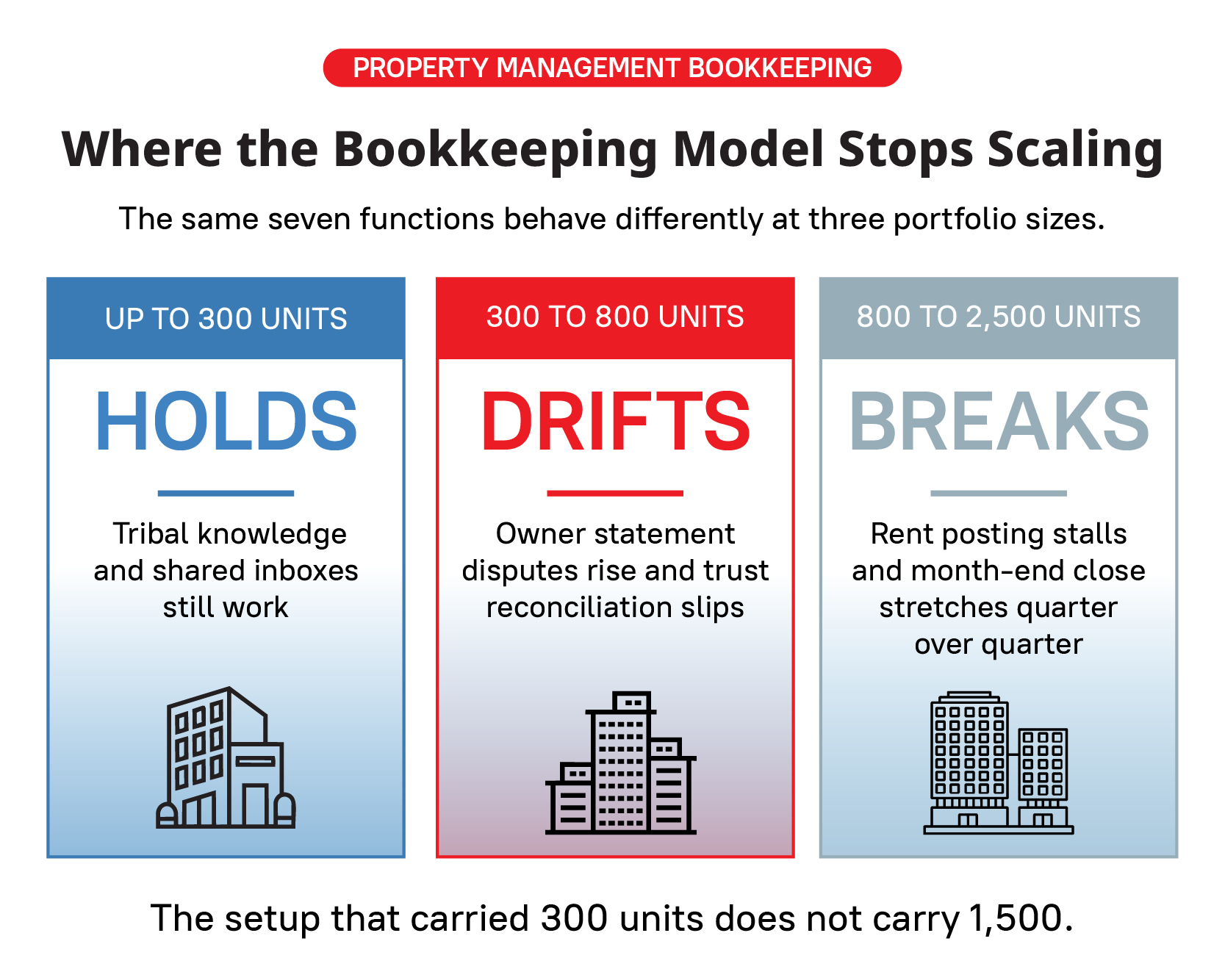
Signal 1: Owner statement disputes rise instead of shrink - Portfolios that have been running clean for two years suddenly generate the same questions from three owners in a month. The trigger is almost never a single coding error. It is usually a chart of accounts that has drifted from owner-facing categories. Sometimes it is a property-specific override no one documented when the owner requested it.
Signal 2: Trust reconciliation slips past close - The three-way reconciliation used to land on the second day of the close cycle. Now it lands on the fifth, then the seventh, then it becomes a running exception. Every month the variance is smaller than the effort to trace it, so it gets carried. Six months later, a state audit surfaces the accumulated drift.
Signal 3: Rent posting delays create false delinquencies - Payments sit unposted for four or five days after they clear the bank. Notices go to tenants who paid on time. Property managers call accounting to fix it. The books eventually catch up, but tenant trust does not.
Signal 4: Month-end takes longer every quarter - A close cycle that ran 10 business days last year now runs 12, then 14, then 18. The reason is rarely a single bottleneck. It is that every function is running on tribal knowledge. Each one is absorbing more portfolio strain than the original setup ever handled.
Any one of these on its own is a workflow tune-up. Two or more in the same quarter is a signal the model itself has stopped scaling.
What Property Management Bookkeeping Looks Like When It Works
Good bookkeeping at 500 to 2,500 units does not look dramatic. It looks quiet. The signals above do not appear. Owner statements go out on the same calendar day each month. Trust reconciliation lands on schedule. The senior accountant can be out for a week and the close does not stall.
A few operating patterns produce that quiet.
- A named owner runs every function: Not a role that someone happens to cover. A named person, documented, with a defined backup. When the named owner is out, the backup runs the function from the same written rule the owner would follow.
- A documented rule governs each function: Not tribal knowledge. A short written record of how it runs: the standard workflow, the exception path, the escalation trigger. New hires can pick it up in a day rather than shadowing for a month.
- Platform-native workflow keeps each function inside the system: AppFolio, Yardi, MRI or Buildium, whichever your team uses. When work moves to spreadsheets, the audit trail moves with it. Statements that require Excel to assemble are the clearest signal the platform is being sidelined rather than used properly.
- The month-end close runs on a fixed calendar and finishes inside 10 business days: Close discipline is what protects every function upstream of it. When close stretches quarter over quarter, one of the upstream functions is the reason. Not the close itself.
- Reporting is a pull, not a build: Owner statements, rent rolls, delinquency reports and variance reports come out of the platform in minutes, not hours. When a report takes hours to assemble, one of the seven functions is drifting.
In-House vs. Outsourced Bookkeeping: What Actually Changes at 500-2,500 Units
Every mid-size property management firm answers the bookkeeping capacity question one of two ways: build in-house or bring in a specialist team. Both work when the model fits the firm. Both create pain when it does not.
The primary break point for in-house teams is turnover. When a controller or senior bookkeeper leaves, months of institutional knowledge walk out with them.
The real cost of that turnover at a growing firm reaches further than most executives expect. The in-house versus outsourced comparison covers the cost and control trade-offs between the two models in detail.
The framing that helps most Controllers is not which model is better. It is which model your growth curve can absorb over the next 12 months. And whether the current setup is running clean at your current unit count.
Outsourced Property Management Bookkeeping: What Stays With You
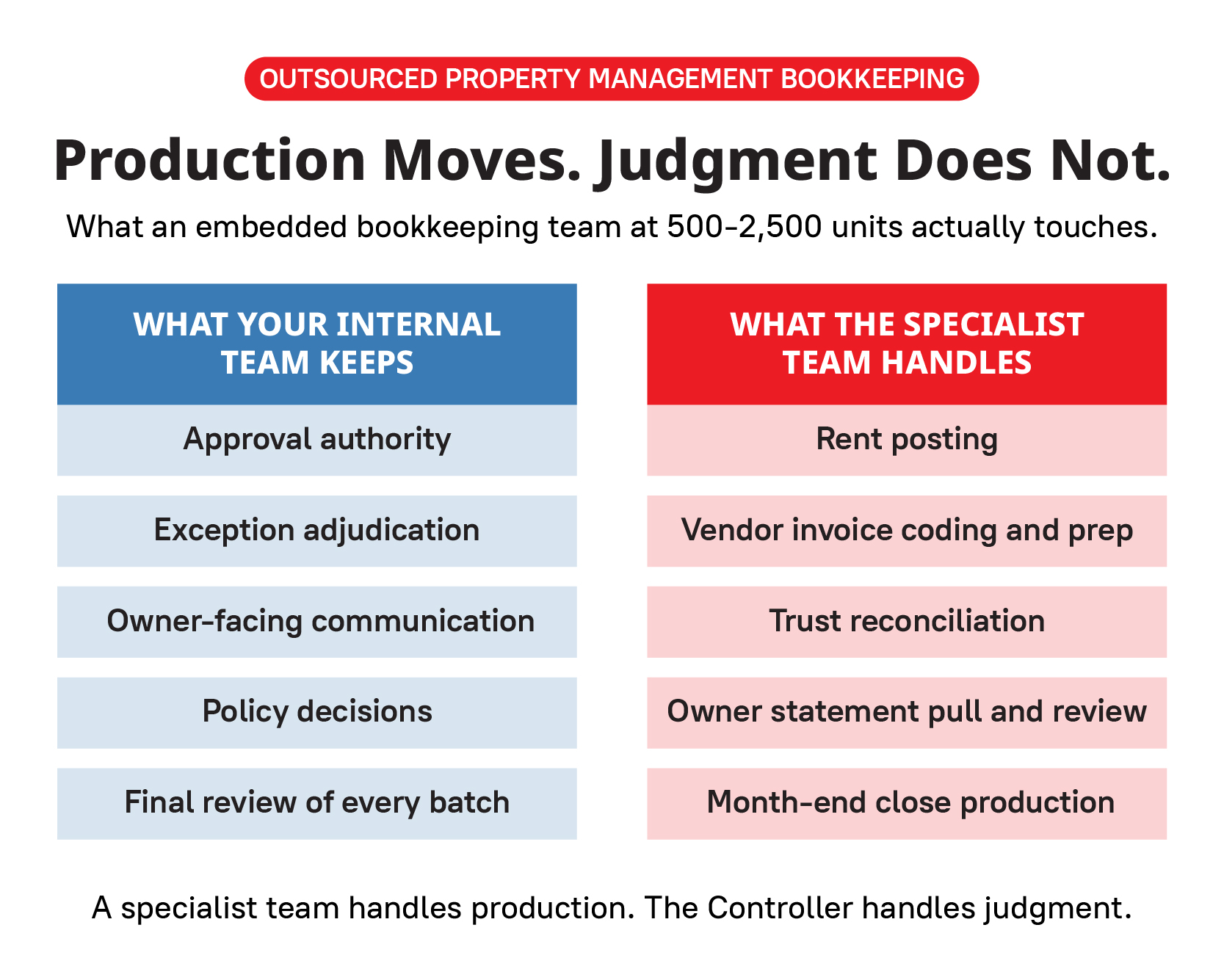
The word "outsourcing" changes the room. Before this section describes the specialist model, it names what stays with you. You keep approval authority, exception adjudication, owner-facing communication and policy decisions. A specialist team handles production, not judgment.
At the 500-2,500 unit range, the specialist model typically works like this.
Under this model, the specialist team takes the daily and weekly production of every function that runs on a defined rule. Rent receipts get posted on the day they clear. Vendor invoices get tagged, coded and prepared for approval. Trust reconciliation gets run against the three-way rule. Owner statements get pulled and reviewed before the calendar date. Month-end tasks land inside the platform on a documented cadence.
Your internal team handles every decision that requires judgment. You approve every batch. Exceptions the specialist team flags come to your desk for adjudication. Owner conversations, policy decisions and coding overrides route to your team. Final authority stays with you on everything that publishes.
The split works when the RACI is documented and followed. Every task has one named owner on each side. A documented escalation path handles the moments when either side misses. Nothing operates on assumption. This is also where the outsourcing category and the vendor comparison split cleanly. Once you decide the specialist model fits your firm, the questions worth asking before you sign become the next step. That guide covers them in depth.
One thing to settle before any external team touches financial data: ask for current security certifications and compliance documentation in writing. A specialist provider produces them without being chased.
How Analytix Solutions Delivers Property Management Bookkeeping Services
Analytix Solutions runs property management bookkeeping for firms at the 500-2,500 unit range. Your internal team keeps authority.
The delivery team handles production. Judgment stays with you. What follows is what that looks like in practice.
Extension of Your Team
The engagement runs inside AppFolio, Yardi, MRI or Buildium, whichever platform your team already uses. Communication happens directly with named individuals through your existing channels, not through an account manager. The close deadline drives the cadence, not vendor operational preferences. Final authority stays with your team on every batch.
Technical Depth
The delivery team brings property-management-specific accounting expertise. Trust accounting, chart of accounts configuration, three-way reconciliation, rent posting, owner statement preparation and month-end close inside the platform. Scope extends into controller-level review and adjacent work when the firm needs it.
Property management bookkeeping sits inside the wider real estate accounting services practice. Where CAM reconciliation or AppFolio-specific bookkeeping runs alongside the general books, both land on one delivery calendar.
Reliable Delivery
Delivery teams are pre-trained on AppFolio, Yardi, MRI, Buildium, Xero and QuickBooks before an engagement begins. Most property management clients are fully operational within two to three weeks of the onboarding call.
There is no ramp-up fee and no learning curve charged to you. Month-end close lands within 10 business days of period close, and reconciliation accuracy runs at 99.9% across client portfolios.
How to Bring the Bookkeeping Case to Your Executive Team
The quiet signals at the top of this guide are not going away. Portfolios keep growing and owners keep asking harder questions.
What carried 300 units does not carry 1,500 without a documented process behind every function.
Those four signals show up in some form inside every property management bookkeeping function that outgrows its original setup. The seven functions that hold the books together do not install themselves either. Someone has to name what breaks first and what a documented process looks like, in language a CEO or CFO will recognize.
When you name the pattern early, you change the conversation. It stops being a defense of why the books close on the 12th. It becomes a decision about which function to formalize first, on what timeline, against what measurable outcome.
A free real estate accounting audit produces the written evidence to bring to that conversation. It is a diagnostic, not a proposal.
You keep the authority, the deliverable and the decision on what to do next.
Frequently Asked Questions
What Are Property Management Bookkeeping Services?
Property management bookkeeping services cover the recording, reconciling and reporting of every financial transaction tied to a property, a unit, an owner or a lease. Seven core functions define the scope. They are trust accounting, chart of accounts, rent posting, accounts payable, owner statements, month-end close and financial reporting. Every function has to run inside the property management platform, not next to it.
How Are Property Management Bookkeeping Services Different from General Bookkeeping?
Every transaction in property management bookkeeping ties to a specific property, owner or trust obligation. The coding decision flows straight to the owner statement. General bookkeeping treats accounts as flat categories. That is why generalists working in AppFolio, Yardi, MRI or Buildium tend to miss trust accounting rules, three-way reconciliation requirements and property-level coding standards. The gap surfaces on owner statements, in trust variances and in audits.
When Should a Property Management Firm Outsource Bookkeeping?
Two conditions usually trigger the decision. First, growth is outpacing hiring capacity. The talent pool for real estate-trained accountants is thinner than the job posting suggests. Second, the current setup is showing the four signals above. Rising owner statement disputes, trust reconciliation slipping past close, rent posting delays, and month-end getting longer every quarter. Firms with stable internal talent and 400 units of clean growth ahead may not need to outsource. Firms scaling faster than that, or absorbing a new portfolio type, usually do.
What Software Do Property Management Bookkeepers Use?
AppFolio, Yardi, MRI and Buildium are the four platforms most mid-size property management firms use. Xero and QuickBooks Online appear when the firm layers general business accounting on top of the property management platform. A specialist bookkeeping team is pre-trained on all of them. Onboarding lands in two to three weeks rather than the weeks a generalist needs to learn the platform on your data.
How Do You Maintain Control When Outsourcing Bookkeeping?
Through a documented RACI that keeps approval authority, exception adjudication, owner communication and policy decisions with your internal team. The specialist team handles rent posting, vendor invoice coding and prep, trust reconciliation, owner statement production and month-end close inside the platform. Every batch runs through your internal approval before it publishes. Every exception routes to your team for adjudication. When you document and follow the split, control gets stronger because the workflow becomes explicit.
How Much Do Property Management Bookkeeping Services Cost?
Pricing scales with portfolio size, transaction volume and scope of work. A firm managing 500 units with a clean AppFolio setup pays less than a firm managing 2,000 units across multiple platforms. Commercial CAM reconciliation and multi-entity consolidation add scope. The more useful comparison for a Controller building the case internally is not sticker price. It is cost per reconciled unit against the fully loaded cost of an internal senior accountant, benefits and turnover risk included.


.svg)
.svg)