

The Real Cost of Controller Turnover at a Growing Property Management Firm



A controller's resignation letter is usually just two paragraphs long. The financial impact, however, lasts for months. Most real estate CFOs measure the loss using one number: the replacement salary. That number hides almost every cost that follows.
Reconciliations start slipping, owner statements miss their usual deadlines, and audit trails develop gaps that nobody notices until somebody goes looking.
"A controller’s resignation letter may be only two paragraphs long, but for a growing property management firm, the business impact can last for months. The risk is not just replacing a finance leader. It is keeping reconciliations current, owner statements on schedule, and audit trails complete while critical knowledge walks out the door."
This scenario plays out across growing property management firms every day. One resignation can disrupt the entire accounting function. Yet many leadership teams still rely on posting job opening and hoping for the best. That is where real estate accounting services become valuable. They remove single-person dependency before it turns into a costly business problem.
Consider the numbers.
According to SHRM, replacing an employee can cost 50% to 200% of their annual salary. Senior and specialized roles typically sit at the higher end of that range. A property management controller is one of those specialized roles. They understand far more than the numbers. They also carry years of institutional knowledge, including:
- State-specific trust accounting requirements
- Owner communication and reporting preferences
- Property-specific accounting exceptions
- Internal approval workflows
- Month-end close processes and deadlines
When that person leaves, the business loses much more than a salary line. It loses the operational knowledge holding the accounting function together.
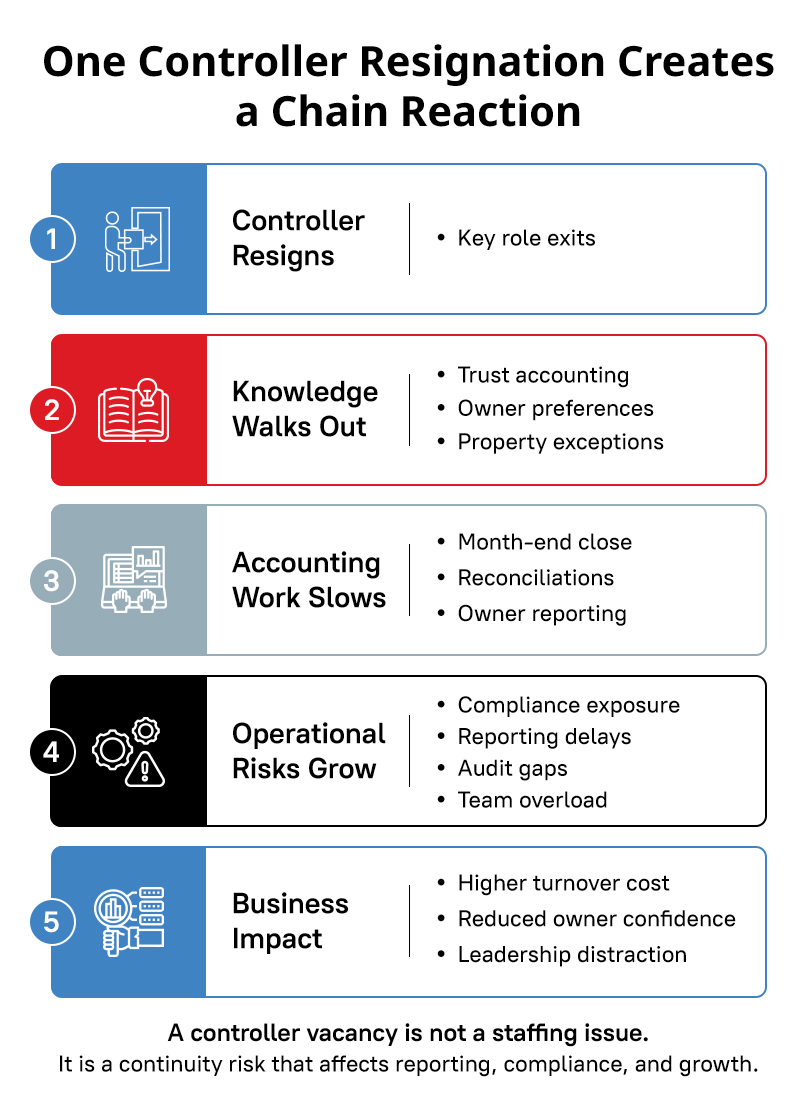
What Actually Happens the Week a Controller Resigns
The first week after a controller resigns rarely looks dramatic. Inside the finance team, it is a different story. Most controllers give two to four weeks' notice. During that time, they are expected to finish month-end work while preparing for their departure. Long-term planning naturally takes a back seat.
Even when handover documents exist, they rarely capture the knowledge that keeps accounting running smoothly. That includes:
- Vendors who always need extra review
- Owners who expect detailed quarterly updates
- Properties with unusual lease structures
- Recurring accounting workarounds
Once the controller leaves, those knowledge gaps become operational gaps. All that work now falls on a smaller team with less experience. Each week the role stays vacant, the risk of a compliance mistake goes up.
The Direct and Hidden Costs of Controller Turnover
Many real estate CFOs assume the replacement salary is the biggest cost of losing a controller. Research from the Center for American Progress pooled 31 case studies drawn from 11 published papers, and the findings split sharply by wage level. For most workers, replacement cost landed near 20% of annual salary. For highly skilled senior positions, it reached 213%. A property management controller belongs to that higher-cost category. Replacing one is rarely as simple as swapping one salary for another.
Here is where those costs usually come from.
Every row in that table compounds on the one before it. A firm that budgets only for a replacement salary is planning for roughly a third of the actual controller turnover cost.
73 Days: Why Property Accounting Controllers Take Longer to Replace
Finding a qualified property accounting controller has become increasingly difficult over the past few years. The numbers explain why. Industry data based on AICPA figures shows the number of licensed accountants in the United States dropped from nearly 2 million in 2019 to just over 650,000 by August 2025. That is a decline of roughly 66%, driven by retirements and a shrinking pipeline of new graduates.
The talent pool behind that hire keeps thinning. NASBA counted 653,408 actively licensed certified public accountants (CPAs) in the United States as of August 2025, down from roughly 672,000 a year earlier. The pipeline feeding that pool is narrowing faster. Accounting degrees fell to 55,152 in the 2023-24 academic year, a third straight annual decline, according to the AICPA 2025 Trends report. New CPA exam candidates dropped from 42,626 in 2023 to 28,082 in 2024, a fall of 34% in a single year.
Demand has not moved with it. The Bureau of Labor Statistics projects roughly 124,200 openings for accountants and auditors every year through 2034. Fewer credentialed people, the same volume of open seats.
Property management makes hiring even more difficult, because a controller in this industry needs expertise beyond traditional accounting. They must understand trust accounting rules, CAM reconciliations, owner reporting standards, and platforms like AppFolio or Yardi.
Most corporate controllers do not have that combination of skills.
Growing firms are not just competing for accounting talent. They are competing for a much smaller group of professionals with property management experience.
The 6-Month Capacity Gap Missing From Your Budget
Here is the timeline most firms never map out. The search usually opens at or just after the departure, which puts 73 days on the clock with the seat already empty. A new controller then needs three to six months before running a close, a reconciliation cycle, and an owner reporting package without supervision. Added together, the firm operates below full accounting capacity for roughly half a year.
Property accounting does not pause for any of it. Across those months, the same work keeps arriving on schedule:
- Monthly three-way trust account reconciliations
- Month-end close every 30 days
- Owner statements delivered on schedule
- Vendor payment approvals
- Board-ready financial reporting
- Ongoing compliance documentation
None of these responsibilities wait for a new hire.
Your close cycle tells you how much room you have. A healthy month-end close at this size should run within 10 business days. If it was already running past that with a controller in the seat, it will not hold once the seat is empty. Six months is not a hiring delay. It is half a year of greater compliance risk, slower reporting, and heavier workloads for the remaining team. For firms managing 500 or more units, that exposure carries real financial and reputational consequences.
A Worked Example of the Real Cost
Put actual numbers against it. Imagine a growing property management firm managing 1,200 units. Its controller earns an annual salary of $145,000. Here is what one resignation could realistically cost:
Even at the bottom of that range, one resignation costs half a year of the salary the firm was trying to protect. At the top, it costs two years of it.
What does not show up in the spreadsheet?
- An owner losing confidence after receiving two late statements.
- A board member questioning internal controls.
- The finance team stretched beyond capacity.
- Leadership spending valuable time solving accounting issues instead of growing the business.
Those costs may not carry a dollar value, but they can have a lasting impact on client trust, operational stability, and future growth.
Real Estate Accounting Services as Structural Insurance
When a controller resigns, most firms react the same way: hire another controller as quickly as possible. It feels like the right solution. But it only replaces the person, not the risk. A departure does not just remove an employee. It removes continuity.
A team-based real estate accounting model takes a different approach. Instead of relying on one individual, they spread responsibility across a dedicated property management accounting team. The team documents the process, shares it, and backs it with specialists who already understand property management accounting.
The result looks very different.
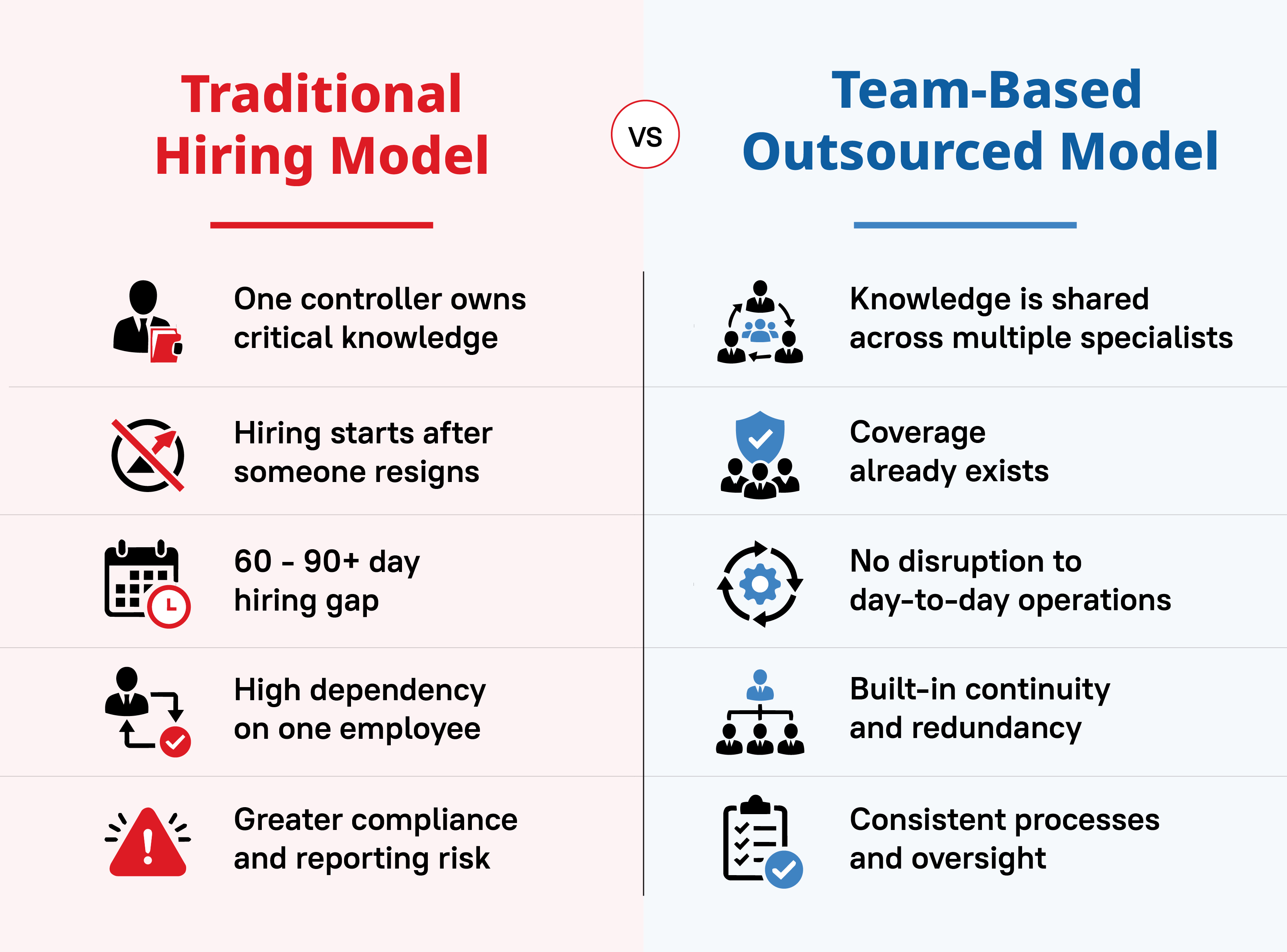
Think of it as structural insurance. If one team member is unavailable, changes accounts, or leaves, another trained professional steps in. Reporting continues, reconciliations stay current, and owner statements go out on time.
How Outsourced Controller Services Actually Work
Outsourced controller services replace a single job title with a documented, cross-trained process. More than one person runs bank, ledger, and deposit reconciliations. Month-end close follows a checklist rather than a memory. Owner reporting continues on schedule because the process does not live inside one individual's calendar.
For a real estate CFO who has already lived through one resignation, that structure removes the anxiety of wondering when the next one will hit.
What the Controller Keeps
A team-based structure does not remove the controller. It removes the exposure the controller has been carrying alone. Review, judgment, owner relationships, and final sign-off stay in house, where they belong. What moves off the desk is the transactional volume, the reconciliation grind, and the coverage problem.
Most controllers at this size spend their week on work well below their pay grade, because there is nobody else to do it. Handing that off is not a demotion. It is the first time the role gets to operate at controller level.
What Changes and What Stays With You
Every one of these conversations lands on the same three things, so here they are up front.
- Cost: A full accounting team for a portfolio this size runs $4,000 to $8,000 per month. Against a single loaded controller at $100,000 to $135,000 a year, the comparison is not close.
- Speed: Most property management clients are fully operational within two to three weeks of the onboarding call. That timeline matters most to the firm that lost a controller last Friday.
- Control: The team works inside your AppFolio, Yardi, MRI, or Buildium environment under your own user permissions. No separate portal, no data migration, no second copy of your financials sitting somewhere else.
5 Questions to Ask Before You Rely on One Person Again
Before assuming the next hire solves the problem, a few questions are worth asking internally.
- Does the accounting function depend on knowledge that lives only in one person's head?
- If that person left tomorrow, how many days would pass before an owner statement went out late?
- Can more than one person on the team run a full trust accounting three-way reconciliation without supervision?
- What happens to month-end close if the controller is unavailable for two weeks during a transition?
- Is the current setup scalable if the portfolio grows by 300 units next year?
If any of those questions produce an uncomfortable answer, the firm is carrying more single-person risk than leadership may have realized. This is precisely the gap that structured property management accounting services are designed to close. The broader signs that a firm has outgrown its current accounting setup are worth reviewing alongside these questions.
The Real Question for a Growing Property Management Firm
What happens to your accounting function if your controller resigns tomorrow? That is the question every growing property management firm should be asking. Firms with documented, team-based processes continue operating with confidence, while others spend the next quarter rebuilding knowledge that was never documented. The difference often comes down to a decision made long before the resignation.
How Analytix Solutions Helps
Analytix Solutions helps property management firms build resilient accounting operations through dedicated, team-based real estate accounting services. From bank and ledger reconciliations to owner reporting and month-end close, experienced professionals deliver continuity, reduce reliance on key individuals, and support scalable growth across expanding portfolios.
Explore how a team-based accounting model can strengthen your finance function. See what is possible before the next staffing change puts operations at risk.
Frequently Asked Questions
1. How much could controller turnover cost my property management firm?
The total cost often extends far beyond the replacement salary. Recruiting, vacancy coverage, onboarding, lost productivity, and compliance risks can push the true cost to 50% to 200% of a controller's annual salary, according to SHRM. Research from the Center for American Progress reached a similar ceiling by a different route, finding replacement costs of up to 213% of salary for highly skilled senior roles.
2. How long should I expect it to take to hire a new property accounting controller?
CPA-required finance roles take an average of 73 days to fill nationally. Finding someone with property management experience, trust accounting knowledge, and AppFolio or Yardi expertise can take even longer.
3. My controller handles almost everything. Should I be concerned?
Yes. If one person owns trust accounting, month-end close, owner reporting, and compliance, your firm carries significant operational risk. A documented, team-based process helps reduce that dependency without removing the controller role.
4. What happens if my controller leaves before we find a replacement?
Property accounting responsibilities do not pause. Trust reconciliations, owner statements, month-end close, and compliance deadlines still need attention, making prolonged vacancies both operationally and financially risky.
5. Would outsourced real estate accounting services be a better long-term option?
For many growing firms, yes. A team-based model provides continuity, shared expertise, and standardized processes that reduce disruption when staffing changes occur.
6. How can I tell if my accounting team relies too heavily on one person?
A simple test is to ask yourself: Could someone else step in tomorrow and complete trust reconciliations, close the books, and deliver owner reports using documented processes? If the answer is no, your firm may be carrying more operational risk than you realize.


.svg)
.svg)