

Real Estate Bookkeeping: What Yardi Specialist Support Looks Like Inside Your System



A bookkeeping team can understand accounting and still create more work for a controller if it does not know how that accounting should flow through Yardi.
That is the gap many property management firms discover as the portfolio grows. It becomes a routine where:
- Teams export invoices for review
- Accountants complete reconciliations in Excel
- Accountants prepare journal entries outside the system
- Controllers clean up reports before review
These practices do not necessarily signal poor accounting. They show the difference between understanding accounting principles and understanding how accounting works within a property management platform.
Yardi Voyager brings property operations, accounting and reporting into one platform. Yardi describes Voyager as supporting accounting functions such as accounts payable, accounts receivable, general ledger and financial reporting. For a controller, however, the important question is not whether an outsourced team can say it "uses Yardi."
The better question is:
Can the team perform property accounting inside Yardi in a way that reduces review work instead of creating more of it?
That distinction defines specialist Yardi accounting support.
Why Real Estate Bookkeeping Looks Different Inside Yardi
General bookkeeping skills still matter. Accountants need to post transactions, maintain the general ledger, reconcile accounts, and prepare financial information.
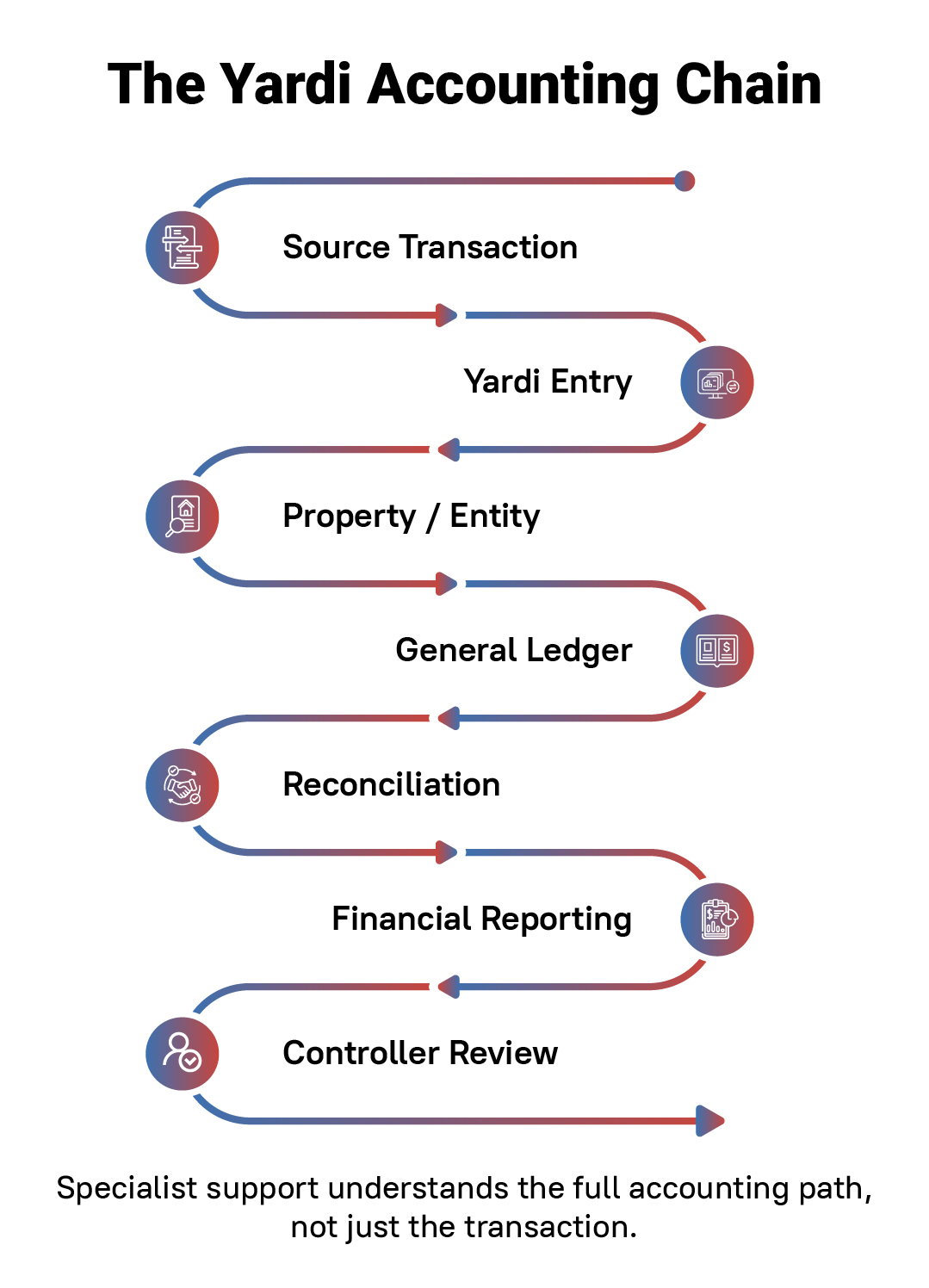
Property accounting adds another layer. The work sits inside a property management environment where accounting activity can connect to properties, entities, tenants, owners, and reporting structures. The quality of the work therefore depends on understanding both the accounting entry and where that entry belongs within the operating system.
The U.S. Bureau of Labor Statistics includes posting transactions, maintaining ledgers, reconciling accounts, and producing financial reports among the duties of bookkeeping and accounting clerks. Those fundamentals remain important. The specialist difference is the property context in which those fundamentals are applied.
The Difference Is Where the Work Happens
A general accounting team may understand how to reconcile a bank account.
A Yardi-specialized team should also understand how that reconciliation fits into the property's accounting structure, how discrepancies affect the general ledger and what the controller needs to review before the period closes.
The second question is where platform fluency becomes valuable.
What Generic Outsourced Bookkeeping Support Looks Like
Generic outsourced bookkeeping can look attractive at first. The provider has accountants, the team understands debits and credits, the monthly fee fits the budget, and the implementation sounds straightforward.
Then the work begins.
- Can you show us how your Yardi setup works?
- Can you export that report for us?
- Where should we code this transaction?
- Can you send the spreadsheet you use for reconciliation?
Those questions can be reasonable during discovery. They become a concern when they continue after the team is expected to operate independently.
A controller should provide portfolio context and accounting judgment. The controller should not become the outsourced team's basic Yardi trainer.
The Spreadsheet Detour
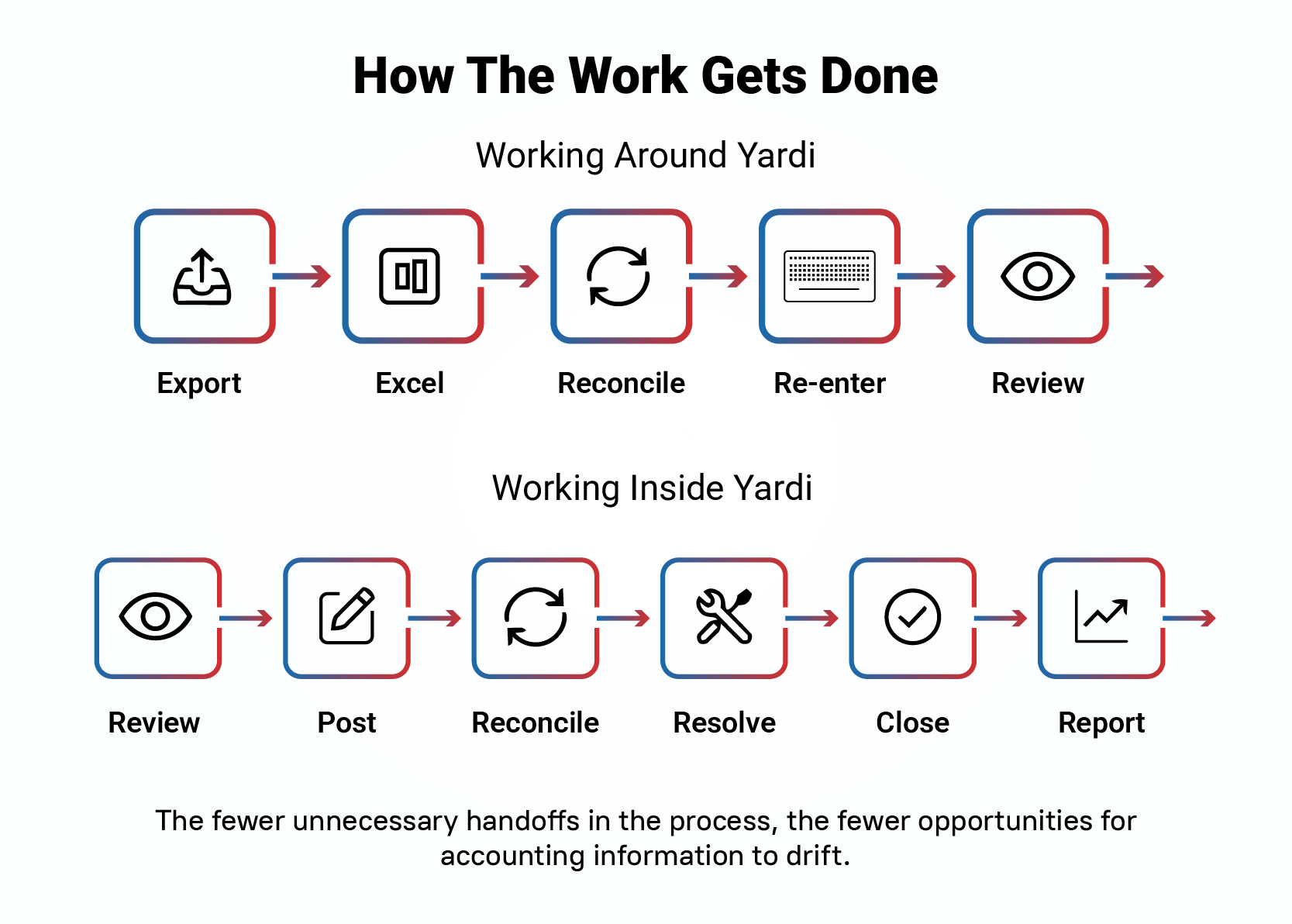
Consider a bank reconciliation. A generalist team exports transactions from Yardi, downloads bank activity, matches the two files in Excel and sends the spreadsheet to the controller.
The reconciliation may still be accurate. The process creates another review question:
Why is the controller reviewing a spreadsheet instead of reviewing accounting work that is already organized in the system?
That distinction becomes more important as the portfolio grows. A multi-unit operation may absorb a few manual workarounds. A larger portfolio with multiple properties, entities, and reporting requirements has less room for processes that depend on individual memory or spreadsheet cleanup.
As those operational demands increase, many firms begin reevaluating whether accounting is better managed in-house or through an outsourced support model. The right answer often depends on the complexity of the portfolio, reporting requirements, and internal resources available.
What Yardi-Specialized Outsourced Bookkeeping Support Looks Like
A Yardi-specialized outsourced accounting team takes a different approach from the start. The team works within the property's existing Yardi environment instead of relying heavily on exports, spreadsheets, and workarounds.
The team can:
- Complete reconciliations within established workflows.
- Code transactions to match the property's reporting structure.
- Follow financial reporting processes that already support the platform.
- Keep accounting activity organized for controller review.
This approach gives the controller more time to review accounting work instead of interpreting or rebuilding it.
A Yardi-specialized accounting team should understand how to work within the existing accounting environment while following the property's established processes. That work can include:
- Accounts payable
- Accounts receivable
- Cash management
- General ledger management
- Bank and balance sheet reconciliations
- Month-end activities
- Property financial reporting
- Variance reporting
- Owner reporting
- Budgeting and forecasting support
The goal is not to make Yardi look impressive. The goal is to make the accounting function easier for the controller to manage.
5 Signs a Yardi-Specialized Team Is Actually Platform-Fluent
1. They Ask About Your Process, Not How Yardi Works
Every portfolio has its own chart of accounts, approval rules, reporting expectations, and property-level exceptions. A specialist still needs to learn your environment. The difference comes from the quality of the questions.
The conversation should move quickly toward portfolio structure, month-end procedures, reconciliation requirements, reporting expectations, and known exceptions. Those questions give the team the context it needs without making the controller teach basic platform navigation.
2. They Understand the General Ledger in a Property Context
The same transaction can look correct in the general ledger and still create reporting challenges later. Property accounting requires decisions that support property-level reporting, entity-level reporting, and management review.
Specialists understand those downstream effects. They think beyond the transaction and consider how accounting will appear during review and how leaders will use the information across the portfolio.
3. They Treat Reconciliations as a Control, Not a Spreadsheet Exercise
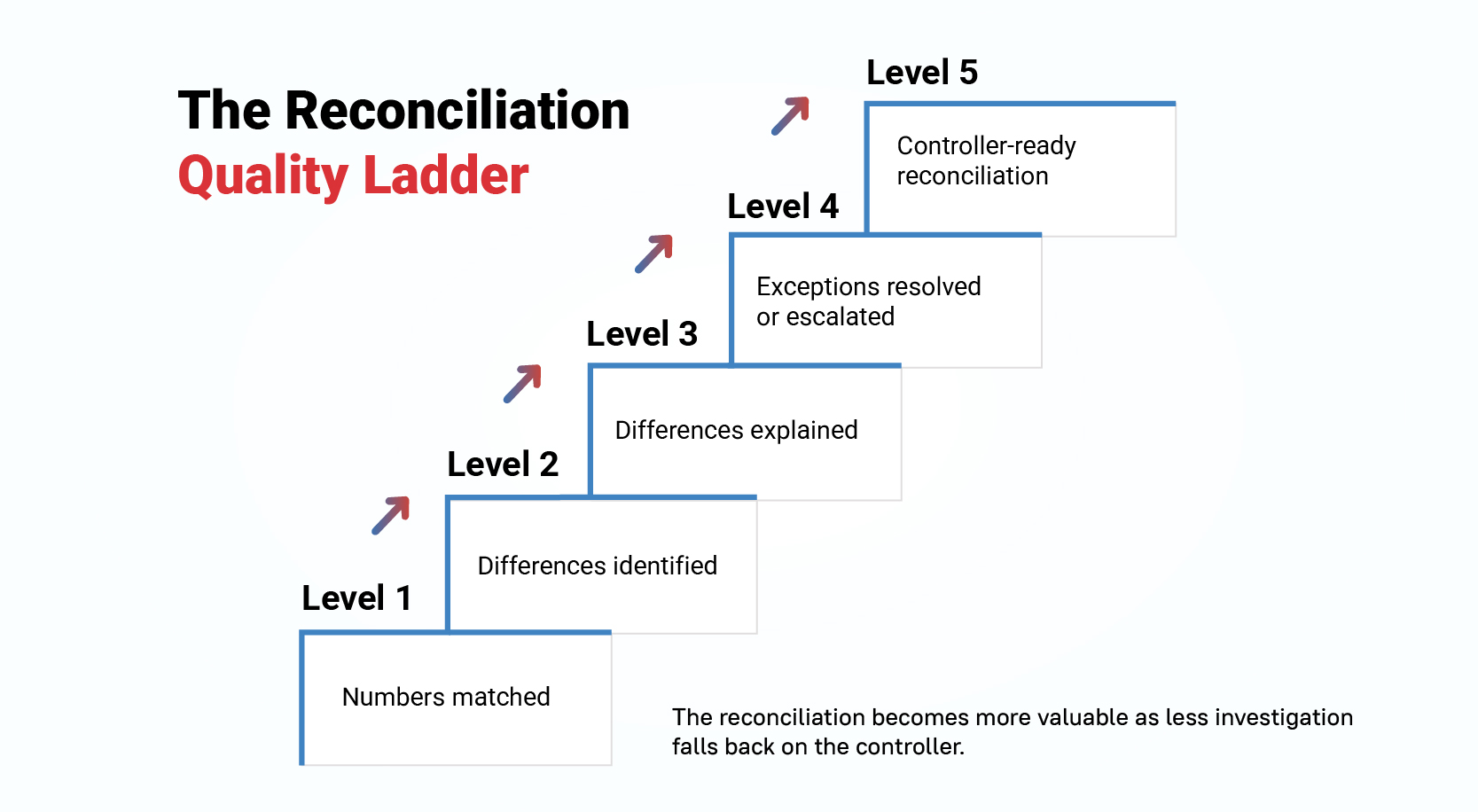
A completed reconciliation does not always mean the team has finished the work. Matching balances represents only one part of the process.
Strong accounting teams look for unusual items, investigate differences, and resolve questions before they reach the controller. The process should surface exceptions instead of simply documenting them.
4. They Know What the Controller Needs to See
Controllers rarely struggle because they lack data. More often, they struggle because important information gets buried inside the data.
Useful review packages bring attention to unresolved items, unusual balances, and meaningful variances. That allows review time to focus on decisions and oversight rather than information gathering.
5. They Can Explain the Workflow Clearly
Questions will arise during the close process. What matters is how quickly the team can answer them.
A capable accounting team can trace activity from transaction to report, explain what happened, identify what remains open, and clarify what requires review. That visibility gives the controller confidence in the underlying process.
Platform fluency helps explain how work gets done. The next consideration is where that expertise can support the day-to-day real estate bookkeeping process within the Yardi environment.
Key Areas of Real Estate Bookkeeping Support Inside Yardi
The strongest test of a Yardi accounting partner is the work it can own inside the system. For a growing property management firm, that work should connect daily accounting activity to month-end close, and controller review.
1. Accounts Payable
Accounts payable can become a volume problem as a portfolio expands. The work includes reviewing invoices, coding expenses correctly, processing approved items and maintaining accurate records.
For a specialist team, property context matters. The team should code each invoice to the right property and account without requiring the controller to correct basic decisions later.
The benefit comes from reducing downstream cleanup, not simply increasing processing speed.
2. General Ledger Management
General ledger management is where individual transactions become financial information leadership can use.
Specialist support should include accurate posting, appropriate coding, recurring accounting activity, and review of unusual entries. For multi-property organizations, consistency matters as much as individual accuracy.
A controller should be able to compare property financials without wondering whether each property followed a different accounting convention.
3. Bank and Balance Sheet Reconciliations
Reconciliations are one of the clearest places to distinguish task completion from accounting control.
Completing the reconciliation matters. The accounting team must also understand and document the reasons behind any variances.
The accounting team should identify outstanding items, investigate unexplained balances, and escalate exceptions that require controller judgment. The result gives the controller a cleaner review point.
4. Month-End Close Support
Month-end close brings multiple accounting workflows together. Accounts payable, accounts receivable, cash management, reconciliations, journal entries, and reporting all need to come together.
For the Tier 2 portfolio segment, Analytix Solutions uses a 10 business day close framework as the operating benchmark for a healthy month-end process. The benchmark should be treated as a workflow target, not a universal rule for every portfolio.
Close timing matters because delayed accounting pushes reporting and review later in the cycle. A specialist team can support the close by completing the accounting work that feeds controller review rather than waiting for the controller to assemble it.
5. Property Financial Reporting
Property financial reporting should make the portfolio easier to understand. That requires more than producing financial statements.
The accounting team needs to maintain the underlying data accurately enough for the controller to review revenue, expenses, balances, and variances without rebuilding the reporting package.
Support may include:
- Financial reporting
- Variance reporting
- Owner reporting
- Month-end reporting
- Property-level reporting
- Budgeting and forecasting support
6. Accounts Receivable and Cash Management
Accounts receivable and cash management require the same platform awareness. The accounting team needs to maintain accurate records, process activity correctly, and reconcile balances, so the financial picture reflects what has actually happened.
For controllers, the important question is often less "Was the transaction posted?" and more "Does the balance make sense?" Specialist support should help answer that question before the reporting package reaches leadership.
The need for this level of support develops gradually. As accounting demands increase, growing portfolios often create similar operational pressures and prompt firms to evaluate additional support.
Common Triggers for Seeking Yardi Accounting Support
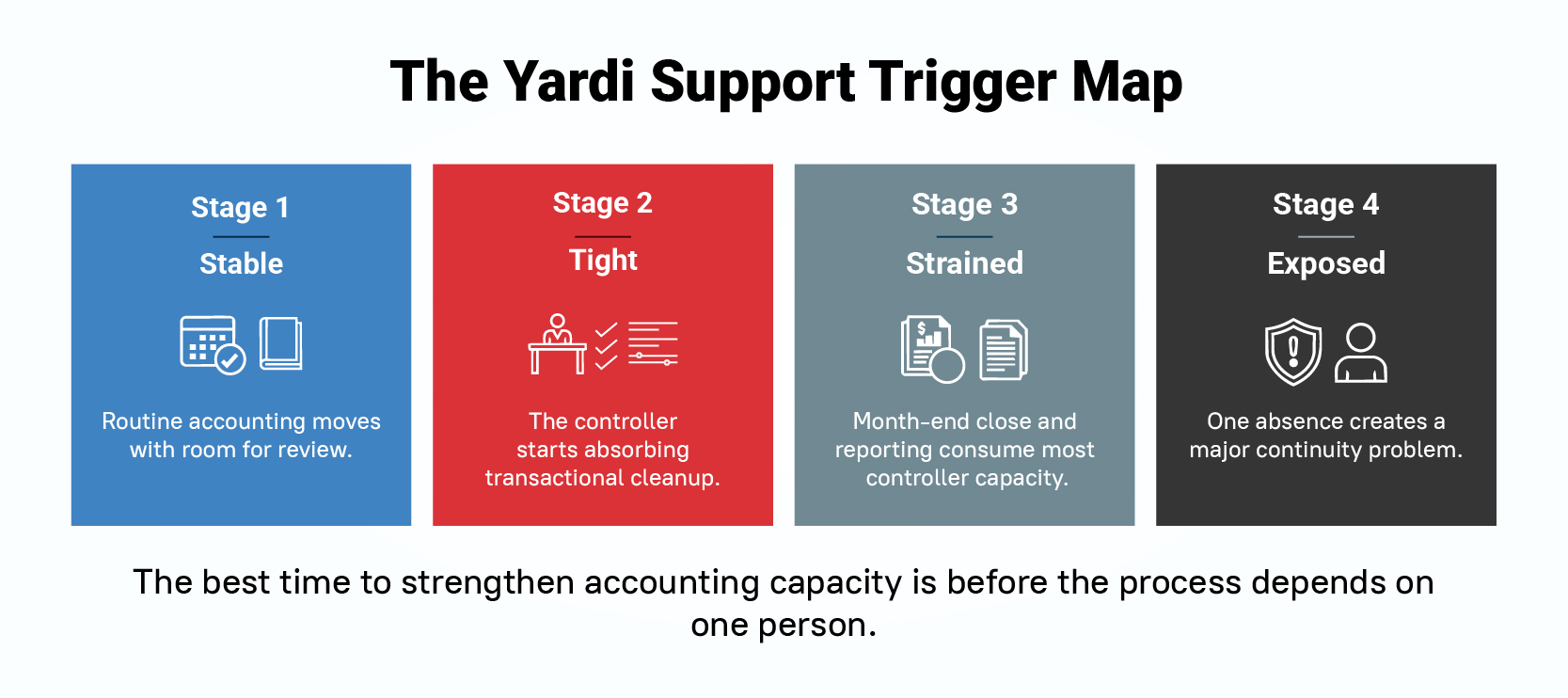
Controllers rarely evaluate outsourced accounting support because the existing process has excess capacity. More often, growing operational demands put pressure on the real estate bookkeeping function.
Common triggers include:
- The portfolio grows, increasing transaction volume, and accounting workload.
- A new property is added, introducing additional reporting and bookkeeping requirements.
- A key accounting employee leaves, creating a coverage gap, increasing individual dependency, and revealing the real cost of controller turnover.
- Month-end starts taking longer, putting pressure on reporting timelines and review cycles.
- Reporting demands increase, requiring more time to prepare, validate, and distribute financial information.
- The controller spends more time correcting accounting work than reviewing the business behind the numbers.
As these pressures build, the conversation often begins to shift.
Instead of asking, "Can the current team handle the work?" the controller starts asking, "How can the accounting function support continued growth without adding another layer of management?"
That is where outsourced property accounting support becomes a strategic consideration. The objective is to strengthen the real estate bookkeeping process, support reporting requirements, and give controllers more time for review, analysis, and decision-making.
Many of these pressures may look unrelated. In practice, they often point to the same issue: the accounting function is being asked to manage more complexity than its current capacity can comfortably absorb.
Understanding the Capacity Threshold
The pressure often comes from a combination of factors rather than a single event.
Portfolio Size + Property Complexity + Reporting Demands + Staffing Dependency = Accounting Capacity Pressure
Two firms may manage a similar number of units and still face very different accounting workloads. The difference is how much accounting effort is required to support the portfolio.
As complexity increases, controllers often spend more time managing accounting production and less time reviewing results, which are often among the earliest signs most firms cannot scale with the portfolio.
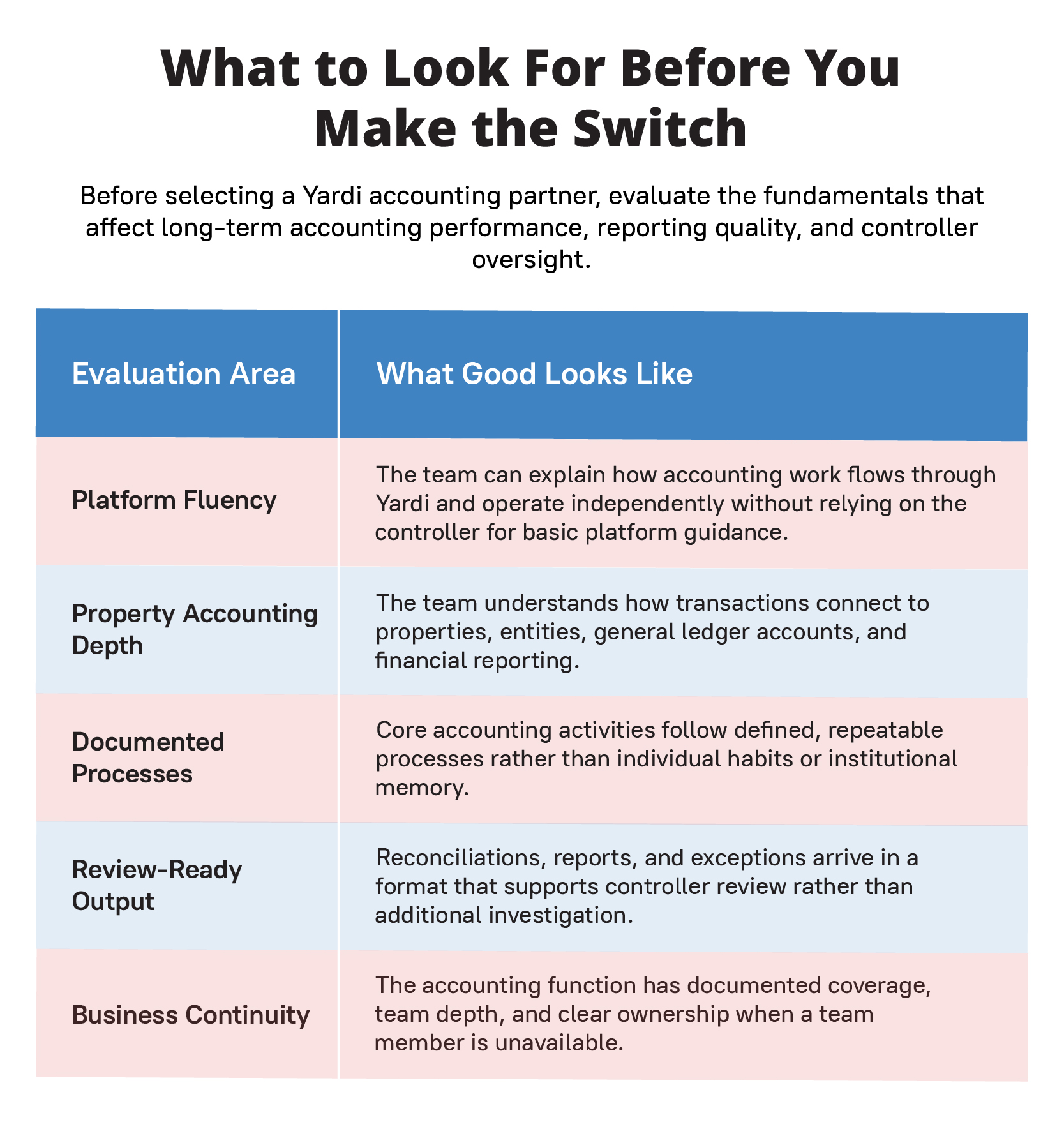
How to Evaluate a Worthy Yardi Accounting Partner
A provider can say "Yardi support" without offering platform-fluent accounting. The evaluation should focus on evidence, workflow, and accountability rather than the platform name alone.
1) Where does the accounting work happen?
Ask whether the team works directly within your Yardi environment or relies heavily on exports and spreadsheets.
2) Who handles the day-to-day accounting work?
Ask about the experience of the people performing the accounting work, not only the sales or implementation team.
3) How does the team approach the month-end close?
Look for a defined month-end close process covering reconciliations, outstanding items, review, and reporting.
4) How are property and entity structures handled?
The answer should demonstrate an understanding of multi-property accounting and reporting.
5) What reaches the controller for review?
Look for a process that surfaces exceptions, unresolved items, and review-ready reporting.
6) How does coverage work when one team member is unavailable?
A team model should include documented processes and cross-trained coverage.
7) What happens during implementation?
Ask what the controller needs to provide and how the provider moves from initial setup to independent execution.
The Security Question Controllers Should Ask
Security belongs in the evaluation from the start because an external accounting team may receive access to sensitive financial information and systems.
The useful question is not simply "Is outsourcing secure?", but What controls govern access to the accounting environment and information?
A thorough evaluation should cover:
- User permissions
- Access levels
- Data handling procedures
- Internal review controls
- Employee access policies
- Offboarding procedures
- Technology controls
- Documentation and accountability
The provider should be able to explain these controls clearly. Security should form part of the operating model rather than appear as an afterthought in the proposal.
Choose Yardi Support Wisely
Yardi can centralize property operations and accounting, but the platform alone does not create an effective accounting function. The people working inside it still determine how accurately transactions are recorded, how consistently accounts are reconciled, how efficiently month-end is completed, and how reliably financial information reaches the controller.
That is why real estate bookkeeping support should be evaluated more than software familiarity alone.
A specialized team should understand property accounting, work confidently within Yardi, and recognize what controllers need for efficient review. The outcome should be fewer spreadsheet detours, clearer reconciliations, and a smoother path from transaction to reporting.
For property management firms managing 500 to 2,500 units, that distinction becomes increasingly important as portfolio complexity grows.
The right question is simple: Can the outsourced team make the accounting function easier to manage?
If the answer is yes, outsourcing can become more than additional bookkeeping capacity. It can become a more resilient accounting structure.
Frequently Asked Questions
What does Yardi accounting support include?
It can cover payables, receivables, general ledger management, reconciliations, month-end close, reporting, cash management, and forecasting support.
Can real estate bookkeeping be outsourced while keeping Yardi?
Yes. Providers can work directly within your existing Yardi environment, reducing exports, spreadsheets and manual re-entry during accounting workflows.
What should a Yardi bookkeeping service handle?
It should handle assigned transactions, reconciliations, general ledger activity, and month-end tasks while leaving appropriate review responsibilities with controllers.
How do I evaluate a Yardi accounting partner?
Evaluate Yardi experience, property accounting knowledge, implementation, close procedures, reconciliation processes, reporting workflows and team coverage before selecting your provider.
Is outsourced property accounting secure?
Evaluate permissions, access controls, data handling, employee policies, technology safeguards, offboarding procedures and oversight before granting providers access to financial systems.


.svg)
.svg)