

In-House vs Outsourced: Property Management Accounting for 500-2,500 Unit Firms


Quick Overview: For property management accounting at firms managing 500 to 2,500 units, the strongest setup is usually a blend of in-house and outsourced. One fully loaded in-house accountant costs about $100,000 to $135,000 a year, before software, training, and turnover. On the other hand, a dedicated outsourced team runs at about a cost of $4,000 to $8,000 a month and covers bookkeeping, month-end close, CAM reconciliation, multi-entity consolidation, and controller-level review. The right choice depends less on price and more on capacity, specialist depth, and how fast you are growing.
You already have an accounting team. That is what makes this decision hard.
If you are a CFO or owner of a firm in the 500 to 2,500 unit range, you are not asking whether you need accounting help. You have one to three people doing the books today. The real question is sharper: do you keep building the function in-house, bring in an outside team, or split the work between both?
This guide breaks down the true all-in cost of each path, the trade-offs that do not show up on a salary line, and a simple way to decide. No sales pitch. Just the numbers and the judgment calls a finance leader actually weighs.
What Property Management Accounting Involves at 500 to 2,500 Units

At 50 units, accounting is bookkeeping. At 500 to 2,500 units, it is a department.
By the time you cross a few hundred units, the work splits into layers. There is the daily and monthly grind: AP, AR, bank reconciliation, rent roll updates, and month-end close. Then there is the specialist layer that generalist accountants struggle with: CAM reconciliation, multi-entity consolidation across a stack of LLCs, owner statements, and variance analysis. Above that sits the work most internal teams never get to, the CFO thinking on cash flow, refinancing, and portfolio net operating income (NOI).
One layer carries extra weight in this industry: trust accounting. You hold rent and security deposits on behalf of owners, and those funds must stay separate from your operating capital. Get it wrong and you are looking at a compliance problem, not just a messy ledger. That fiduciary duty, a clean chart of accounts, the choice between cash and accrual basis, year-end 1099 filing, and generally accepted accounting principles (GAAP) reporting are all part of why property management accounting differs so much from standard business accounting. For a plain-english primer on those building blocks, the fundamentals of real estate accounting is a solid starting point.
Most mid-size firms handle the daily layer fine. They stall on the specialist and strategic layers. The team can post invoices and close the month, but CAM true-ups slip, consolidation takes too long, and nobody has bandwidth for forward-looking analysis. That gap is the core of the in-house versus outsourced question. You are not replacing basic bookkeeping. You are deciding how to cover the depth your portfolio now demands.
So the work is bigger than bookkeeping. The first real question is what it costs to staff all of it yourself.
The Real All-In Cost of an In-House Accounting Team
Salary is the number that gets quoted. It is rarely the number that matters.
A mid-level real estate accountant who knows AppFolio or Yardi, understands CAM, and can handle multi-entity work that is expensive and hard to find. Robert Half puts a property accountant's base pay at roughly $70,000 to $94,000, with a midpoint near $80,500. Once you add benefits, payroll taxes, and paid time off, the real cost climbs. Bureau of Labor Statistics (BLS) employer cost data supports a loaded multiplier of about 1.43 times wages, which puts a mid-level property accountant near $100,000 to $135,000 a year, fully loaded. A true controller costs far more.
Here is how that looks for the two roles most mid-size firms build around:
Note: Base figures are from Robert Half with loaded multiplier from BLS employer cost data.
Many firms run an accounting manager instead of a full controller, which lowers the second line, but the pattern holds: covering daily work, month-end, CAM, and review usually takes more than one seat. Then the costs you do not see on the offer letter start stacking up:
- Software and tools. Your platform, plus the add-ons for reporting, dashboards, and AP automation. This scales as you add entities.
- Recruiting and ramp. Finding someone with real estate experience takes 8-16 weeks. Getting them productive in your systems and your reporting calendar takes another 60-90 days.
- Turnover and key-person risk. When your one CAM expert leaves, institutional knowledge walks out with them, and you start the clock over.
- Coverage gaps. Vacation, sick days, and one open seat can push month-end late and delay owner reporting.
Add it up and a single specialist seat costs well over six figures a year once you count everything around it. That is the part that surprises CFOs: the question was never the cost of one accountant. It is the cost of a function.
That is one side of the ledger. Here is what the same coverage costs when you buy it as a service.
What Outsourced Property Management Accounting Actually Costs
Here the math gets simpler, because the price is one predictable line.
A dedicated outsourced real estate accounting team for a 500 to 2,500 unit firm typically runs at about a cost of $4,000 to $8,000 a month, or about $48,000 to $96,000 a year. For that flat fee you generally get a small team rather than a single person, performing full scale real estate bookkeeping, AP/AR, month-end close, CAM reconciliation, multi-entity consolidation, owner reporting, and a controller-level review layer on top. Software and reporting tools are often bundled in, so you are not buying licenses on the side. Put another way, that works out to roughly $3 to $8 per unit per month at this size, and it drops as you scale, which is a number you can hold up against your current fully loaded spend per door.
Set that against the in-house numbers above. A full outsourced team for the year often lands at or below the fully loaded cost of one mid-level in-house hire, and well below the cost of a controller. You trade variable, hard-to-predict payroll and overhead for a fixed monthly number you can plan cash flow around.
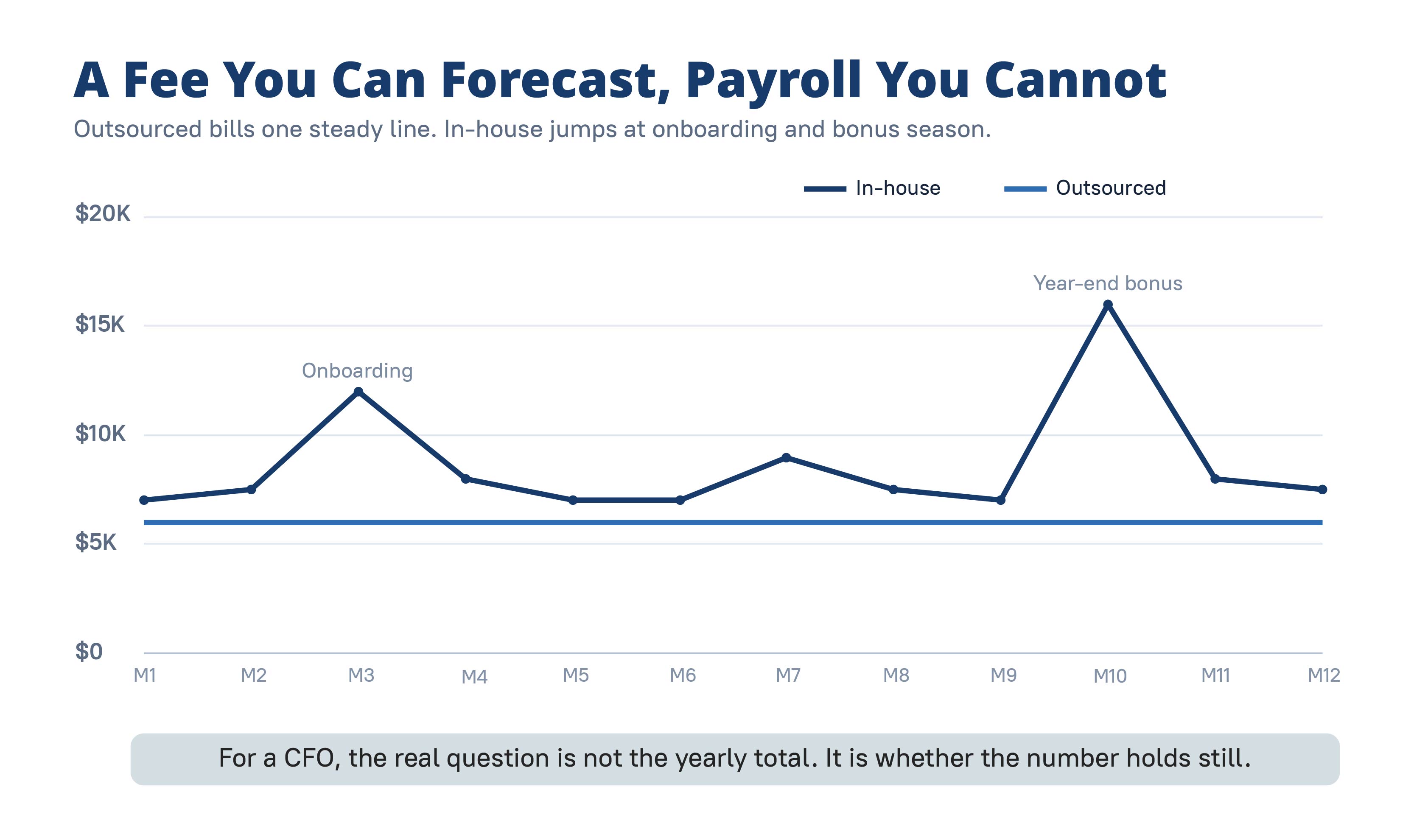
One honest caveat: a flat fee is not a magic discount. You are paying for a structured delivery model and specialist depth, not bargain-basement bookkeeping. The savings come from leverage and from skipping the hidden costs of in-house staffing, not from cutting corners on the work.
Lined up side by side, the trade-offs get easier to weigh.
In-House vs Outsourced: A Cost and Capacity Comparison
The pattern is clear. In-house wins on day-to-day proximity and direct control. Outsourced wins on speed, depth, predictable cost, and resilience when someone is out or moves on. For most firms at this size, the smartest move is not to pick one side. It is to combine them.
Those trade-offs shift as you grow, so it helps to see the cost at three points in the range.
What It Costs at 500, 1,000, and 2,500 Units

Role-level numbers tell you the price of a seat. What a CFO really wants is how the bill grows as the portfolio does. Here is the rough shape at three points in the range.
Headcount here is typical, not fixed. It shifts with your commercial mix and how many entities you run. The pattern is the part that matters: in-house cost climbs in salary-sized steps as you grow, while the outsourced fee scales in a smooth, predictable line. The bigger you get, the wider that gap tends to open. Even these numbers understate it, because the most expensive costs never reach the budget line.
The Hidden Costs Most CFOs Miss
The biggest line items in this decision are the ones no spreadsheet shows by default.
Start with CAM, where a reconciliation that runs late or comes out wrong is not a tenant problem, it is a revenue problem. Under-bill the recoverable CAM charges across a few commercial properties and the gap is real money, often more than a quarter of an accountant's salary, and most of it is gone by the time you catch it at year-end. The work is not hard. It is relentless, which is why it slips. Running it as a year-round reconciliation process rather than a December scramble is what keeps that revenue on the books.
Next, count the cost of a slow close. If your team is still reconciling tenant ledgers two weeks into the next period, owner reports go out late and decisions get made on stale numbers. A healthy month-end close at this size should run within seven to ten business days, not 20.
Then there is the cost of the work that never happens. When your most senior accountant is chasing invoices and posting entries, nobody is doing CFO-level thinking on refinancing, acquisition analysis, or portfolio NOI. That is opportunity cost, and on a growing portfolio it is the most expensive line of all. If several of these are true at once, you may be hitting the signs it is time to bring in real estate accounting help. Once the full cost is on the table, a smarter setup tends to reveal itself.
The Hybrid Model: Keep Control, Outsource the Volume
This is where most 500 to 2,500 unit firms land, and for good reason. You already have internal staff worth keeping, so a clean "replace the team" frame is the wrong frame. The better question is who does what.
The practical split keeps judgment, relationships, and control inside the building, and sends high-volume execution out. Your finance lead still owns the numbers and sits in leadership meetings. The daily transactions, the month-end mechanics, the CAM work, all of it runs through a real estate accounting team that already knows your platform, then comes back to you for review.
This structure fixes the two problems that hurt most at this size. It gives the function backup, so one person being out or leaving no longer stalls the close. And it frees your senior people for the strategic work you are actually paying them for.
Still, the blend is not right for every firm.
When In-House Still Makes Sense
Outsourcing is not the answer for everyone, and a credible comparison says so.
Keeping accounting in-house can be the right call if your portfolio is stable rather than growing, your structure is simple with few entities, and you already have RE-trained people you trust and can retain. Some functions also tend to stay close by nature. Highly sensitive work like lender reporting, owner relations, and final approvals often belongs in-house regardless of what else you outsource, because of the judgment and confidentiality involved. If your current setup is keeping pace, there may be no reason to change.
The signal to revisit the decision is strain. Late CAM, a stretching close cycle, a recent controller departure, or growth that is outrunning your team are the moments when the in-house math stops working. If none of those apply, in-house is a perfectly defensible choice.
Not sure which camp you are in? Five questions will tell you.
How to Decide: 5 Questions That Tell You Whether to Outsource
Skip the gut call. Run your situation through these five questions.
Question 1: Is month-end close taking longer than ten business days?
Answer: If yes, you have a capacity or process problem that another hire may not fix fast enough.
Question 2: Are CAM reconciliations late, disputed, or done once a year in a scramble?
Answer: Specialist depth matters more here than headcount.
Question 3: Did a key accountant recently leave, or are you worried one might?
Answer: Key-person risk is a strong signal to build in backup.
Question 4: Is your portfolio growing faster than your team can absorb?
Answer: Hiring cycles of three to four months may not keep up.
Question 5: Is your most senior accountant stuck doing data entry?
Answer: If your controller is reconciling petty cash, you are paying controller rates for bookkeeping work.
Two or more yes answers usually mean the in-house-only setup is near its ceiling. That does not automatically mean full outsourcing. It means the current model needs reinforcement.
If the answers point you outside, the next job is choosing a partner you can trust.
What to Ask Before You Hand Over the Books
Control is the worry that sits right behind cost. The fix is not keeping everything in-house. It is knowing what to ask. Before you sign with any provider, get clear answers on these:
- Do they work inside your platform with role-based access, so people see only what their job needs?
- Is there segregation of duties, so the person entering a payment is not the one approving it?
- Are bank access and payment limits set by you and visible to you?
- Do they hold recognized security standards like SOC 2 or ISO 27001, and will they show proof?
- Who reviews and signs off, and how often do you see exception reports?
A serious partner answers all five without flinching. If a provider gets vague on any of them, that is your answer. Strip away the checklist and it comes down to one thing: who is actually doing the work.
Why Specialist Depth Beats a Generalist Hire
The last factor decides whether outsourcing actually pays off: who is doing the work.
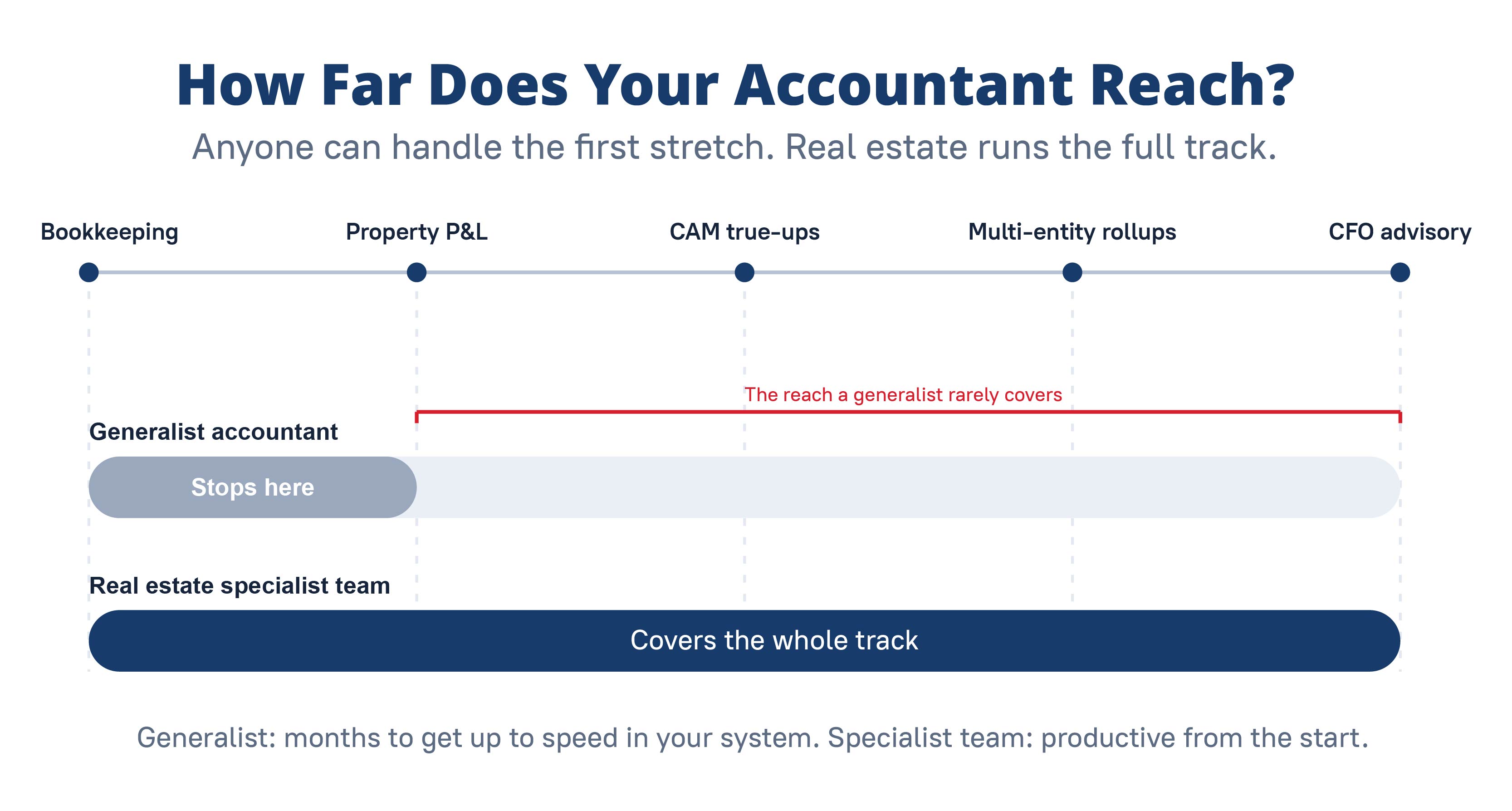
A general bookkeeping firm can post your transactions. Real estate accounting needs more. It needs people who speak NOI, CAM, and multi-entity consolidation without a ramp-up, who know how a CAM true-up works, and who can drop into AppFolio, Yardi, MRI, or Buildium on day one. That specialist depth is exactly what is hardest to hire and keep in-house, and it is the reason a fee that looks similar to one salary can deliver the output of a full department.
This is where the model matters. An outsourced team built specifically for property management firms gives you controller-level review, RE-trained accountants, and CFO advisory under one roof, instead of stitching together a junior hire, a software vendor, and your CPA at tax time. For the broader case for outsourcing your back office, the benefits extend well past real estate, but for property firms the deciding factor is specialist depth. The goal is not to replace your team. It is to give it the depth and resilience your portfolio now requires.
For background on the rules that shape rental real estate recordkeeping, the Internal Revenue Service (IRS) guidance on rental real estate income and deductions is a useful reference, and the BLS outlook for accountants tracks the wage and demand trends behind the hiring squeeze.
Knowing the work is in good hands is one thing. Trusting the switch is another.
What Switching Actually Looks Like
The fear that stops most CFOs is not cost. It is disruption. Nobody wants a botched close in month one. A clean handoff avoids that by running in parallel before anything goes live.
Done this way, you are not betting a month-end on a cold start. You are watching the new process prove itself before you lean on it.
With the path clear, the decision comes down to one honest look at your own firm.
Choosing the Right Model for Your Firm
At this size, the decision was never a clean either-or. The goal is to add depth to the team you have, not to pay for a second controller. The numbers point the same way the work does. One in-house hire covers one seat. A blended model covers the whole function, keeps your oversight intact, and usually costs less than building it all internally.
Run your situation through the five questions first. If two or more land, the in-house-only setup is near its ceiling, and the next move is deciding what to keep close and what to hand off. Either way, make the call on purpose. The firms that struggle are not the ones that chose wrong. They are the ones that never chose, and let the close run late by default.
Frequently Asked Questions
How much does outsourced property management accounting cost?
For firms managing 500 to 2,500 units, a dedicated outsourced team typically costs $4,000 to $8,000 a month. That usually covers bookkeeping, month-end close, CAM reconciliation, multi-entity consolidation, owner reporting, and controller-level review, with software and dashboards often included. Cost scales with complexity, such as the number of entities and the share of commercial property.
What is the difference between in-house and outsourced property accounting?
In-house means your own employees handle the books, which gives you direct control but carries full salary, benefits, software, and turnover costs. Outsourced means a specialist team handles the work for a flat monthly fee, usually with tools and backup built in. Most 500 to 2,500 unit firms blend the two: they keep oversight and approvals in-house and outsource high-volume execution like AP, AR, and CAM.
Is outsourced accounting less secure than keeping it in-house?
Not necessarily. A serious provider works inside your own platform with role-based access, documented processes, and managed Information Technology (IT) and security controls. In many cases an outside team with formal procedures is more resilient than a single internal person holding everything in their head. Ask any provider directly about access controls and data handling before you sign.
Will I lose control of my numbers if I outsource?
No, if the model is set up right. The strongest setup is a hybrid: your internal finance lead owns the relationships and reviews the output, while the outside team handles volume and specialist work in your system. You keep oversight through dashboards and a regular reporting calendar.
How long does it take an outsourced team to start working in AppFolio or Yardi?
Usually two to three weeks to go live, because the team already knows the platform and does not need a 60 to 90 day ramp. Compare that to the 8 to 16 weeks it can take just to find and hire an experienced real estate accountant.
When should a property management firm outsource its accounting?
The clearest signals are a month-end close that runs past ten business days, CAM reconciliations that slip or get disputed, a recent accountant departure, or growth that is outpacing your team. When two or more of these show up, the in-house-only model is usually at its ceiling.


.svg)
.svg)