

How to Close Month-End in 10 Days: The Proven Framework for Property Management Firms


Quick Overview: This blog explains why many property management firms still take 15 to 20 days to close their books and why that delay is often caused by process gaps rather than a lack of people or software. It introduces a practical 10-day month-end close framework, breaking down what needs to happen before month-end and what tasks should be completed each day through reporting. It also highlights common mistakes that slow teams down, signs that the current accounting structure may no longer support growth, and best practices that help firms build a close process that stays efficient as portfolios expand.
Closing books in 20 days has become so common that many property management firms accept it as the cost of growth.
As portfolio expands, the workload naturally becomes heavier. More units bring more transactions, more owners, and more moving pieces to manage. It is easy to conclude that as multifamily and commercial property portfolios grow, a slower close is simply part of the deal.
That assumption is what keeps month-end broken.
The single biggest misconception in property management accounting is this: a slow close is caused by too much volume and not enough staff. The real issue is usually the process design.
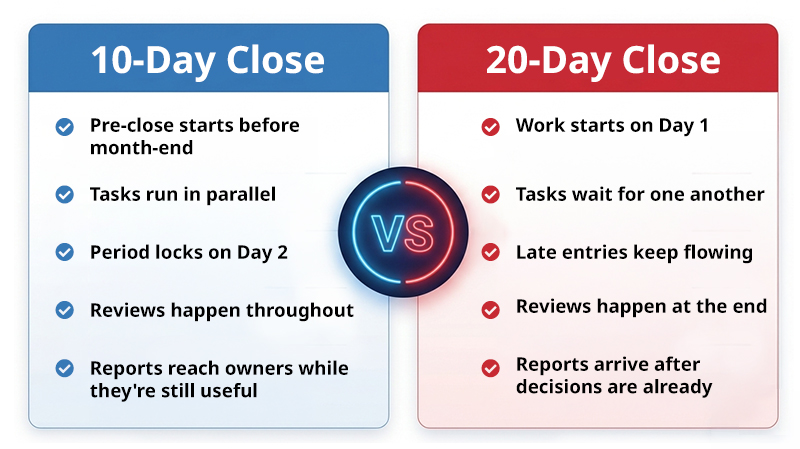
Most property management accounting team workflows are built sequentially. One task waits for another to finish. A delay in reconciliations pushes back accruals, a delayed review postpones reporting, and days disappear quietly before anyone notices, by which point the financials are ready but the window to act on them has already narrowed.
Yet firms managing similar portfolios are consistently closing in 8 to 10 business days. The gap is rarely explained by portfolio size. More often, it comes down to how the close process is structured.
This guide breaks down the framework behind that difference through four practical phases and daily milestones. Whether you are improving an internal process or evaluating an outsourced property management accounting partner, you will have a blueprint for building a faster, more predictable close.
What Is a Month-End Close in Property Management Accounting?
A property management accounting month-end close is the process of finalizing all financial activity for a property portfolio at the end of each accounting period. The outcome is clear: reconciled bank accounts, accurate property-level financials, balanced subledgers, and owner-ready reporting packages.
On paper, that sounds similar to any other accounting close.
The property management accounting close is far more complex because every property functions as its own financial ecosystem. Each property may have a separate bank account, rent roll, AP aging, ownership structure, reporting requirements, and operating entity. What works for one asset rarely works identically across the portfolio.
A complete month-end close typically includes:
- Bank reconciliation: Matching operating account statements to the general ledger for each property.
- Rent roll reconciliation: Confirming that rent payments, vacancies, concessions, and delinquencies recorded in the property management software (PMS) align with the GL.
- Subledger reconciliation: Ensuring AP and AR aging tie back to the general ledger before final review.
- Accrual and adjusting entries: Recording items such as prepaid amortization, depreciation, accrued expenses, and payroll accruals.
- Owner reporting package: Preparing property-level P&Ls, NOI summaries, budget variance reports, cash position updates, and distribution statements.
Understanding these moving pieces explains why month-end often stretches far beyond expectations.
What Does a Healthy Property Management Close Timeline Look Like?
There is no universal benchmark for a property management month-end close, but many multifamily, commercial, and mix portfolio firms aim to complete the process within 7 to 10 business days. That timeline gives accounting teams enough time to reconcile accounts, review exceptions, and deliver owner reporting while the information is still useful for decision-making.
In practice, many firms operate on a 12 to 18-day close cycle, and some extend beyond 20 days during periods of growth. The difference is rarely driven by portfolio size alone. More often, it comes down to how the close process is designed and executed.
Why Property Management Month-End Closes Run Long
Most property management accounting closes stretch to 12 to 18 days for a simple reason. The process was designed for a smaller portfolio. It works when there are fewer properties, fewer stakeholders, and fewer reporting requirements.
So, before looking at the 10-day framework, it is important to understand the pattern.
The shift from sequential to concurrent is often the highest-leverage improvement a Property management accounting team can make. It does not require new software or a larger headcount. It requires structure, clear ownership, and discipline to follow the close calendar every month.
The 10-Day Month-End Close Framework
A 10-day close is the result of working in the right sequence. The property management accounting close framework is built around four phases: Pre-Close, Core Close, Accruals and Adjustments, and Reporting and Distribution. Each phase has a defined objective, assigned ownership, and a clear output that signals readiness for the next stage.
Phase 0: Pre-Close (3 to 5 Days Before Month-End)
Pre-close is the most commonly skipped phase in property management accounting. Teams that consistently finish by Day 10 do most of the preparation before the month ends. They collect information early, resolve known exceptions, and set expectations with site teams in advance. Without this phase, the first week of the new month is spent chasing data instead of closing the books.
Pre-Close Checklist
- Send vendor invoice reminders to all site teams and establish a hard cutoff date three business days before month-end.
- Pre-code all bank and credit card transactions to the appropriate property and GL code.
- Confirm the final rent roll count in Yardi, AppFolio, or MRI, and freeze updates after the 28th.
- Verify that all management fee calculations are prepared and ready to post.
- Follow up on outstanding security deposit reconciliations with site managers.
- Confirm intercompany transfer amounts and approval workflows for multi-entity portfolios.
- Review open items from the prior month. Assign ownership and target dates for any carry-forward balances.
- Notify property managers in advance that the accounting period will lock on Day 2 and that late entries will move to the next period.
Phase 1: Core Close (Days 1 to 4)
This phase handles the foundational accounting that everything else depends on. Bank reconciliation comes first. It is the spine of the entire property management accounting close process. Until bank accounts are reconciled to zero, nothing downstream is reliable.
Phase 2: Accruals and Adjustments (Days 5 to 7)
This is where most sequential closes fall apart. Teams that finish bank reconciliations and subledger reviews on Day 5 or 6 then have to start accruals from scratch, which means the trial balance review and financial statements are still 4 to 5 days away.
In a concurrent model, recurring accruals are scheduled to post automatically, and only exception items require manual review.
Phase 3: Reporting and Distribution (Days 8 to 10)
The reporting phase is where the close starts creating value. Sending owner packets on Day 10 instead of Day 17 gives asset managers more time to act and helps teams make decisions using numbers they trust.
Even with a clear framework, many teams struggle to sustain a 10-day close. The culprit is rarely complexity alone. More often, it is a handful of recurring mistakes that quietly derail the process.
Avoid These Mistakes If You Want 10-Day Close
The most common mistake in property management month-end close is skipping pre-close preparation and treating Day 1 as the start of the process. The second is leaving the period open after Day 2, which allows late entries to arrive and invalidate completed reconciliations.
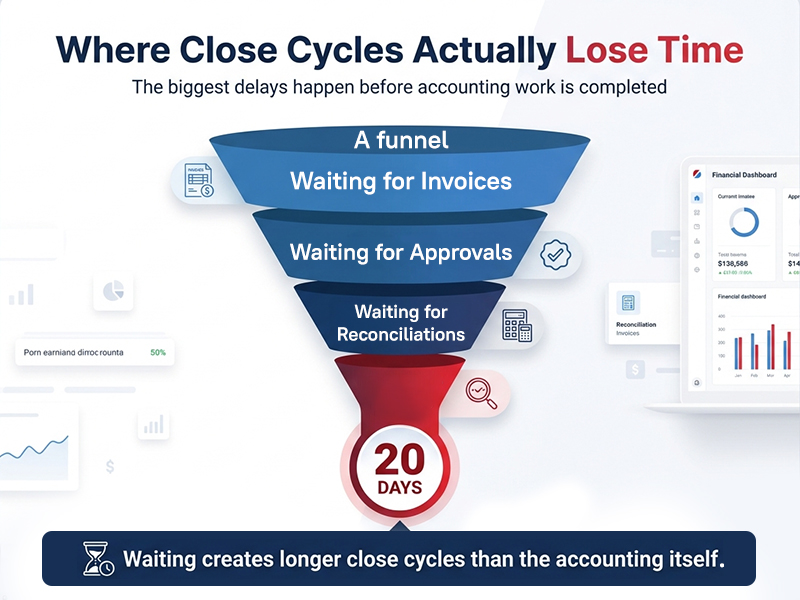
Teams do not miss the 10-day close because of one major failure. They lose time through small process gaps that repeat month after month.
- No hard period lock: The period stays open because site teams "might need to add something." Every late entry restarts a reconciliation step.
- Sequential task design: Waiting for account payable (AP) to be fully resolved before starting bank reconciliations adds 3 to 5 days to every close cycle.
- One person knows everything: The process lives in someone's head instead of a documented checklist. One absence can disrupt the entire close.
- No pre-close calendar: Site teams do not know the invoice cutoff date. Data arrives throughout the first week of the new period instead of before month-end.
- Skipping the variance review: Financials go to owners without a budget-to-actual check. Errors surface after distribution, leading to restatements and loss of trust.
- Treating the close as accounting-only: Close success depends on site teams, property managers, and operations, not just the accounting team.
When the Framework Tells You to Outsource
This framework is designed to help teams improve their internal close processes. It can also help identify the underlying causes of delays in the close cycle. If you consistently miss Day 10 despite following the framework, the issue may not be execution. It may be a sign that the underlying structure needs to be changed.
Signal 1: Pre-close preparation keeps falling apart
- What it means: Site teams are not consistently submitting invoices and supporting documents on time. Critical data continues to arrive late despite repeated reminders.
- Fix: Reduce reliance on informal follow-ups. Assign ownership for invoice collection and establish a structured process with clear deadlines and accountability.
Signal 2: Bank reconciliations take more than two days
- What it means: Transaction volume has outgrown the capacity of the current team, creating bottlenecks during the close.
- Fix: Go for split reconciliation responsibilities across properties or portfolios, so work is shared across the team rather than handled by one person.
Signal 3: The trial balance still has multiple open items by Day 7
- What it means: Exception handling is reactive or undocumented, causing the team to spend excessive time resolving recurring issues.
- Fix: Create a documented workflow for identifying, assigning, and resolving exceptions before they delay the reporting phase.
Signal 4: Owner packets consistently go out after Day 12
- What it means: Delays from earlier phases are compressing the reporting window and pushing distributions further out.
- Fix: Protect the reporting phase by enforcing deadlines earlier in the close and preventing unresolved items from carrying forward.
Signal 5: One resignation would disrupt the entire close
- What it means: The process depends on individual knowledge rather than a repeatable system.
- Fix: Maintain documented procedures, train multiple team members on key tasks, and make sure someone else can step in when needed.
Reaching a 10-day close is important. Building a process that delivers it consistently is what creates long-term operational confidence.
Best Practices for a Repeatable Property Management Close
The framework above provides structure. These practices help it stick month after month without requiring the controller to manually manage every step.
Assign Ownership by Name, Not by Role
Every task in the close calendar should have a person's name attached to it, not just a role title. The "accounting team" owns nothing. When a task has no clearly identified owner, it waits until someone notices it is overdue. In property management bookkeeping at scale, those delays quickly add up.
Use Your Property Management Software (PMS) Workflow Rules Fully
Yardi, AppFolio, and MRI all offer recurring journal entry schedulers, automated reconciliation flags, and management fee calculators. Yet most property management accounting teams still rely heavily on spreadsheets, often using less than 60% of available system capabilities. Reviewing how your team uses the system can often uncover simple automation opportunities that shorten the close by several days.
Build a Standing Close Calendar
Close deadlines should be based on day numbers such as Day 1 and Day 2, rather than calendar dates. Calendar dates shift with weekends and holidays. Day-number deadlines remain consistent and predictable regardless of the month. Share the calendar with site teams, not just accounting. Their invoice cutoff is part of your close process.
Run a Post-Close Review Every Month
A 15-minute post-close debrief that covers what ran late, why it happened, and what needs to change helps prevent the same issues from repeating. Most teams skip this step and then wonder why the same delays appear in every cycle. The post-close review is what allows the process to improve over time instead of simply repeating itself.
A Faster Close Is a Better Operating System
A 10-day close is not about speeding through accounting tasks. It is about building a process that delivers accurate information while decisions can still be made on it. With clear ownership, disciplined deadlines, and a repeatable framework, property management firms can turn month-end from a recurring bottleneck into a reliable operating rhythm that scales with growth.
FAQs
1. Is a 10-day month-end close realistic for a property management firm?
Yes. Many property management firms complete the close within 7–10 business days by preparing before month-end, automating recurring tasks, and resolving exceptions earlier in the process.
2. What usually causes a property management month-end close to run past 15 days?
The most common reasons are late invoices, delayed bank reconciliations, manual accruals, and review processes that depend too heavily on one person.
3. How do I know if my accounting team has reached its capacity limit?
Recurring delays, growing backlogs, owner reports going out late, and difficulty maintaining close timelines often indicate the team is operating beyond its ideal capacity.
4. Does adding more accountants automatically shorten the close process?
Not always. Extra staff helps, but close performance usually improves more when responsibilities, workflows, and review steps are redesigned.
5. When should a property management firm consider outsourcing accounting support?
It may be time to evaluate outsourcing when close timelines continue to slip, reporting becomes inconsistent, or growth outpaces the team's ability to keep up.


.svg)
.svg)