

AppFolio Bookkeeping: What a Specialist Outsourced Team Does That a Generalist Cannot



You have been on at least one call with an outsourced accounting firm that said, "We support AppFolio." They meant they can open your books, export a report, and send you a reconciliation by email. That's not AppFolio bookkeeping; that's working around AppFolio while charging for platform expertise.
Controllers managing 500 to 2,500 units know the difference immediately.
You can tell when a journal entry lands in the wrong entity. You notice when a management fee hits the wrong bank account. You also know when an owner statement comes from a spreadsheet instead of the owner portal. You can spot every issue. But you still spend the next 48 hours fixing them.
The gap between a generalist bookkeeper and a true AppFolio bookkeeping specialist is not a marketing distinction. It shows up in reconciliation accuracy, close timelines, owner reporting quality, and audit readiness.
This guide breaks down exactly where that gap exists, what specialist-level work actually looks like inside the platform, and how to evaluate any outsourced team against those standards.
Why AppFolio Is Not QuickBooks and Why That Gap Matters
AppFolio is purpose-built for property management. Every accounting workflow inside the platform ties to a property, a unit, a lease, or an owner. That is a fundamentally different structure from general-purpose accounting software.
When a generalist bookkeeper opens AppFolio for the first time, they look for familiar menus like the chart of accounts, journal entries, and bank reconciliation. Those features exist. But the logic behind them is different. In AppFolio, a rent receipt is not just a credit to income. It is tied to a tenant ledger, a property GL, a trust account, and potentially an owner reserve. If any of those connections are wrong, the downstream impact touches owner statements, trust account balances, and your three-way reconciliation.
Generalists learn this through trial and error, usually on your portfolio. Which is very risky. The comparison below makes that risk concrete, task by task.
Working Inside AppFolio vs. Working Around It
The clearest way to understand the difference is to look at what each team actually does inside the platform, task by task. This is not about credentials; it's about whether the work happens in AppFolio or alongside it.
Every row in that table is a place where an error can reach an owner statement, a trust account, or a compliance report. The difference is not effort; it is platform knowledge.
The Four Places Where AppFolio Bookkeeping Expertise Shows Most
1. AppFolio Trust Accounting
Trust accounting is often where generalists make bigger mistakes and correcting them can take significant time. Every state has regulations governing how tenant and owner funds are held, segregated, and reported. AppFolio trust accounting requires a three-way reconciliation every month:
- Bank statement balance
- AppFolio trust ledger balance
- Combined owner and tenant ledger balances
All three balances must match exactly.
A generalist treats the trust account like a standard operating bank account. They do not run the three-way reconciliation. They do not check for negative tenant ledgers. And the first time a state real estate commission audits your firm, those gaps surface in the most uncomfortable way possible.
A specialist knows that even a single penny out of balance on the trust ledger must be identified and resolved before the period closes. They also understand that security deposit dispositions follow state-specific timelines, typically between 14 and 30 days. Transfers from escrow to operating accounts follow their own compliance workflow inside AppFolio and must be handled accordingly.
2. CAM Reconciliation Inside the Platform
CAM reconciliation is one of the most time-consuming tasks in commercial property management, and it is also one of the easiest to get wrong when completed outside the platform. AppFolio includes CAM tracking and reconciliation tools that automate tenant share allocation based on square footage, pro-rata lease terms, or other predetermined factors.
Generalists skip this and build CAM reconciliations in Excel. The result is a process that cannot scale, produces inconsistent calculations, and creates tenant disputes because the math cannot be audited directly from the system.
Specialists run CAM billing entirely inside AppFolio, where every calculation, adjustment, and audit trail is recorded. Reports can be generated in minutes, and tenant disputes are resolved using system-generated breakdowns instead of spreadsheets.
3. AppFolio Chart of Accounts Configuration
The AppFolio chart of accounts is the foundation of every financial report your owners receive. A generalist inherits whatever COA was set up before them, makes no changes, and wonders why income categories do not tie cleanly to budget variance reports.
A specialist sets up and maintains a COA built for property-level financial reporting. They understand how a well-structured chart of accounts supports accurate reporting across the portfolio. This includes:
- Mapping income and expense codes correctly to owner NOI summaries.
- Coding inter-entity transfers accurately across multi-entity portfolios.
- Structuring the COA to support clean property-level reporting and reconciliations.
- Preventing reporting issues that can lead to reconciliation problems and hours of manual rework.
4. Property Management Month-End Close in AppFolio
A specialist team closes the books inside AppFolio, not next to it. Rent receipts are posted on the same day. The accounting period is typically locked by Day 2 of the close cycle, and any late entries are posted to the next period. Owner reports are pulled live from the platform and distributed through the owner portal, not assembled in Excel and emailed as PDFs.
For firms managing 300 to 1,500 units, property management month-end close in AppFolio should be completed in 8 to 10 business days. Teams working with a specialist outsourced accounting firm often do it faster because the team does not spend the first three days of every close cycle figuring out where last month's entries were posted.
Spotting this gap on your own team does not require an audit. It just takes one question.
The Ramp-Up Test | The Fastest Way to Identify a Generalist
Ask any outsourced property management accounting firm one question before you sign anything:
If we hire you today, how many weeks does it take before you're operational in our AppFolio?
A Specialist Team's Answer: We are operational on Day 1.
They know AppFolio Core, Plus, and Premium. They know how your chart of accounts should be structured for your portfolio type. They know what an AppFolio property accountant needs to see before posting the first journal entry.
A Generalist's Answer: We take weeks.
Four weeks. Eight weeks. "It depends on your setup." That timeline is not about learning your properties. It is about learning the platform on your time, at your expense, and with your data.
Once you have that answer, a short list of follow-up questions confirms it either way.
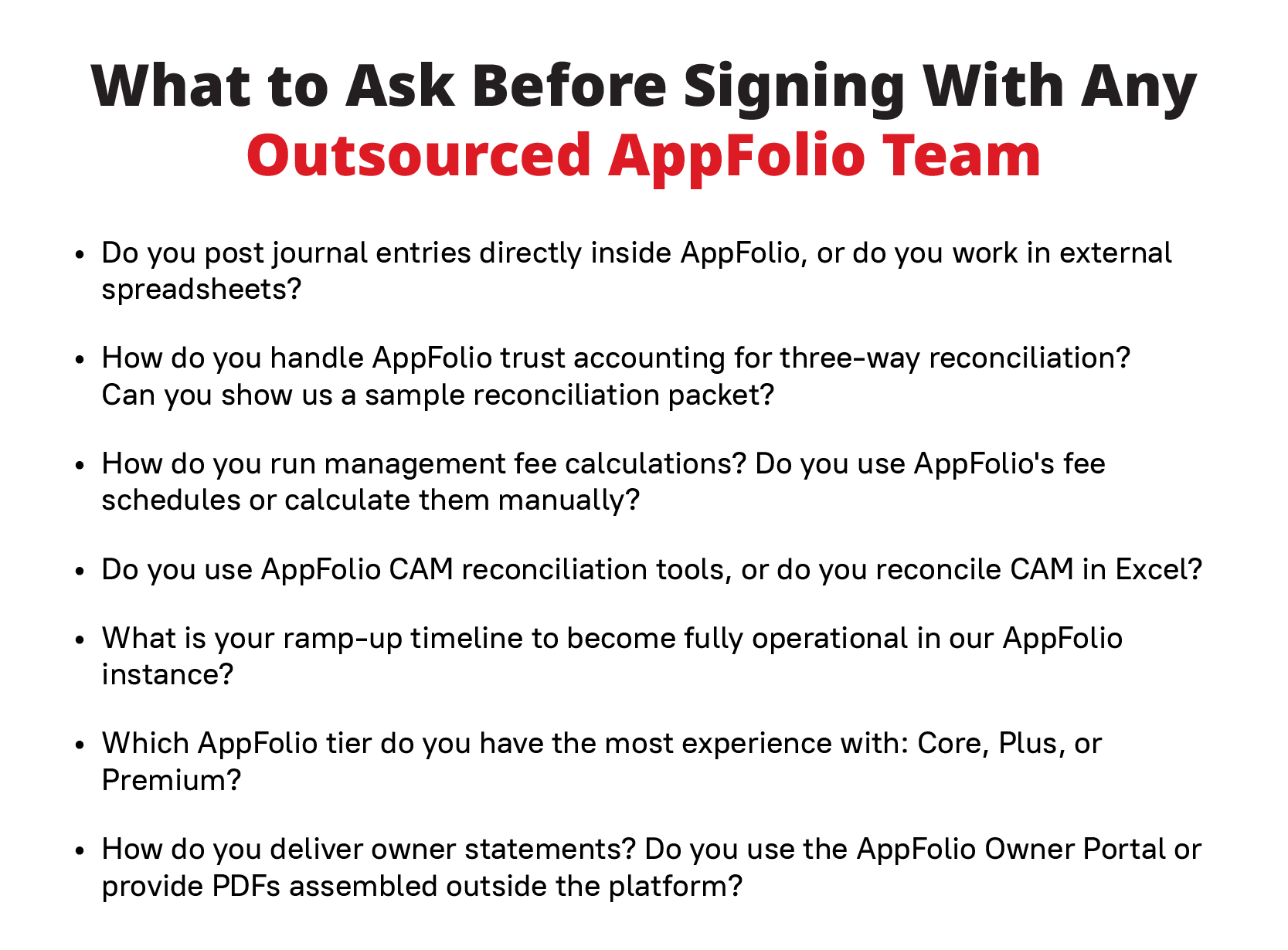
If those questions exposed uncertainty or inconsistent answers, the next step is to evaluate whether your current AppFolio bookkeeping setup is still supporting your growth.
Signs Your Current AppFolio Bookkeeping Setup Has Outgrown
This guide isn't about convincing you to switch providers. It's about helping you determine whether your current setup, whether in-house or outsourced, is causing delayed closes, late owner statements, or longer reconciliation cycles. If any of the following signs sound familiar, it may be time to reassess your approach.
Signal 1 - Owner statements are built in Excel
If your team exports data from AppFolio, builds statements in a spreadsheet, and emails them as PDFs; you are running a manual process on top of an automated platform. It adds 2 to 4 days to every close and introduces formatting and calculation errors that live outside the system audit trail.
Signal 2 - The trust account is reconciled but no one runs a three-way reconciliation
A bank reconciliation is not the same as a three-way reconciliation. Your bank balance, AppFolio Trust Ledger, and the total of all owner and tenant ledgers must all match on the same date. If they do not, you are out of compliance, even if your bank account balances correctly.
Signal 3: CAM reconciliation happens once a year in a spreadsheet
Commercial tenants expect transparent, auditable CAM calculations. If your team cannot show a tenant exactly how their share was calculated from data inside AppFolio, disputes take longer to resolve and often end with adjustments that could have been avoided.
Signal 4: New properties take three to four weeks to get into proper bookkeeping shape
Setting up a new property in AppFolio involves creating the chart of accounts, configuring trust accounts, setting up owner portal access, and building fee schedules. If this process regularly takes more than a week, the team likely does not have a documented onboarding process. As a result, every new property adds more work instead of making the business easier to scale.
Signal 5: The outsourced team needs data exports to do their work
If the firm handling your AppFolio bookkeeping regularly asks for CSV exports, Excel files, or screen-sharing sessions to access data, they are likely not working directly inside AppFolio. Instead, they are working outside the platform, which can affect reconciliation accuracy, reporting speed, and your audit trail.
Recognizing the warning signs is only half the picture. The next step is understanding what specialist-level AppFolio bookkeeping actually looks like in day-to-day operations.
What Specialist AppFolio Bookkeeping Actually Delivers
This is not a feature list. It is what day-to-day accounting looks like when the team knows AppFolio well enough to use it as it was designed. The difference is not just speed. It shows accuracy, visibility, and consistency throughout the close process.
- Rent receipts are posted on the same day they clear, directly to the correct property and tenant ledger. The bank feed is reviewed daily, and transactions are coded to the right GL account before month-end.
- Management fees run through AppFolio's built-in fee schedules, not manual spreadsheets. Owner distributions, reserve withholdings, and fee calculations are completed inside the platform with a complete audit trail.
- Questions are answered directly from AppFolio, not from external files. When an owner asks about a transaction from three months ago, the information is available on the platform within seconds.
- Every workflow stays inside AppFolio, reducing manual work, improving reconciliation accuracy, and keeping reporting consistent across the portfolio.
That is what platform-native AppFolio bookkeeping looks like. For firms evaluating the right level of real estate accounting support for their current portfolio size, see how specialist accounting teams support growing AppFolio portfolios and manage these workflows from Day One.
Platform Knowledge Is a Non-Negotiable Requirement
Controllers and directors managing AppFolio portfolios are not looking for a bookkeeper who can figure it out. They are looking for a team that already knows it. One that can post a journal entry, run a trust reconciliation, pull an owner report, and close a period the right way, inside the platform, without a learning curve on your portfolio.
Generalist accounting knowledge is a starting point. AppFolio bookkeeping expertise is what the work actually requires. The two are not interchangeable, and the difference is visible in every close cycle, every owner statement, and every audit.
The Right Accounting Partner Should Strengthen Your AppFolio Workflow
A strong AppFolio bookkeeping team should make your accounting process simpler, faster, and more reliable. That means shorter close cycles, cleaner reconciliations, timely owner reporting, and accounting workflows that stay inside the platform instead of relying on spreadsheets.
If your current setup is making those outcomes harder to achieve, it may be time to evaluate what specialist AppFolio bookkeeping support should look like. Analytix Solutions works with growing property management firms to streamline accounting workflows while keeping operations inside AppFolio.
Frequently Asked Questions
1. How is AppFolio bookkeeping different from regular property management accounting in my firm?
Ans: AppFolio bookkeeping connects every transaction to properties, units, and owners. Unlike general property management accounting tools, it handles trust accounts, fee schedules, and owner reporting directly inside the platform.
2. Why does AppFolio trust accounting need a specialist instead of a general bookkeeper?
Ans: AppFolio trust accounting requires monthly three-way reconciliation of bank, trust ledger, and owner balances. Most general bookkeepers are not trained for this, which creates compliance risks in audits.
3. How do I check if an outsourced team actually knows AppFolio bookkeeping well?
Ans: Ask how quickly they start working inside your AppFolio system. A true AppFolio bookkeeping team works from Day 1, posts directly, and avoids spreadsheets or manual re-entry.
4. Can AppFolio bookkeeping really help reduce my month-end close timeline?
Ans: Yes. Property management accounting teams working inside AppFolio bookkeeping close in 8 to 10 days. Spreadsheet-based processes often add 5 to 7 extra days due to delays.
5. What should my AppFolio chart of accounts look like for accurate reporting?
Ans: A proper AppFolio chart of accounts aligns property income, expenses, and owner reports. It also supports trust accounting, management fees, and multi-entity structures without creating reporting gaps.
6. Is outsourced AppFolio bookkeeping more cost-effective than hiring in-house?
Ans: Outsourced AppFolio bookkeeping scales with your unit count, unlike fixed in-house costs. The better benchmark is cost per reconciled unit in property management accounting, not salary alone.


.svg)
.svg)