

Real Estate Accounting Outsourcing: The 10-Criterion Vendor Checklist for Property Management Firm CFOs



Your Head of Accounting has narrowed the list to three outsourced providers.
Two of the vendor decks say the same thing about real estate accounting expertise. The third leads with software integrations. Reference calls are scheduled for next month.
Your job in the next four weeks is to decide which one to sign.
Marketing decks blur together at the CFO evaluation stage. What separates the vendor who delivers from the vendor who onboards well and then drifts is not obvious from a demo. It comes down to the specific capabilities tested by the checklist below.
This guide covers the 10 criteria that matter for evaluating outsourced real estate accounting at the 500-2,500 unit range.
Each criterion includes what to ask for as proof and what a defensible answer looks like.
Who Should Use This Checklist Guide
This checklist is written for the CFO or CEO at a property management firm managing 500 to 2,500 units who owns the vendor decision.
The checklist assumes you have already narrowed the field to two to four shortlisted providers and are past the marketing-deck stage. It also assumes the RFP responses have come back and reference calls are scheduled.
That framing matters because the checklist tests for capability delivery at your scale, not enterprise readiness or SMB simplicity. A firm at the 500-unit mark has already outgrown a general-ledger bookkeeper. A firm approaching 2,500 units has usually crossed into multi-entity consolidation, CAM reconciliation and sponsored-deal reporting.
The 10 criteria below sit at that intersection.
One structural factor sits behind the outsourcing question itself. The wider hiring shortage for real estate-trained accountants is part of why the outsourced route is on the table at all.
The BLS Occupational Outlook Handbook projects 115,300 accountant openings each year through 2035. Specialist real estate accounting talent is a subset that is scarcer still. That backdrop shapes the trade-offs behind every criterion below.

Criteria 1-2: Real Estate Fluency and Platform Depth
The first pair tests whether the vendor understands the actual work before the first day of the engagement.
This is the fastest filter on the list, and the one most likely to eliminate two of your three shortlisted providers by itself.
Criterion 1: Real estate-specific terminology and workflow fluency
The vendor should demonstrate working fluency in NOI, CAM, DSCR, waterfall distributions, lender covenants, and lease-accounting concepts.
Ask the vendor to walk through a sample lease abstract, describe a preferred-return waterfall, or explain how ASC 842 lease classification changes right-of-use asset recognition. The right answer is confident and specific. Hesitation on any of these terms is a disqualifying signal.
Proof to request: a sample deliverable from a similar-scale client (redacted), plus 15 minutes with the accounting lead who would actually run your account.
Criterion 2: Platform-native fluency, not "supports the tool" boilerplate
The vendor should be pre-trained on the platform your firm already uses.
AppFolio, Yardi, MRI, Buildium, Xero and QuickBooks each have platform-specific quirks that determine whether the engagement lands in two weeks or two months. Ask specifically about permissions setup on the platform, native report library depth, and typical workflow inside the platform for month-end close.
Proof to request: a written statement of which platforms the vendor currently runs for other clients. Also ask for references from clients on the same platform as your firm. The platform-specific bookkeeping approach matters more than the vendor's general accounting depth.
Criteria 3-4: Controller Judgment and CAM Reconciliation Depth
The second pair tests judgment and technical depth. Criterion 3 governs everything above transactional bookkeeping.
Criterion 4 is the single line item most likely to be quietly downgraded during onboarding.
Criterion 3: Controller-level review capability, not just bookkeeping
The vendor should have named individuals with controller-grade judgment available for review, exception handling and executive reporting.
A transactional-only vendor will process what you give them and hand back what the platform generates. A vendor with real controller-level review capability catches coding decisions before they land in the owner statement. That vendor also questions unusual variances before you have to and prepares audit-ready workpapers as a matter of routine.
Proof to request: the name and background of the controller-level reviewer for your account. Also ask for a sample of the exception log format the vendor uses on other engagements.
Criterion 4: CAM reconciliation as a headlined core service, not a "capable of that" line
Common area maintenance reconciliation is the most technical repeating deliverable in commercial property accounting.
Vendors who treat it as a checkbox typically underprice the work at the RFP stage and underdeliver at the year-end. Ask specifically about the year-end reconciliation calendar, the workflow for tenant-level reconciliation statements, and how the vendor handles disputed billings.
Proof to request: a sample redacted CAM year-end reconciliation package delivered to another client, plus the vendor's written policy on the CAM reconciliation calendar.

Criteria 5-6: Multi-Entity Consolidation and Owner Reporting
The third pair tests whether the vendor can produce the two outputs the board actually reads. Miss on either one and the value of the entire engagement is in question.
Criterion 5: Multi-entity consolidation delivered on a documented cadence
Property management firms at the 500-2,500 unit range typically run multiple entities: property LLCs, holding companies, GP vehicles, management entities.
The vendor should have documented workflows for entity roll-up, intercompany reconciliation and consolidated financial statements. Ask how many entities the vendor currently consolidates for its largest similar-scale client, and how the intercompany reconciliation is handled when postings drift asymmetrically.
Proof to request: a sample redacted consolidation package for a portfolio of comparable entity count, plus the vendor's written policy on intercompany reconciliation cadence.
Criterion 6: Owner and investor reporting delivered on schedule
The vendor should produce owner statements, variance reports and investor packages on a fixed calendar every month.
Ask how the vendor handles late data from property managers. Ask how variances above a materiality threshold get flagged. Ask what the escalation path looks like when a report is at risk of missing the calendar.
Proof to request: a sample redacted owner statement and investor variance package from another similar-scale client. Also ask for the vendor's written delivery date policy.
Criteria 7-8: Trust and Escrow Controls, Data Security, and Audit/SOC Compliance
The fourth pair covers fiduciary and information-security risk. Criterion 7 is a compliance and fiduciary matter. Criterion 8 is a technical and audit matter.
They are frequently bundled by vendors and should be evaluated separately.
Criterion 7: Trust and escrow fund controls, plus segregation of duties
Property management firms hold funds that are not their own. Security deposits, tenant reserves and owner disbursements sit in trust or escrow accounts governed by state broker rules and by the NARPM Accounting Standards.
The vendor should demonstrate documented segregation of duties across recording, approval and disbursement. Named individuals should sit in each role, with a rule against any one person spanning them. Ask about fidelity bonding support. Ask whether trust accounting workflows follow a NARPM-aligned chart of accounts. Ask how the vendor coordinates with your bank on signatory approvals.
Proof to request: the vendor's written policy on segregation of duties, plus its position on trust accounting standards.
Criterion 8: Data security, access controls and audit/SOC compliance
The vendor should hold current certifications and be able to produce them in writing. Ask specifically for the AICPA SOC 2 Type II report.
The AICPA SOC framework rests on five Trust Services Criteria: Security, Availability, Processing Integrity, Confidentiality and Privacy. Only Security (the Common Criteria) is mandatory. The scoped report tells you which additional criteria the vendor actually covers. That detail matters when your board eventually asks. Also ask about role-based access controls, vulnerability testing cadence, and how source records are retained per IRS recordkeeping guidance.
Proof to request: current SOC 2 Type II report (scoped), ISO 27001 certificate, and a written data-handling policy.
Criteria 9-10: Pricing Transparency and Transition Process
The fifth pair covers the commercial model and the operational start. Both criteria have the same pattern. The vendor with the tightest RFP response wins if the discipline is real.
The vendor with the vaguest RFP response fails inside 90 days if the discipline is only marketing copy.
Criterion 9: Pricing model transparency, including hidden costs
The vendor should quote pricing in a model you can benchmark against your internal cost per unit, per entity or per transaction.
Custom pricing that resists benchmarking is a signal. Ask specifically about ramp-up fees, learning-curve charges, scope-change fees, off-cycle report fees, and rate escalations after year one. Ask about the pilot or limited-scope option, which reputable providers typically offer.
Proof to request: a written pricing schedule with all fees, plus the terms of any pilot arrangement.
Criterion 10: Transition process with a documented parallel close
The vendor should land operationally inside two to three weeks and complete a full parallel close inside the first 90 days.
The in-house vs outsourced framing covers why the parallel close matters. It catches coding drift, chart-of-accounts mapping errors and workflow assumptions before they land in a real report. Ask about the day-by-day transition plan for the first 30 days. Ask about the shadow-close protocol for days 31-60.
Ask about the go-live sign-off criteria for days 61-90. Also ask about the named point of contact on both sides, the communication cadence, and the SLA for urgent requests.
Proof to request: a written 90-day transition plan and the name of the accounting lead who will run your account.
How Analytix Solutions Maps to Each of the 10 Criteria
Analytix Solutions runs real estate accounting services for property management firms at the 500-2,500 unit range.
Below is how the delivery scope maps to each of the 10 criteria above. The mapping uses only capabilities Analytix Solutions currently publishes on its site.
Criteria 1-2: Real Estate Fluency and Platform Depth
Delivery teams are pre-trained on AppFolio, Yardi, MRI, Buildium, Xero and QuickBooks before an engagement begins.
The team also supports Entrata, RealPage, Bill.com, Ramp, Tipalti, Power BI, Looker and Microsoft Dynamics 365. Terminology fluency across NOI, CAM, DSCR, waterfall distributions and lender covenants is treated as baseline competency, not a training milestone.
Criteria 3-4: Controller Judgment and CAM Reconciliation Depth
Controller-level review sits inside the delivery scope for property management firms.
CAM audit and CAM year-end reconciliation are named core services within the Lease and Property Administration practice, not "capable of that" line items.
Criteria 5-6: Multi-Entity Consolidation and Owner Reporting
Multi-entity consolidation, intercompany allocations and consolidated financial reporting are named deliverables in the real estate scope.
Owner, variance and investor reporting are covered under the same practice, on a documented monthly calendar. CFO advisory services sit above the reporting layer for firms that need it.
Criteria 7-8: Trust Controls, Data Security and Audit Readiness
Analytix Solutions publishes AICPA SOC compliance, ISO 27001:2022 certification and ISOQAR/UKAS certification. Ask for the current scoped SOC 2 Type II report and ISO 27001 certificate in writing before signing.
On trust and escrow controls specifically, evaluate the vendor's written policy on segregation of duties against the criterion above.
Criteria 9-10: Pricing Transparency and Transition Process
The published commercial model carries no ramp-up fee and no learning-curve charge.
Most property management clients are fully operational within two to three weeks of the onboarding call. Month-end close lands within 10 business days of period close, and reconciliation accuracy runs at 99.9% across client portfolios.
The 7 questions to ask before you sign companion piece covers the diligence sequence in a shorter format.
How to Bring the Vendor Decision to Your Board
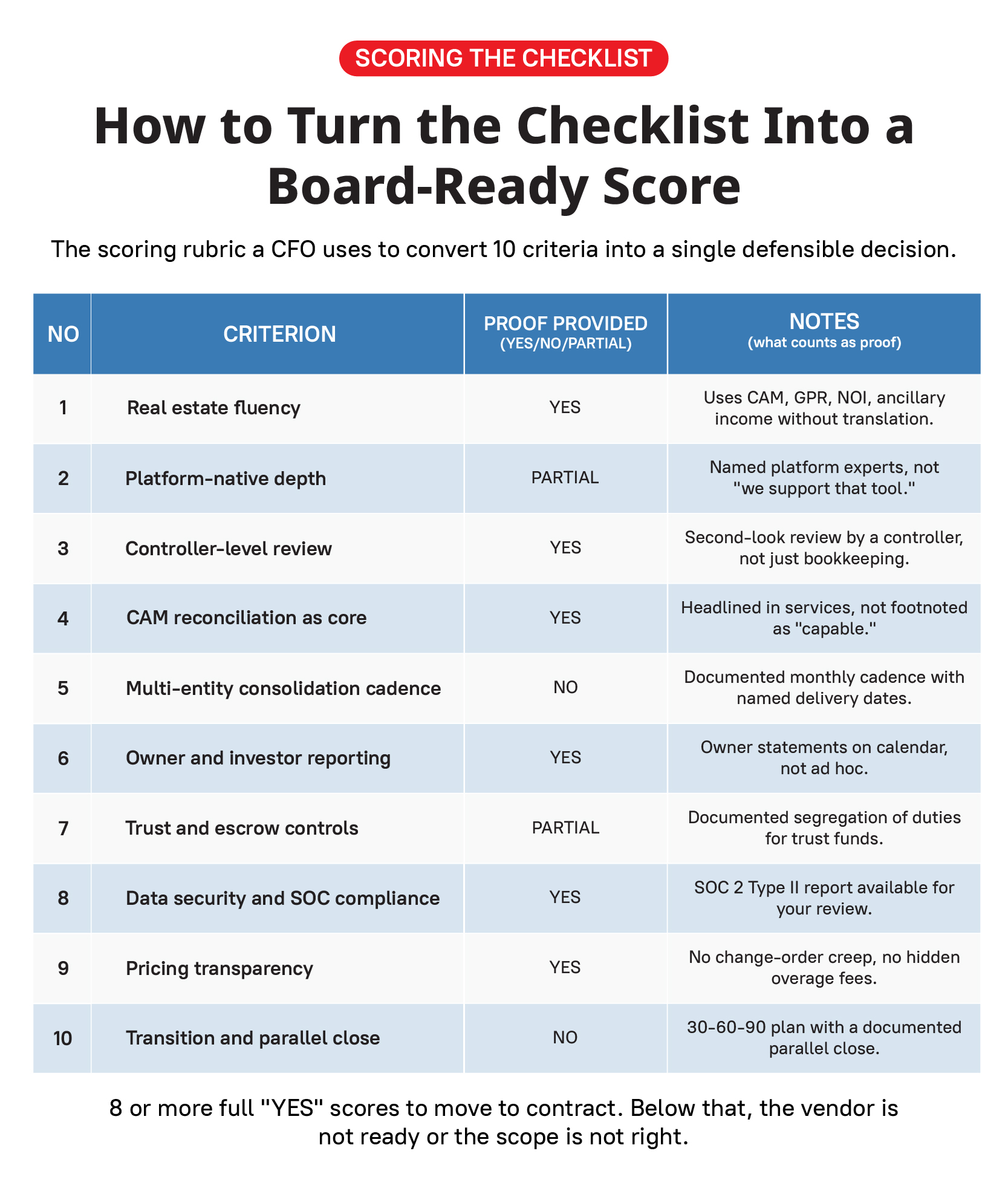
A checklist gives you the scaffolding. The score gives you a defensible recommendation.
Eight or more full "yes" scores across the 10 criteria means the vendor is ready to sign, subject to reference checks and contract terms. Six or seven means the scope needs to be renegotiated before you sign. Five or fewer means the vendor is not fit for the mid-size property management workload, regardless of the RFP polish.
The board conversation changes when the recommendation is structured this way. It stops being a defense of "why this vendor and not that one."
It becomes a decision about which criteria matter most for your firm. And which trade-offs the board is willing to accept.
A free property accounting audit produces the written diagnostic to bring to that board conversation.
The audit maps your current accounting workflow against the 10 criteria above and shows where each shortlisted vendor would fit. It is a diagnostic, not a proposal. You keep the authority, the deliverable and the decision on what to do next.
Frequently Asked Questions
What Is Real Estate Accounting Outsourcing?
Real estate accounting outsourcing is the practice of contracting an external provider to run property management firm accounting. Scope typically includes bookkeeping, month-end close, CAM reconciliation, multi-entity consolidation, controller-level review and owner or investor reporting. The scope varies by engagement. For a firm at the 500-2,500 unit range, the typical scope covers full-cycle property accounting inside the firm's existing platform. A named delivery team works on a documented cadence.
How Do You Evaluate an Outsourced Real Estate Accounting Provider?
The most defensible approach is a structured checklist scored against evidence rather than marketing decks. The 10 criteria cover real estate fluency, platform depth, controller-level review, CAM reconciliation, multi-entity consolidation, and owner reporting. The final four cover trust controls, data security and audit compliance, pricing transparency, and transition process. Each criterion needs a proof. Sample deliverables. Current certifications in writing. Named references in your asset class. A documented transition plan.
What Should CFOs Look For in an Outsourced Accounting Partner?
CFOs should look for fluency in real estate terminology and workflows. Native platform experience on the tool your firm already uses. Named controller-level reviewers. CAM reconciliation as a headlined core service. Documented multi-entity consolidation workflows. A fixed owner and investor reporting calendar. NARPM-aligned trust controls. A scoped SOC 2 Type II report. A benchmarkable pricing model. A documented 90-day transition plan with a parallel close. Every one of those is testable with a specific proof request.
What Certifications Should a Real Estate Accounting Outsourcing Provider Have?
Ask for the current AICPA SOC 2 Type II report scoped to the Trust Services Criteria that matter for your engagement. Also ask for an ISO 27001 certificate if the vendor holds one. The AICPA SOC framework rests on five criteria: Security, Availability, Processing Integrity, Confidentiality and Privacy. Only Security is mandatory in a SOC 2 report. The scoped report tells you which additional criteria the vendor actually covers. Certification logos on a website are not a substitute for the report itself.
How Much Does Outsourced Real Estate Accounting Cost?
Pricing varies with scope, portfolio size, entity count and platform. At the 500-2,500 unit range, the fully-loaded outsourced fee typically covers bookkeeping, month-end close, CAM reconciliation, multi-entity consolidation and controller-level review. Pricing usually runs on a per-unit or per-month model. Directional benchmarks: many mid-size property management firms operate in the range of $4,000 to $8,000 per month. Alternatively, roughly $3 to $8 per unit per month, depending on scope. Ask for the written pricing schedule with all fees and any escalation clauses before scoring the commercial criterion.
How Long Does the Transition to an Outsourced Accounting Provider Take?
A well-run transition lands operational inside two to three weeks and completes a full parallel close inside the first 90 days. Days 1-30 typically cover role-based access setup and chart-of-accounts mapping. Days 31-60 run a parallel close where the outside team shadows a full cycle. Days 61-90 cover the first live close, with sign-off from your finance lead. Vendors quoting longer than that usually have either capacity constraints or workflow gaps. Vendors quoting shorter than that usually have not done a real parallel close.


.svg)
.svg)